

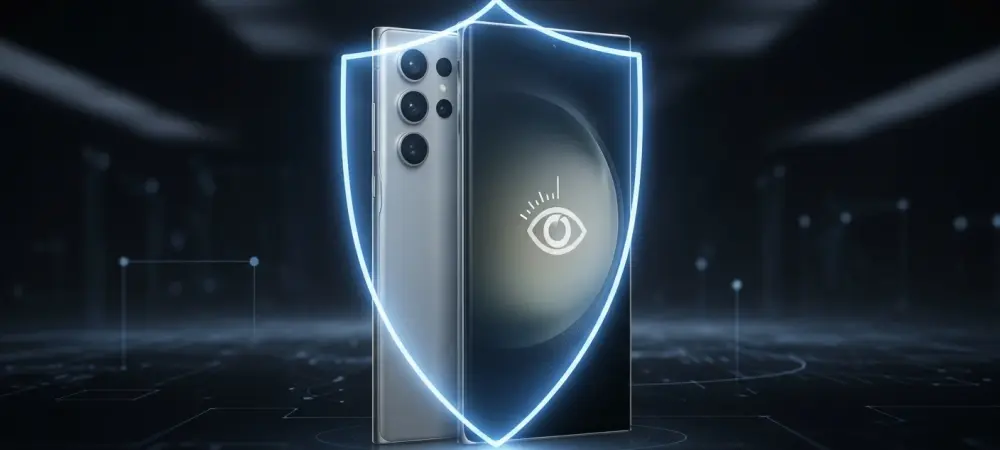
The experience of using a modern flagship smartphone often feels like holding a glowing billboard that invites every passerby to scrutinize your private conversations and bank balances. This aesthetic tension defines the current mobile landscape, where the demand for expansive, immersive visuals constantly clashes with the fundamental human need for digital discretion. As devices like the Samsung Galaxy S26 Ultra push the boundaries of what a handheld screen can achieve, the stakes for personal privacy have never been higher. The sheer brilliance and size of contemporary displays mean that a simple act, such as checking a sensitive work email or viewing a personal video in a crowded elevator, becomes a shared experience with anyone standing within a five-foot radius. This vulnerability is the modern trade-off for high-definition clarity, creating a gap that software developers are now racing to fill.
The Visibility Paradox of the Modern Oversized Display
Large, vibrant screens are the crowning achievement of modern smartphones, yet they turn every text message and private video into a public broadcast for anyone standing nearby. While the 6.9-inch display on the Galaxy S26 Ultra offers an unmatched viewing experience, it also creates a significant vulnerability in crowded spaces like subways or elevators. The QHD+ Dynamic AMOLED 2X panel is designed to be seen clearly from almost any angle, which is a triumph of engineering but a nightmare for security. When a screen can reach peak brightness levels that rival professional monitors, it effectively illuminates the user’s surroundings, drawing the eyes of strangers toward whatever content is being displayed. This visibility paradox forces a choice between enjoying a premium device and maintaining a basic level of confidentiality.
As users demand more screen real estate, the risk of “shoulder surfing” grows, making the need for a truly private display more urgent than ever before. This phenomenon is not merely about hiding embarrassing content; it is about protecting the digital identity that is now inextricably linked to mobile devices. Financial transactions, two-factor authentication codes, and intimate family photographs are all displayed on these massive panels. The industry has reached a point where the physical dimensions of the phone have outpaced the traditional methods of keeping information personal. Consequently, the challenge lies in creating a display that is expansive for the user but invisible to the intruder, a goal that requires a departure from old-school hardware solutions.
Why Traditional Privacy Solutions No Longer Meet User Expectations
Privacy used to mean applying a physical plastic film to a screen, which permanently dimmed the display and ruined the viewing angles for the owner as much as for the stranger. These adhesive layers were a blunt instrument in an era that demanded precision, often resulting in a grainy image and reduced touch sensitivity. For a user who has invested in a device as sophisticated as the Galaxy S26 Ultra, the idea of degrading a 120Hz refresh rate and billions of colors with a cheap piece of plastic is an unacceptable compromise. In a world of multitasking and high-definition content, these crude hardware fixes are no longer sufficient to meet the lifestyle needs of a professional or a tech enthusiast.
Users now require a dynamic solution that can protect sensitive information during a video call or while banking without compromising the brilliance of the AMOLED panel for everything else. The expectation has shifted from static, permanent barriers to intelligent, software-driven privacy that can be toggled on or off depending on the environment. People want to enjoy the full cinematic potential of their device when they are alone at home but require a digital “shutter” the moment they step into a public space. This shift in user behavior is driving the development of sophisticated software layers that interact with the display hardware in real-time. This ensures that the premium viewing experience remains intact while the user gains a sense of control over their visual boundaries.
Analyzing the Surgical Privacy Layer and Intelligent Multitasking in One UI 9
The One UI 9 Beta 4 update introduces a refined “surgical” approach to the Privacy Display feature, specifically targeting the complexities of Picture-in-Picture (PiP) mode. Unlike previous iterations that obscured the entire screen, this new software logic allows the privacy filter to isolate a single floating window, such as a YouTube video or a banking app, while leaving the rest of the interface bright and accessible. This level of granularity is essential for modern multitasking, where a user might be monitoring a private video call in a small window while simultaneously navigating a public map or a news feed. By focusing the privacy layer only where it is needed, Samsung avoids the unnecessary dimming of the entire panel, maintaining the overall usability of the device. This granular control is further enhanced by dynamic tracking, where the obscured layer stays locked to the PiP window even as the user drags it across the 120Hz display, ensuring that sensitive data remains hidden regardless of its position on the screen. The software recognizes the coordinates of the floating window and applies the light-direction filter specifically to those pixels. This prevents any lag or ghosting that might occur when moving content quickly across the large 6.9-inch canvas. This technical achievement ensures that the privacy shield feels like a natural extension of the user interface rather than a clunky overlay. It represents a significant step forward in making security features intuitive and frictionless for the average consumer.
Validation from the Bench: How Hardware Integration Drives Software Security
Industry insiders like Ice Universe and contributors to the Samsung Community have noted that these advanced privacy features are only possible because of the synergy between One UI 9 and the Snapdragon 8 Elite Gen 5 processor. The chipset provides the heavy lifting required to apply real-time light-direction filters without causing the device to overheat or the battery to drain prematurely. Managing a 120Hz display is already a power-intensive task; adding a secondary, mathematically complex privacy layer requires a level of computational efficiency that was previously unavailable. This hardware-software harmony allows the Galaxy S26 Ultra to perform these tasks in the background, ensuring that the user experience remains fluid and responsive. Early feedback from the beta cycle suggests that these optimizations also extend to thermal management, allowing the S26 Ultra to maintain peak performance even when running intensive privacy layers alongside demanding applications like Android Auto. In previous generations, running multiple high-bandwidth processes often led to thermal throttling, which would dim the screen or slow down the interface. However, the current architecture appears to handle the simultaneous demands of the Privacy Display and high-speed data processing with remarkable composure. This stability is a key indicator that the feature is ready for a wider rollout, providing a reliable shield for users who cannot afford for their devices to stutter during critical moments of use.
Deploying the Shield: A Practical Approach to Screen Privacy Management
For users looking to secure their devices, the One UI 9 framework offers a highly customizable suite of tools accessible directly through the Samsung Members app for beta participants. Once the update was installed, the Privacy Display was managed via a dedicated toggle in the Quick Panel, allowing for instant activation. This streamlined access meant that a user could react to their surroundings in seconds, turning on the shield as they entered a crowded bus and turning it off once they reached the privacy of their office. The interface was designed to be as simple as possible, removing any barriers to adoption for those who were not traditionally tech-savvy.
Users further tailored their experience by whitelisting specific applications that required constant protection or setting the filter to trigger only when notifications appeared, providing a personalized security strategy that adapted to different environments and sensitivity levels. This flexibility transformed the device from a passive tool into an active guardian of personal space. By allowing the software to learn which apps contained sensitive data, the system began to anticipate the user’s needs, automatically applying the privacy layer when a banking app was opened or a private message was received. This proactive approach represented the final evolution of mobile privacy, moving away from reactive measures toward a fully integrated and intelligent security ecosystem.
The introduction of One UI 9 Beta 4 marked a significant turning point in how digital privacy was handled on flagship devices. Developers successfully integrated complex privacy layers with high-performance hardware, ensuring that the Galaxy S26 Ultra remained a leader in both utility and security. Users who participated in the beta program discovered that they no longer had to sacrifice the beauty of their 6.9-inch displays to keep their information safe from prying eyes. The software demonstrated that intelligent, surgical filters provided a much better solution than the crude hardware films of the past. This evolution reflected a deeper understanding of the modern user’s lifestyle, where multitasking and public mobility were the norms. Ultimately, the update proved that a smartphone could be both a window to the world and a private vault, depending on the needs of the moment. By focusing on granular control and hardware synergy, the mobile industry established a new standard for protecting personal data in an increasingly transparent world. This transition helped bridge the gap between high-end performance and the essential human right to privacy.