

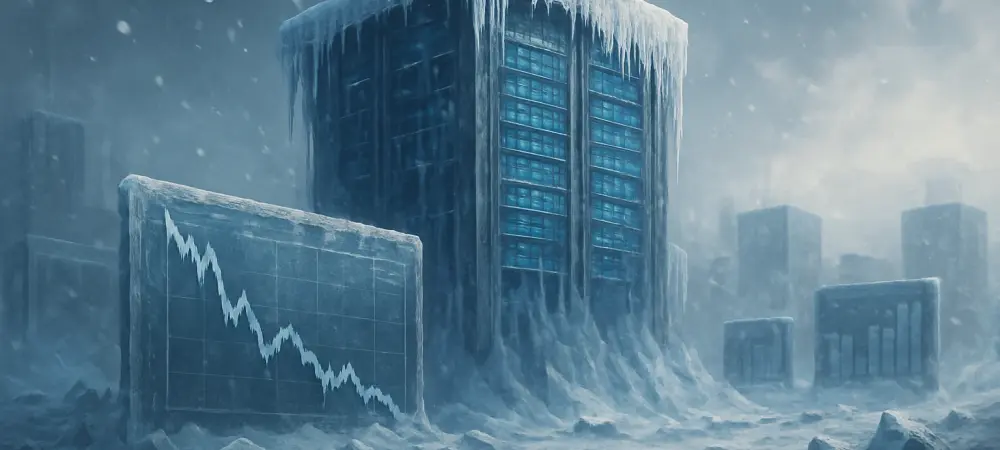
In an age where trillions of dollars traverse the globe at the speed of light, a simple failure to properly winterize a cooling tower in a single building demonstrated the profound fragility of the entire global financial system. The event served as a jarring reminder that the world’s digital economy, for all its sophistication, remains tethered to physical infrastructure where human error can trigger a global cascade. This incident was not a hypothetical stress test but a real-world crisis that forced Wall Street to confront a vulnerability hidden in plain sight: its absolute dependence on the climate-controlled rooms that house its servers.
What Happens When the Digital Heart of Finance Overheats
The disruption originated at a facility that serves as the primary data hub for CME Group, one of the world’s most critical derivatives exchanges. When its systems went dark, trading in everything from gold and oil futures to interest rate derivatives came to an abrupt and complete halt. Markets handling trillions of dollars in daily transactions were effectively frozen, with impacts rippling outward from the exchange’s hub in Aurora, Illinois, to trading desks in Tokyo and London.
This paralysis underscored a fundamental truth of modern finance: the market is no longer just a concept but a physical location. The stability of global asset prices relies directly on the uninterrupted performance of servers, network switches, and, as this incident proved, cooling systems. The failure highlighted the immense concentration of risk within these specialized facilities, where a single operational oversight can have consequences that dwarf those of a typical corporate IT outage.
Why Data Center Stability Is the Bedrock of Global Economics
Data centers are the unseen engines of the twenty-first-century economy, housing the critical infrastructure that underpins everything from global commerce to financial transactions. For financial markets, these facilities are not merely service providers but integral components of the market structure itself. Their promise of near-constant uptime and resilience is the foundation upon which high-frequency trading algorithms and global settlement systems are built.
The expectation of unwavering reliability has made the data center industry a darling of investors, who viewed long-term tenant leases as a source of stable, predictable revenue. However, the 10-hour standstill at the CME hub shattered this perception of invincibility. It revealed that beneath the complex layers of digital security and network redundancy lies a susceptibility to basic operational failures, forcing a re-evaluation of what “mission-critical” truly means.
How a Single Failure Cascaded Across the Globe
The sequence of events began with a startlingly routine task. On-site staff and contractors at the CyrusOne-operated facility failed to follow standard procedures for draining cooling towers in preparation for freezing temperatures. This oversight, a fundamental error in basic facility management, became the tipping point for a global event, proving that the most significant threats are not always sophisticated cyberattacks but simple human error.
What started as a localized cooling issue quickly spiraled into a full-blown crisis. The overloaded system caused temperatures inside the data hall to rise, leading to the failure of several chillers. This triggered a more than 10-hour trading standstill. In a critical moment, CME Group made the decision not to failover to its disaster recovery site in the New York area. This choice was based on initial, and ultimately inaccurate, projections from the data center operator that the problem would be resolved swiftly.
Conflicting Accounts and Market Jitters in the Aftermath
In the wake of the outage, the accounts from the two central companies diverged significantly, adding a layer of corporate tension to the technical failure. CyrusOne reported that it took “extensive and decisive steps to restore the cooling systems,” dispatching its CEO and top engineering teams to manage the crisis. In contrast, CME Group issued a separate statement claiming that the data center’s “initial remediation attempts further exacerbated the problem,” suggesting a breakdown in communication and execution during the critical first hours.
The fallout on Wall Street was immediate and palpable. The incident prompted Goldman Sachs Group Inc. to pause a planned $1.3 billion mortgage-bond sale for CyrusOne, a clear signal of shaken investor confidence. More broadly, the event served as a wake-up call, forcing investors and tenants to scrutinize lease agreements. An analysis from Citigroup Inc. highlighted a commonly overlooked risk: many data center leases contain termination clauses that tenants can invoke after critical service failures, challenging the notion that these agreements are unbreakable.
A Blueprint for Preventing the Next Global Outage
In response to the crisis, the data center operator initiated a comprehensive overhaul of its operational protocols to prevent a recurrence. The first step involved a complete revision of its cold-weather procedures, creating a more rigorous and failsafe playbook for preparing critical infrastructure for freezing temperatures. This was coupled with a significant enhancement of employee training programs to ensure that all on-site personnel understand and can execute these critical tasks without error.
Beyond procedural updates, the company committed to bolstering its human and physical defenses. Plans were put in place to increase the number of on-site engineering staff, ensuring that more expert personnel are available to oversee and manage facility operations around the clock. Simultaneously, a program to harden the physical infrastructure was launched, involving targeted upgrades to the cooling systems and other critical components to build greater resilience against both environmental and operational risks.
The incident was a costly but powerful lesson in the interconnectedness of the digital and physical worlds. It exposed how a lapse in routine maintenance could threaten the stability of global markets, prompting an industry-wide reassessment of operational risk. The legacy of that day was not just a revised set of cold-weather protocols but a renewed understanding that in the modern financial system, the most formidable risks can emerge from the most unexpected places.