

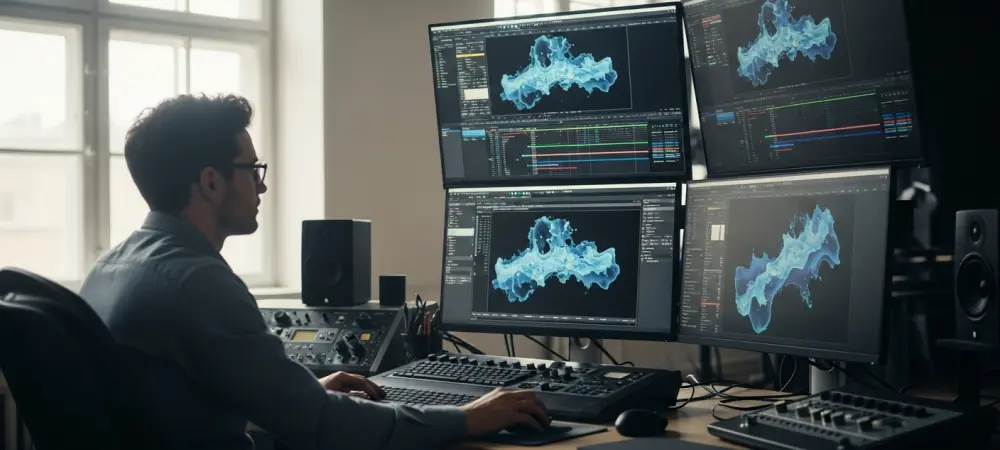
The sudden infusion of two point eight billion dollars into the coffers of Kling AI marks a seismic shift in the competitive landscape of generative artificial intelligence, signaling that the race for cinematic fidelity is no longer just a theoretical battle between research labs. This massive capital injection comes at a time when the industry is transitioning from experimental short clips to full-scale professional production tools capable of maintaining temporal consistency over extended sequences. While early iterations of synthetic video often struggled with physical inaccuracies and visual artifacts, the latest investments suggest a future where the distinction between captured footage and synthesized pixels becomes nearly imperceptible to the average viewer. The scale of this funding reflects a profound confidence in the ability of proprietary models to challenge established giants in the lucrative market of automated content creation. By providing the necessary resources to scale computational power and data acquisition, this funding effectively positions the developer as a formidable challenger to the established dominance of Western counterparts, potentially redrawing the map of global artificial intelligence leadership for years to come.
Advanced Architectures: Redefining Digital Realism
Diffusion Transformer Models: Achieving Temporal Consistency
Central to the technical prowess of the platform is its sophisticated integration of Diffusion Transformer models, which allow for the generation of video sequences that exhibit unprecedented temporal stability and visual clarity. Unlike earlier generative methods that often resulted in dream-like warping or inconsistent lighting, this architecture treats video as a coherent four-dimensional block, ensuring that objects remain consistent even as they move through complex spatial environments. The recent infusion of capital is specifically earmarked for enhancing these underlying algorithms, allowing the model to process higher resolutions and frame rates that meet the rigorous standards of professional cinematography. The ability to generate clips up to two minutes in length without a loss in fidelity sets a new benchmark for the industry, pushing the boundaries of what automated systems can achieve in a single pass. This focus on long-form consistency is essential for creators who require reliable tools for storytelling rather than just short, looped animations, providing a foundation for more complex narrative structures in digital media. Beyond mere visual quality, the scalability afforded by the multi-billion dollar investment enables the deployment of massive GPU clusters that are necessary to refine the model’s understanding of real-world physics. By training on increasingly diverse and high-quality datasets, the system is learning to simulate the nuances of fluid dynamics, human locomotion, and the interplay of light and shadow with increasing precision. This deep technical refinement ensures that the generated content does not just look realistic at a glance but stands up to the scrutiny of professional editors and digital artists. Optimization of these models allows for faster inference times, making it feasible for studios to iterate on creative concepts in a fraction of the time required by traditional rendering engines. As computational efficiency improves, the barrier to entry for high-end visual effects continues to lower, democratizing the production of high-fidelity media for independent creators and major corporations alike, while simultaneously reducing the total cost of ownership for high-tier AI assets in the current production cycle.
Industrial Applications: Moving Toward Professional Production
The economic ramifications of a well-funded AI video ecosystem extend far beyond the technology sector, directly impacting the global advertising and film production industries by drastically reducing overhead costs. Marketing agencies are already beginning to leverage these tools to produce hyper-personalized video content that can be adapted for local markets with minimal manual intervention. This shift is not merely about cost-cutting; it represents a fundamental change in how visual narratives are constructed, allowing for rapid prototyping that was previously impossible. This rapid advancement also necessitates a robust discussion surrounding the ethical sourcing of training data and the potential for digital displacement within the traditional creative workforce. As developers integrate these tools into existing social media and e-commerce platforms, the line between organic and synthetic content will continue to blur, necessitating new standards for transparency and digital provenance to maintain consumer trust across various digital marketplaces and professional creative environments.
The strategic deployment of this capital focused on establishing a sustainable lead through the development of proprietary safety protocols and more intuitive user interfaces that prioritized professional workflows. Stakeholders recognized that the next phase of development required a move toward specialized fine-tuning, allowing users to control specific stylistic parameters without sacrificing the underlying realism of the model. Organizations that successfully adopted these high-performance AI video tools found they could shorten production cycles by nearly sixty percent, effectively reallocating human talent toward higher-level creative direction. Moving forward, businesses prioritized the establishment of clear internal guidelines for synthetic media usage and invested in training for their staff to effectively collaborate with these emerging technologies. By focusing on responsible implementation and technical excellence, the industry ensured that this massive investment translated into a more efficient and creative media landscape that balanced rapid innovation with necessary ethical considerations and structural reliability.