

Mathematical verification of execution allows for a trust layer that bridges the gap between independent hardware owners and enterprise-level AI needs. As of 2026, the global demand for computational power has reached a breaking point, forcing a radical shift in how we conceive of digital infrastructure. For decades, the industry relied on the consolidation of thousands of servers into monolithic warehouses, but this centralized paradigm is now facing unprecedented scrutiny. The rise of agentic AI—systems capable of autonomous reasoning and long-term planning—requires a scale of processing that traditional facilities struggle to accommodate without causing localized ecological strain. This friction has created a unique opportunity for innovators like the Florida-based OpenMatter Network, which seeks to decouple progress from physical expansion. By pivoting away from the construction of massive hubs, the industry is exploring a future where the network becomes the data center, utilizing the idle capacity of existing hardware.
Transitioning Beyond Concentrated Computing Infrastructure
Rising Costs and Community Resistance
The current political climate in 2026 has shifted significantly against the unchecked expansion of hyper-scale data centers. Following recent midterm elections, a bipartisan consensus emerged among voters who view these massive installations as threats to local resource security. The primary concerns revolve around the astronomical energy consumption required to cool server racks and the millions of gallons of water consumed daily by evaporative cooling systems. In many states, utility rates for residential consumers have spiked to subsidize the infrastructure upgrades needed to support these industrial-sized loads. Consequently, local governments are increasingly denying permits for new construction, citing the strain on power grids that are already struggling to transition to renewable sources. This social and political pushback has made the traditional model of building massive facilities increasingly untenable, forcing technology firms to look for alternatives that integrate more harmoniously with community layouts.
Strategic Implementation of Data Residency
Beyond the external pressures of public opinion and regulatory hurdles, the internal economics of massive data centers are beginning to falter under the weight of their own scale. The capital expenditure required to build a single hyper-scale facility now reaches into the billions of dollars, creating a high barrier to entry that favors only a handful of global conglomerates. This concentration of power not only stifles competition but also creates single points of failure that could have catastrophic consequences for the global digital economy. As agentic AI models become more integrated into critical infrastructure, the vulnerability of a centralized hub becomes a strategic liability. Moreover, the long lead times for traditional construction—often spanning several years from planning to operation—cannot keep pace with the rapid evolution of AI requirements. Organizations are finding that by the time a facility is finished, the hardware specifications may already be outdated. This mismatch necessitates an agile, modular approach to compute scaling.
Engineering the Verifiable Trust Layer
Orchestrating a Global Hardware Mesh
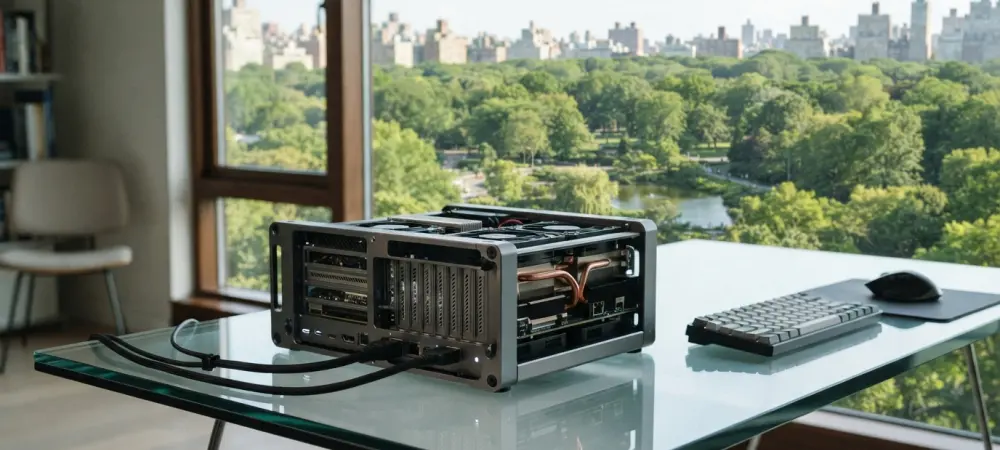
To address the limitations of centralization, the OpenMatter Network has pioneered a decentralized platform that transforms independently owned hardware into a unified computational engine. This system utilizes sophisticated orchestration algorithms to break down complex AI workloads into smaller, manageable tasks that are distributed across a vast network of smaller installations. Unlike previous attempts at distributed computing, which often suffered from latency and reliability issues, the 2026 iteration of this technology leverages high-speed connectivity and edge-computing advancements to ensure seamless execution. By tapping into the enormous amount of latent processing power available in existing corporate offices and smaller local server rooms, the network effectively creates a virtual supercomputer. This model bypasses the need for massive new construction projects by maximizing the utility of assets already connected to the power grid. It represents a shift from a build-more mentality to a use-better strategy.
Future Perspectives on Distributed Intelligence
The era of relying solely on massive, centralized data centers reached a point of diminishing returns as both ecological and social costs became impossible to ignore. Decision-makers recognized that the path forward required a fundamental decoupling of computational growth from physical expansion. By adopting decentralized frameworks, companies began to see that high-performance AI execution did not necessitate the destruction of local resources. The focus shifted toward auditing existing hardware assets and integrating them into a trust layer that prioritized efficiency. Moving forward, enterprises should implement a hybrid strategy that offloads non-critical batch processing to distributed networks while maintaining sensitive core functions in localized, verifiable nodes. This approach significantly reduced operational overhead and encouraged a circular economy where businesses were compensated for their idle capacity. The successful pilot programs of 2026 proved that a decentralized digital future was not only viable but essential for resilience.