

The relentless pursuit of artificial intelligence has propelled the digital world into an era of unprecedented capability, but it has simultaneously anchored the industry to a stark physical reality of finite resources. What was once a distant concern on a corporate social responsibility report has become an immediate and defining challenge for the entire data center ecosystem. This is the new frontier where digital ambition collides with planetary limits.
The Tipping Point When AI’s Ambition Met Earth’s Limits
The exponential growth of artificial intelligence has acted as a great accelerator, transforming sustainability from a commendable corporate goal into a critical operational constraint. The sheer computational power required to train and run advanced AI models has pushed demand for data center capacity to levels never before seen. This surge has moved the industry past a theoretical point of no return, where optimizing for efficiency is no longer enough. Instead, survival depends on a fundamental redesign of how facilities are planned, built, and operated. The year 2025 marks a defining moment, an inflection point where the industry’s voracious appetite for power, water, and land began to outstrip readily available supply in key markets. This unprecedented strain revealed the brittleness of an expansion model built on the assumption of unlimited resources. Consequently, operators are now forced to confront the direct environmental and social costs of their growth, turning every new project into a complex negotiation between technological need and ecological reality. Navigating this new era requires confronting core conflicts head-on, from acute resource scarcity and mounting community opposition to the dawn of a stringent new regulatory landscape. The path forward is being forged through innovation, where engineered solutions for water conservation, next-generation energy strategies, and a newfound emphasis on earning a social license to operate are becoming the essential tools for viability in a resource-constrained world.
Navigating the New Landscape of Scarcity and Scrutiny
Beyond Power How Water Scarcity Became Data’s Newest Choke Point
The dialogue around data center sustainability has long been dominated by energy consumption, but the intense cooling requirements of high-density AI infrastructure have elevated water scarcity to a primary global risk. The vast quantities of water needed for traditional evaporative cooling systems place immense pressure on local water supplies, particularly as many technology hubs are located in arid or drought-prone regions. This has transformed water access from an operational line item into a potential choke point for growth.
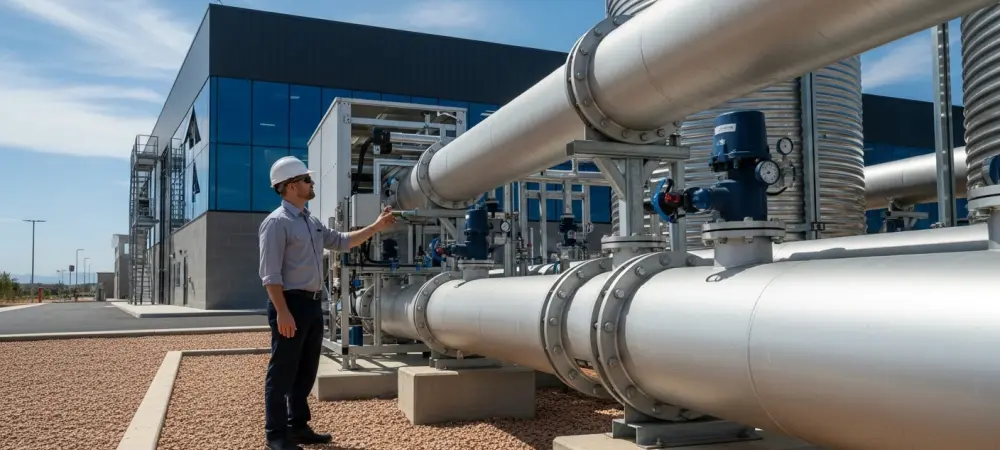
In response, the industry is shifting from broad conservation pledges to a more rigorous, data-driven approach centered on engineered solutions. Metrics like Water Usage Effectiveness (WUE) are becoming standardized, providing a clear framework for measuring and managing water consumption. This focus on tangible outcomes is driving innovation in closed-loop cooling systems and other technologies that dramatically reduce a facility’s reliance on municipal water sources, turning abstract goals into concrete engineering practices.
This heightened focus on water has also brought facilities into direct conflict with local communities. The debate over site selection has intensified, with residents and local governments increasingly questioning the wisdom of allocating precious water resources to data centers during periods of drought. This rising community opposition is now a critical factor in the permitting and development process, forcing operators to demonstrate responsible water stewardship to gain public acceptance.
The Unquenchable Thirst for Watts Decarbonizing AI’s Energy Footprint
The data center industry faces a formidable dual challenge: securing the massive, constant power supply needed to fuel AI workloads while simultaneously meeting aggressive decarbonization targets. The sheer scale of energy demand from next-generation computing dwarfs that of previous infrastructure, making reliance on traditional grid power increasingly untenable from both a capacity and an environmental standpoint. This reality compels a strategic overhaul of energy sourcing and management.
To address this, the industry is pursuing a two-pronged strategy. The first prong involves optimizing current assets by deploying on-site renewable generation, such as solar arrays, and integrating large-scale battery storage to ensure a consistent power supply. The second, more forward-looking approach involves exploring next-generation baseload power sources that can provide reliable, 24/7 carbon-free energy. This exploration has ignited significant momentum behind Small Modular Reactors (SMRs) as a potential long-term solution. While not yet a commercially deployed technology, SMRs promise the kind of dense, clean, and continuous power that AI data centers require. This has positioned nuclear energy as a serious contender in the industry’s future energy portfolio, representing a paradigm shift in how operators think about powering the next wave of digital infrastructure, though it comes with its own set of regulatory and social challenges.
Earning the Social License Why Community and Compliance Now Dictate Viability
The days of data centers operating as anonymous, insulated facilities are over. As these massive structures become more common, they are drawing increased public scrutiny and, in many cases, significant pushback from local communities concerned about noise, resource consumption, and environmental impact. This shift in public perception has fundamentally altered the development landscape, making proactive and transparent community engagement a prerequisite for success.
This grassroots pressure is complemented by a new wave of government regulations. Policymakers are no longer taking a hands-off approach, instead implementing stringent rules governing emissions, land use, and water rights that directly reshape investment strategies. Compliance is no longer a matter of best practice but a foundational business imperative that can determine whether a project moves forward or is halted indefinitely. Ultimately, these forces have demonstrated that a “social license to operate” has become as vital as a building permit. The old assumption of building in a vacuum has been shattered. Today, a project’s viability hinges on its ability to integrate into the local community, address environmental concerns transparently, and prove it can be a responsible neighbor. This new reality demands a strategic focus on relationship-building and sustainable practices from the very outset.
From Blueprint to Reality Redefining Sustainable Design and Global Strategy
In response to these interconnected pressures, the industry is fostering innovation in both operational models and facility design. The inherent efficiencies of colocation, where shared infrastructure and economies of scale naturally lower the environmental impact per customer, are gaining recognition as a key sustainability strategy. This contrasts with the holistic model of purpose-built sustainable facilities, which are designed from the ground up to integrate high-performance computing with low-impact operations.
The path toward sustainability is also diverging regionally, reflecting different priorities and resources. In the Middle East, for instance, state-backed initiatives like Saudi Arabia’s green projects demonstrate a top-down commitment to harmonizing massive digital growth with net-zero goals. In contrast, the Asia-Pacific region faces a more complex dilemma, where the urgent need for digital infrastructure often clashes with a reliance on carbon-intensive energy grids, creating a critical tension between rapid expansion and long-term climate targets.
These trends are converging around an emerging paradigm of integrated design. This approach moves beyond single-metric optimization and instead weaves energy efficiency, water conservation, circular economy principles, and community impact into the core architecture of a facility. This holistic vision represents the future of data center development, where sustainability is not an afterthought but the foundational blueprint for resilient and responsible growth.
The Survival Playbook A Strategic Roadmap for the Resource Constrained Era
The most critical takeaway from the industry’s current challenges is that integrated sustainability is now a non-negotiable component of any growth strategy. The era of treating environmental and social governance as a secondary objective has definitively closed. For data center operators, embedding sustainability into every facet of the business is no longer a choice but a prerequisite for survival and market leadership in a world of finite resources.
This new reality demands a clear set of actionable strategies. Operators must adopt and report on measurable efficiency metrics for both power and water, moving beyond vague commitments to transparent performance. Furthermore, prioritizing early and continuous community engagement is essential to de-risk projects and build long-term local support. Finally, diversifying energy portfolios to include a mix of on-site renewables, storage, and long-term investments in next-generation power is critical to achieving both reliability and decarbonization.
To ensure long-term viability, this strategic focus must be embedded into the earliest stages of planning. By treating sustainability as a core design principle rather than a feature to be added later, organizations can proactively address resource constraints, navigate regulatory hurdles, and build facilities that are not only powerful and efficient but also resilient and socially responsible. This foresight is the key to unlocking future growth in an increasingly constrained world.
The Final Verdict Sustainability as the New Bedrock for Growth
The resource crisis, accelerated by the insatiable demands of artificial intelligence, has permanently redefined the foundational principles of the data center industry. Sustainability is no longer an adjacent concern but has become the bedrock upon which all future growth must be built. The collision of digital expansion with physical limits has forced a necessary and overdue reckoning, compelling the industry to innovate at an unprecedented pace.
Success in this new era will be measured by a different set of metrics. While computational power and uptime remain critical, they are now inseparable from the ability to operate within strict environmental and social boundaries. The most successful operators will be those who can master the art of innovating within these constraints, turning what was once seen as a limitation into a competitive advantage.
This profound shift presents a clear mandate. The industry must embrace this new reality not as a burden, but as its central organizing principle. Doing so is the only viable path to ensure not just its survival, but its continued leadership in powering the digital future. The challenge is immense, but the opportunity to build a more resilient, responsible, and sustainable digital infrastructure has never been greater.