

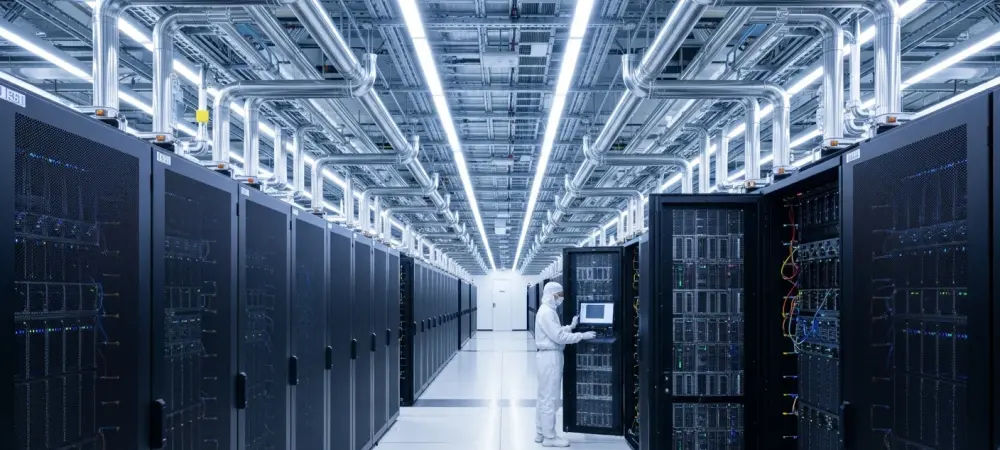
With the data center industry undergoing a seismic shift fueled by artificial intelligence, investments are reaching staggering new heights. To understand the strategy behind these billion-dollar moves, we sat down with Dominic Jainy, an IT professional whose expertise lies at the critical intersection of AI, machine learning, and the physical infrastructure that powers them. His insights offer a clear view into the high-stakes world of building the backbone for our AI-driven future.
This conversation delves into the anatomy of a modern “megawatt deal,” exploring the strategic selection of rural locations for massive AI computing sites. We examine how infrastructure firms are navigating a dual strategy of building colossal, client-specific facilities while also developing flexible colocation capacity. Furthermore, we break down the financial logic and key metrics driving these capital-intensive projects and discuss the specialized engineering required to meet the unprecedented demands of advanced AI workloads.
Nscale’s $865M deal for 40 MW at the NC-1 facility is a major commitment. Could you elaborate on the specific qualities of this rural North Carolina site that made it ideal for an AI computing anchor, and walk us through the key milestones for activating that capacity by May 2026?
When you’re planning an AI computing anchor of this magnitude, you’re fundamentally looking for scale and a clear path to power. A rural site like the one in Madison offers exactly that. You have 96 acres to work with, which is essential for building out a one million-square-foot facility and, just as importantly, for the supporting infrastructure like substations and cooling systems. This space gives you the runway to grow. The milestones are aggressive and reflect the urgency in the market; Nscale is set to begin taking and paying for the first 20 MW of capacity in April 2026, with the next 20 MW coming online just a month later. This rapid deployment shows that the site was not just about empty land; it was about having a clear, actionable plan for bringing a massive amount of power and compute online in a very short timeframe.
You’re building out the 40 MW NC-1 site in North Carolina while also delivering 104,000 Nvidia GPUs in a 240 MW Texas data center for Microsoft. How do these two distinct projects fit into Nscale’s broader US strategy, and what are the primary logistical challenges you face?
These two projects represent the two core pillars of a successful AI infrastructure strategy today. On one hand, you have the Texas project, a massive, purpose-built facility for a single hyperscale client, Microsoft. That 240 MW build is a direct response to a specific, colossal demand for GPU-powered compute. On the other hand, the 40 MW deal at NC-1 is about establishing a strategic, flexible footprint. It anchors a new location and allows Nscale to serve a growing ecosystem of AI clients. Together, they fulfill the company’s stated goal of adding “hundreds of megawatts of new capacity” to its North American portfolio. The biggest challenge is orchestrating these enormous undertakings simultaneously. You’re not just pouring concrete; you’re managing complex supply chains for everything from power distribution units to those 104,000 GPUs, all while navigating different regional regulations and labor markets. It’s a logistical ballet on a national scale.
Given Nscale’s recent $1.1 billion in Series B funding and WhiteFiber seeking new financing for the buildout, what key metrics do you prioritize when evaluating the ROI on these capital-intensive AI infrastructure deals? Please describe the step-by-step financial evaluation process.
In this market, the single most important metric is securing a creditworthy anchor tenant on a long-term lease. That’s your validation. Look at the WhiteFiber and Nscale deal. WhiteFiber invested an initial $150 million, but the game-changer is the $865 million, 10-year commitment from Nscale. The financial evaluation process starts with this principle. First, you engineer a site to meet the demanding specifications of hyperscalers. Second, you engage in what WhiteFiber’s CEO calls a “prudent and cautious approach to client selection” to find the right partner. Third, you secure that multi-year, multi-megawatt commitment. That agreement becomes the cornerstone of your financial model. It de-risks the project immensely and is precisely what you take to lenders to secure the additional financing needed for the full buildout. The ROI is no longer theoretical; it’s anchored to a tangible, long-term revenue stream.
Analyst Steven Dickens expects more “megawatt deals” like this. What specific engineering and power-sourcing strategies does WhiteFiber use to meet hyperscaler specifications for advanced AI workloads? Can you share an anecdote about a unique challenge you solved while designing the one million-square-foot NC-1 facility?
Meeting hyperscaler specifications for AI is a whole different ballgame. It means designing for extreme power density and the associated heat load. You’re engineering a facility that can deliver and cool racks that consume multiples of what traditional servers did. This involves redundant, high-capacity power feeds and sophisticated liquid cooling solutions. As for a challenge, when you’re designing a one million-square-foot facility, one of the biggest hurdles is future-proofing. We knew this facility had to support “the most advanced AI workloads,” but those workloads are a moving target. The challenge wasn’t just building for today’s GPUs, but anticipating the power and cooling needs of processors that are still on the drawing board. We had to design the core power and cooling spine of the building with enough modularity and excess capacity to adapt over the next decade without a complete overhaul. It’s like building a highway system before you know exactly how many cars will be on the road, or if they’ll be cars at all, and not something else entirely.
What is your forecast for the AI-fueled data center market over the next three to five years?
The forecast is clear: a sustained period of explosive, large-scale growth. The era of speculative, smaller builds is giving way to what analyst Steven Dickens correctly calls “megawatt deals.” We’re going to see a flood of these announcements, especially heading into 2026. This isn’t just a cyclical boom; it’s a fundamental reshaping of the market. As Nscale’s CEO put it, AI is transforming entire industries and national strategies, and that transformation absolutely depends on this physical backbone. The demand is not just for space, but for massive blocks of pre-committed power. The market will be defined by 10-year, multi-hundred-million-dollar agreements becoming the standard, as companies race to secure the foundational infrastructure they need to compete in the age of AI.