

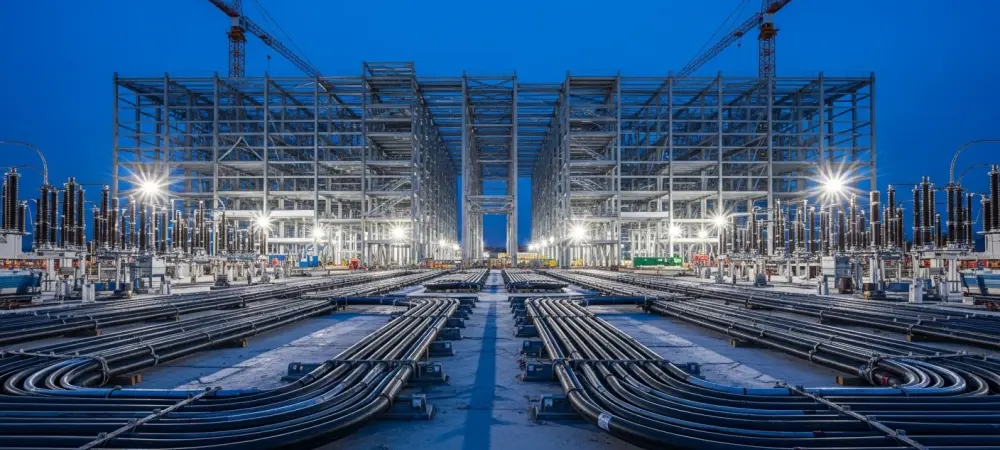
The global race for computational supremacy has transformed the quiet landscape of data center construction into a frantic, multi-billion-dollar sprint that spans continents and tests the limits of modern engineering. While software can be deployed across the globe in a matter of seconds, the physical architecture required to run sophisticated artificial intelligence models takes years to manifest in steel, concrete, and copper. This fundamental tension defines the current era of technology, where Alphabet has already secured a staggering $460 billion backlog by selling capacity in data centers that do not yet exist. The market has moved decisively past the initial phase of speculative betting, evolving into a period of massive, tangible infrastructure investment.
This transition marks a departure from the “AI trade” being merely a financial instrument toward becoming a heavy industrial undertaking. In previous years, investors focused on the availability of high-end graphics processing units, but the conversation has now shifted to the sheer scale of the physical footprint required to host them. Hyperscalers are no longer just software companies; they have become some of the largest real estate and power infrastructure developers in the world. As they race to clear their backlogs, the disconnect between digital demand and physical supply remains the most significant risk to the continued expansion of the artificial intelligence economy.
Beyond the Hype: The Physical Reality of AI Expansion
The sheer scale of the current expansion is best illustrated by the financial commitments made by the industry leaders. Alphabet’s massive backlog suggests a level of demand that is effectively decoupled from current availability, forcing customers to reserve space years in advance. This pre-selling strategy is a direct response to the multi-year reality of civil engineering, which cannot be bypassed by clever algorithms or faster coding. While a new AI model might be trained and released in a few months, a facility capable of housing the tens of thousands of chips required to run it still requires a traditional construction timeline.
Moving past the initial GPU shortage, the focus has settled on the long-term viability of these massive builds. The transition from speculative interest to infrastructure investment reflects a maturing market that recognizes the permanence of AI workloads. For companies like Amazon and Microsoft, the challenge is no longer just securing the silicon, but managing the logistics of massive construction sites, global supply chains for specialized cooling equipment, and the localized impact of high-density computing clusters. The physical reality of AI is loud, hot, and incredibly resource-intensive, requiring a different set of skills than those typically found in a Silicon Valley boardroom.
The Urgent Shift from Silicon Scarcity to Industrial Bottlenecks
The tech sector is currently grappling with a changing definition of “binding constraints.” For a long time, the primary limiter of growth was the availability of advanced chips, but as production has stabilized, more traditional industrial hurdles have emerged. Today, the ability to scale is dictated by the speed of municipal permitting and the capacity of regional power grids. Without a massive influx of electrical energy, even the most advanced data center is nothing more than an expensive shell, leading to a new era where tech giants must negotiate directly with utility providers and government regulators.
These power generation challenges are becoming the true gatekeepers of the next generation of AI workloads. Global energy grids were not designed to support the concentrated, high-density power draw of modern AI clusters, which require significantly more energy than traditional cloud servers. This has forced a radical rethinking of where data centers are located, moving away from traditional hubs toward regions with surplus power or renewable energy potential. The connection between energy stability and digital innovation has never been more direct, as the ability to host a “frontier model” now depends as much on a transformer or a turbine as it does on a transistor.
Mapping the Financial and Temporal Gap in Hyperscale Capacity
The financial data from recent quarters highlights a record-breaking surge in revenue for AWS and Google Cloud, yet these figures only tell half the story. While cloud growth remains in the high double digits, the capital expenditure required to maintain that momentum has reached astronomical levels. Meta and Microsoft have committed tens of billions of dollars per quarter to build the digital foundation for their AI ambitions. However, a significant gap exists between the 6-month innovation cycle of AI software and the 36-month construction cycle of the data centers needed to run them.
This temporal mismatch creates a volatile environment for capacity planning. If a hyperscaler builds too slowly, they risk losing market share to a more aggressive competitor; if they build too fast, they may end up with specialized infrastructure that is poorly suited for the next architectural shift in AI hardware. Analyzing the spending trends reveals a desperate attempt to bridge this gap, as companies front-load their investments to ensure they aren’t caught without floor space when the next wave of enterprise demand arrives. The digital foundation of the future is being poured in concrete today, based on projections of what software might look like three years from now.
Insights from the Frontier: Operational Discipline and Infrastructure Limits
As the industry matures, there is a visible transition from a “build at any cost” mentality toward a focus on optimized deployment strategies. Microsoft has become a notable case study in this regard, managing to achieve 40% growth in its cloud business while simultaneously refining its capital expenditure efficiency. This operational discipline involves better utilization of existing space and the development of modular data center designs that can be brought online more quickly. Efficiency is no longer just a financial goal; it is a necessity when physical constraints limit the number of new sites that can be commissioned each year.
Furthermore, the physical requirements of AI are forcing a complete redesign of traditional data center architecture. Dense AI clusters generate immense amounts of heat, making traditional air-cooling methods insufficient. This has led to the rapid adoption of liquid cooling technology and more robust power delivery systems within the rack. These engineering requirements further complicate the construction process, as retrofitting older facilities is often more expensive than building new ones from the ground up. The transition to AI-first infrastructure is not just an upgrade; it is a fundamental shift in how large-scale computing environments are designed and operated.
Preparing for the Enterprise AI Influx: Strategies for Scalability
The current demand surge is widely considered to be the “tip of the iceberg,” with the most significant wave of adoption expected to come from the corporate sector. As large enterprises move from experimental pilots to full-scale production, the pressure on hyperscale capacity will only intensify. The primary catalyst for this next phase will be the integration of AI agents into core ERP software, such as systems provided by SAP and Oracle. Once these tools become standard for managing supply chains, human resources, and financial data, the requirement for reliable, scalable AI hosting will become a non-negotiable utility for every major corporation.
To avoid being left behind, organizations should have prioritized long-term capacity planning and developed frameworks for integrating AI agents into their existing workflows. The era of “on-demand” cloud resources was replaced by a more complex landscape where hyperscalers pre-sold their available footprint years in advance. Strategic partnerships with cloud providers became essential for ensuring that a business had the necessary “compute runway” to execute its digital strategy. Leaders who recognized these infrastructure limits early were able to secure the resources needed to remain competitive in a landscape where raw processing power became the most valuable commodity in the world.
The preceding years demonstrated that the primary challenge for the cloud industry was not a lack of vision or code, but the stubborn reality of the physical world. Hyperscalers recognized that their growth was tethered to energy grids and construction permits, leading them to invest more heavily in power generation than in software development. As the gap between digital ambition and physical capacity widened, the most successful organizations were those that treated compute power as a finite, strategic asset. This shift in perspective allowed the industry to move beyond the initial hype and toward a more sustainable, if more difficult, path of industrial scaling.