

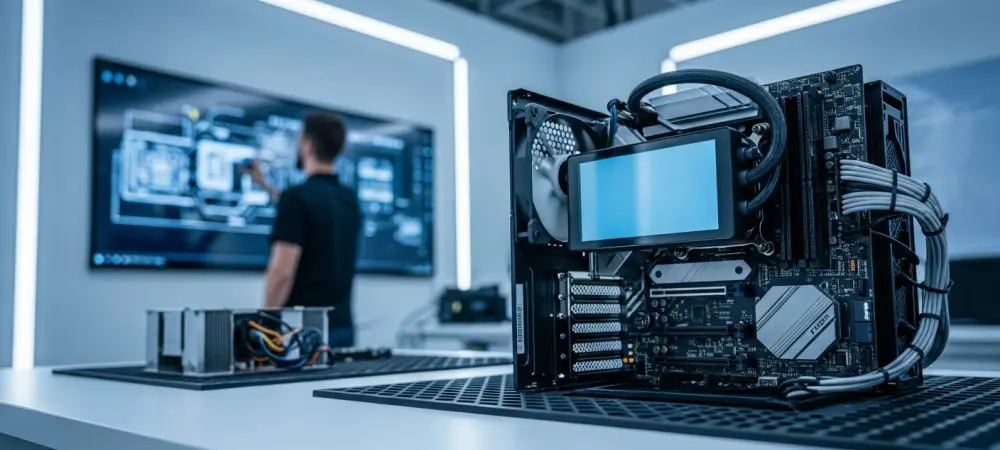
The vast, buzzing halls of the Consumer Electronics Show this year presented a familiar landscape of technological marvels, yet one brand’s showcase felt less like an exhibition and more like a declaration of war on the established order of the PC hardware industry. Long respected as a giant in the motherboard arena, ASRock has now unveiled a comprehensive, multi-front assault on nearly every component category imaginable, forcing enthusiasts and industry analysts alike to confront a startling question: is the era of meticulously curated, multi-brand PC builds drawing to a close in favor of a single, all-encompassing ecosystem? This aggressive expansion is not merely about adding new products to a catalog; it signifies a meticulously planned strategy to reshape market dynamics, challenge legacy component titans, and fundamentally alter how consumers approach building their next computer.
From Motherboard Specialist to Full-System Architect
ASRock’s journey from a value-oriented motherboard manufacturer to a potential full-system architect represents one of the most significant strategic pivots in the recent history of PC hardware. For years, the brand carved out a reputation for delivering high-performance, feature-rich motherboards that often undercut the pricing of its primary competitors. This foundation built immense brand trust and a loyal user base. However, the company’s latest product onslaught signals a deliberate move beyond this core competency. By venturing into highly competitive markets like cooling solutions, monitors, and power supplies, ASRock is signaling its ambition to control the entire user experience, ensuring that every key component within a system can bear its logo and function within a unified design and software philosophy.
This transition from a specialized component provider to a holistic system brand is a high-stakes gamble that could redefine its identity. While a successful expansion promises greater market share and enhanced brand loyalty, it also carries the risk of diluting the focus that made its motherboards so successful. The challenge lies in translating its established expertise in circuit board engineering and BIOS development into mastery over fluid dynamics for coolers, panel technology for monitors, and power regulation for PSUs. ASRock’s success or failure in this endeavor will serve as a critical case study for other specialized brands contemplating a similar leap, determining whether the future of PC building lies with specialists or with all-in-one ecosystem providers.
Why ASRock’s Aggressive Expansion is a Game-Changer
The sheer breadth of ASRock’s new portfolio directly challenges the long-standing tradition of the mix-and-match PC build, a practice where enthusiasts painstakingly select the “best” component in each category from different manufacturers. The market is increasingly shifting toward single-brand ecosystems, a trend popularized by companies in the mobile and laptop sectors. ASRock is betting that PC builders are ready for a similar experience, where a Taichi motherboard, Taichi GPU, and Taichi AIO cooler not only share a cohesive aesthetic but are also designed and validated to work together seamlessly. This strategy directly confronts legacy giants who have long dominated individual categories, such as cooling or power supplies, by offering a compelling one-stop-shop alternative that promises simplified compatibility and unified software control through platforms like PolyChrome RGB Sync. Furthermore, a core pillar of this expansion is the democratization of “high-end” features, a move poised to disrupt market pricing and consumer expectations significantly. Previously, elements like customizable LCD screens on AIO coolers, OLED panels on gaming monitors, or robust multi-layer PCBs on motherboards were the exclusive domain of expensive, flagship-tier products. ASRock is systematically dismantling this barrier by integrating these premium features into its mid-range Steel Legend and even more accessible product lines. For budget-conscious builders and mainstream consumers, this means gaining access to a level of performance, aesthetics, and functionality that was previously unattainable without a significant financial investment, thereby forcing competitors to either follow suit or risk being perceived as poor value.
A Top-to-Bottom Invasion and ASRock’s Multi-Front Product Assault
The centerpiece of ASRock’s campaign is its stunning entry into the AIO liquid cooler market with an ambitious five-tiered offensive designed to capture every segment. At the apex sits the “Supreme Flagship” Taichi Aqua, an engineering marvel built for extreme overclockers, boasting a dual-pump design capable of handling thermal loads exceeding 500W. Its all-metal water block, thick radiator, and premium LCP fans are matched by a dazzling 3.4-inch LCD screen. This tiered strategy extends downward through the Phantom Gaming and Steel Legend series, which bring those desirable LCD screens and advanced features like integrated VRM cooling fans to the core gaming and mainstream markets. Finally, the Challenger and Pro series redefine expectations for entry-level liquid cooling, focusing on smart design choices like hidden cable routing and robust pump motors to offer a premium experience without the premium price.
This multi-front assault extends decisively into the visual domain with a dominant new lineup of displays. The flagship Taichi OLED series pushes the boundaries of monitor technology, offering everything from a 4K/240Hz QD-OLED panel for stunning visual fidelity to a revolutionary 27-inch monitor with a dual-mode that can achieve an unprecedented 720Hz refresh rate for competitive esports. Recognizing the growing demand for superior panel technology, the Phantom Gaming series makes both OLED and ultra-fast 400Hz IPS panels more accessible to a wider audience. This aggressive push into the high-end display market demonstrates ASRock’s intent not just to participate but to lead in a category critical to the overall gaming experience.
Of course, ASRock has not neglected its foundational product line. The introduction of the new “ROCK” series motherboards for the latest Intel and AMD platforms underscores the company’s commitment to its core business while reflecting its new strategy of democratizing premium features. These boards bring specifications typically reserved for high-end models, such as an 8-layer PCB for signal integrity and a Dr.MOS power delivery system for stable overclocking, to the more affordable B-series segment. Simultaneously, they are thoroughly future-proofed with support for Wi-Fi 7, Gen5 PCIe slots for next-generation GPUs and SSDs, and oversized 64MB BIOS chips to ensure compatibility with future processor releases.
The company’s visual powerhouse credentials were further solidified with stunning new custom graphics cards. The Taichi OC White edition of the Radeon RX 9070 XT is a showcase of both aesthetic design and high-performance engineering, featuring a brilliant white triple-fan cooler, an onboard LCD screen, and a 16-phase power design engineered to sustain extreme clock speeds. In a brilliant strategic move to capture a core gaming audience, ASRock also revealed a collaboration with Capcom for a special Monster Hunter: Wilds edition GPU, leveraging a massive cultural touchstone to create a highly desirable and collectible piece of hardware that resonates deeply with its target demographic.
Finally, ASRock addressed the unsung heroes of any PC build with a sharp focus on power supply safety and form factor versatility. In a direct and welcome response to the melting connector crisis that has plagued high-end GPU users, the company introduced its 12V-2×6 L-Type power cable. This innovative solution features a dual-color connector for a clear visual confirmation of a secure connection and incorporates proprietary Cable Over-Temperature protection. Alongside this critical safety innovation, ASRock expanded its PSU lineup to include high-wattage SFX models for compact builds and new Platinum-rated ATX power supplies, ensuring that builders of all types have a reliable and safe foundation for their systems.
Decoding the Strategy and Evidence of a Meticulously Planned Market Takeover
A thorough analysis of ASRock’s product launches reveals a meticulously planned market takeover strategy built on clear and effective principles. The most evident of these is the tiered approach: a product for every wallet. Findings from the new AIO cooler lineup perfectly illustrate this, with a clear segmentation from the cost-no-object Taichi Aqua down to the budget-friendly Pro series. Each tier is carefully calibrated to offer a specific value proposition, ensuring that whether a consumer is building a top-of-the-line enthusiast rig or a simple entry-level machine, there is an ASRock product designed specifically for their needs and budget. This model is not isolated to coolers; it is replicated with precision across the new monitor and power supply lineups, demonstrating a cohesive plan to capture the entire market spectrum from top to bottom. Beyond simple market segmentation, the strategy is defined by innovation with a purpose, focusing on user-centric design choices that solve real-world problems for PC builders. For instance, the small VRM fan integrated directly into the waterblock of the Steel Legend AIO demonstrates a deep understanding of system stability. This feature goes beyond simply cooling the CPU; it actively cools the surrounding power delivery components and even a nearby M.2 SSD, addressing a common thermal bottleneck in modern systems. Similarly, the development of the Cable Over-Temperature protection and the dual-color indicator on the new 12V-2×6 power cable is not a flashy gimmick but a direct and practical solution to a major pain point and safety concern that has caused significant anxiety among high-performance PC owners.
Ultimately, these individual product lines are designed to converge and build powerful brand synergy through the creation of an integrated ecosystem. The remarkable aesthetic and software continuity across the portfolio—from a Taichi motherboard to a Taichi AIO, a Taichi GPU, and a Taichi monitor—is a powerful incentive for brand loyalty. A builder who invests in one Taichi component is naturally encouraged to purchase others to achieve a perfectly matched and visually harmonious system. This synergy is more than skin deep; software features like PolyChrome RGB Sync become vastly more powerful and cohesive when they can orchestrate the lighting across an entire suite of ASRock components, transforming a collection of individual parts into a single, unified, and personalized whole.
The ASRock Blueprint and Reimagining the Modern PC Build
The practical implications of this product onslaught are profound, effectively providing builders with a complete blueprint for rigs of any caliber. For those chasing ultimate performance, assembling a “god-tier” rig is now possible almost entirely within the ASRock ecosystem. A builder can combine a flagship Taichi OLED monitor with a Taichi Aqua 360 AIO, a Taichi OC White GPU, and a high-end ASRock motherboard. The evaluation of such a build goes beyond raw performance benchmarks; the benefits lie in the guaranteed aesthetic cohesion, the simplified setup of a single RGB software suite, and the implicit assurance that these components were developed with each other in mind, potentially leading to greater stability and a more polished user experience from top to bottom.
For the competitive esports athlete, crafting a championship-winning loadout is now a more streamlined process. The strategy involves pairing an ultra-high-refresh-rate monitor, like the 500Hz+ Phantom Gaming OLED, with a corresponding Phantom Gaming motherboard and AIO cooler. This combination is designed to minimize system latency and maximize frames per second for a tangible competitive advantage. Furthermore, integrated features once considered novelties, such as the Wi-Fi antennas built directly into ASRock’s monitor stands, now offer a practical edge by ensuring the most stable wireless connection possible, free from the signal interference that can occur with antennas tucked behind a metal PC case.
Even for the vast majority of mainstream builders, the goal is often to create the ultimate “value king,” and ASRock’s new portfolio provides a clear path. A guide to maximizing performance-per-dollar would center on the new “ROCK” series motherboards, which offer premium underpinnings at an accessible price, paired with components from the Steel Legend line. It is in this segment where ASRock’s democratization of features provides the most significant impact. A builder can now construct a machine with a multi-layer PCB, an LCD-equipped liquid cooler, and a high-quality power supply for a price that would have been unimaginable just a few years ago, fundamentally raising the bar for what is considered a “mid-range” PC.
The sheer scale and strategic depth of ASRock’s CES showcase left an indelible mark on the industry. The company presented a future where its brand is not just an option for a single component but the foundation for an entire system. While achieving true dominance across so many fiercely competitive categories remains a monumental challenge that will unfold over the coming years, the message sent was unambiguous. ASRock has meticulously laid the groundwork, executed a brilliant multi-front product launch, and fired a definitive warning shot across the bows of every established component manufacturer. The landscape has been irrevocably altered, and for PC builders everywhere, the possibilities for their next creation have just become vastly more interesting.