

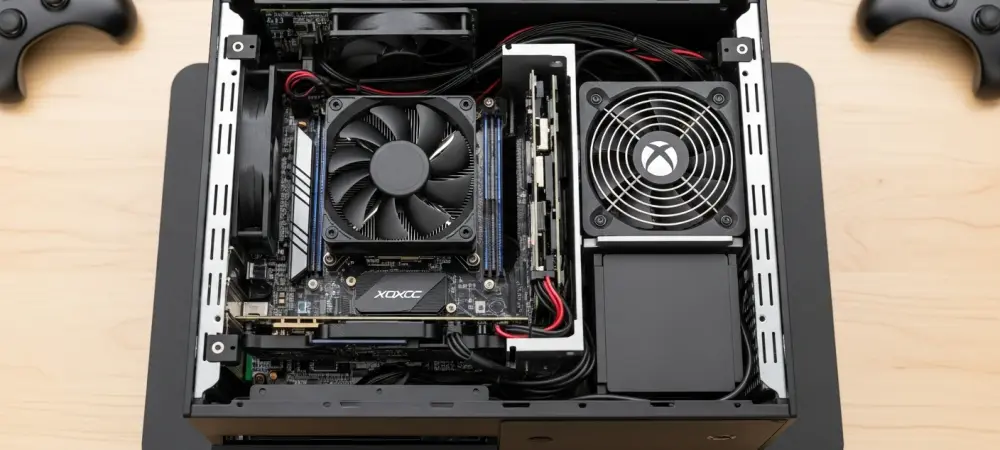
Today we’re joined by Dominic Jainy, an IT professional whose work at the intersection of AI, machine learning, and hardware gives him a unique perspective on the art of system building. We’ll be diving deep into an ambitious project that transformed a classic Xbox One S console into a fully functional, high-performance desktop PC. Throughout our conversation, we will explore the intricate design challenges born from strict self-imposed rules, the innovative use of 3D printing to overcome physical limitations, and the delicate balancing act between performance and thermal management within a tiny 4.4-liter chassis. We will also discuss the real-world user experience of such a stealthy, high-concept build and its place in the world of custom PCs.
You set some strict rules for this build, including a fully internal power supply and a working disc drive. What specific design challenges did these restrictions create, and how did they influence your initial component selection for the project? Please share some details about that process.
Those rules were the entire challenge, really. Most people doing these console conversions cheat a little by using an external power brick, which immediately frees up a huge amount of internal space. By demanding an internal PSU, you’re not just adding one component; you’re adding a major source of heat and a massive physical blocker. This decision cascaded through the whole build. We had to use a 250W flex PSU, which then dictated the power budget for everything else. That’s why a power-efficient combo like the Ryzen 5 3600 and a low-profile RTX 3050 was chosen. It was the only way to get dedicated graphics without overwhelming that tiny power supply or turning the whole thing into a space heater.
Instead of using adhesives, you relied on custom 3D-printed brackets. Could you walk us through the design process for one of these brackets and explain how you managed to secure key components like the GPU riser and optical drive using only existing screw points?
The “no glue” rule was about elegance and serviceability. It forces you to think like an engineer, not just a modder. Take the bracket for the optical drive, for example. The process started with meticulously measuring the drive’s dimensions and locating every available screw boss or structural cutout in the Xbox shell nearby. Using CAD software, a bracket was designed to bridge these points, essentially creating a custom-fit cradle. It had to be printed, test-fitted, and tweaked multiple times to get the alignment perfect to the millimeter. The GPU riser was even trickier, as it needed to hold the card vertically and perfectly stable. The final bracket for it not only screwed into the chassis but also incorporated features that clipped into the shell’s plastic structure, making it surprisingly rigid without a drop of adhesive.
The build features a Ryzen 5 3600 and a low-profile RTX 3050. What was the thinking behind this CPU/GPU pairing, and what trade-offs did you consider when balancing performance against the system’s thermal limits and the 250W power supply?
That pairing was all about finding the sweet spot of “good enough” performance within an incredibly tight power and thermal envelope. The Ryzen 5 3600 is a fantastic CPU that sips power at idle but can still deliver solid multi-core performance when needed. We paired it with the low-profile RTX 3050 because it’s one of the few modern GPUs that comes in a single-slot form factor and doesn’t demand a massive amount of power. The main trade-off was raw power; we could have tried to stuff something more powerful in there, but the 250W PSU would have been a serious bottleneck, and the heat would have been unmanageable. The goal wasn’t to build a 4K gaming monster, but a capable 1080p machine that could actually survive inside that tiny plastic box.
With temperatures reaching 80°C under load in a 4.4-liter case, thermal management was clearly a hurdle. Can you detail the specific airflow path you engineered using the original top vent and how you positioned the components to cool both the CPU and GPU effectively?
Managing heat in a 4.4-liter enclosure is a nightmare, and 80°C is definitely pushing it, but it’s stable. The key was leveraging the Xbox’s original, large top vent as the primary air intake. We very deliberately positioned the motherboard so the low-profile Noctua CPU cooler sat directly under one half of that vent. Then, by mounting the RTX 3050 vertically with the riser cable, its fan was positioned directly under the other half. This created a dual-intake system where both the CPU and GPU could draw in their own supply of fresh, cool air from outside the case, rather than fighting over hot internal air. It’s not an ideal setup with dedicated exhaust, but it’s the most direct and efficient way to get cool air to the two hottest components in such a cramped space.
The system achieves impressive frame rates in esports titles. Beyond these metrics, what was the subjective user experience like? How does it feel as a living-room PC, and what other practical applications do you see for this type of high-concept, stealth build?
Beyond the benchmarks, the feeling is really what makes it special. Sitting in the living room, it just looks like an old Xbox. There’s a certain magic to hitting the power button and seeing a full Windows desktop appear on your TV. For gaming, hitting 200 fps in Valorant on a machine that looks like a console is just plain fun. It’s snappy, responsive, and perfect for that kind of casual or competitive living-room gaming session. I see huge potential for these builds as stealthy home theater PCs (HTPCs) that can also handle emulation and indie gaming flawlessly, or even as a compact, portable workstation for someone who travels and needs more power than a laptop can offer but wants an unassuming package.
What is your forecast for the future of small form factor PC building?
I believe we’re on the cusp of a golden age for small form factor (SFF) building. The drive for efficiency in both CPUs and GPUs, especially with advancements in mobile and low-power architecture, is going to unlock incredible potential. We’ll see even more powerful components that don’t require massive coolers or high-wattage power supplies. This will allow builders to push the boundaries of creativity, fitting true high-end performance into ever smaller and more unique enclosures. The community’s passion for custom solutions, combined with the increasing accessibility of 3D printing and custom manufacturing, means the future isn’t just smaller boxes, but more personal, artistic, and ingeniously designed systems that truly blend performance with aesthetics.