

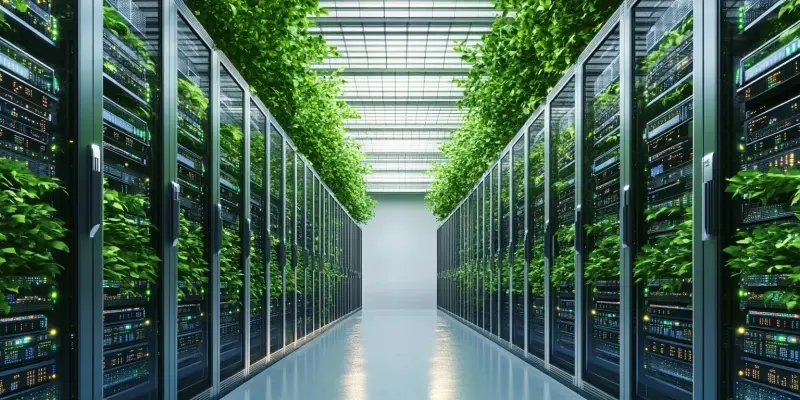
Alberta is poised to become a major hub for artificial intelligence (AI) data centers, with a bold plan calling for $100 billion in infrastructure investment over the next five years. This ambitious plan, spearheaded by Alberta Technology Minister Nate Glubish, aims to leverage the province’s deregulated electricity market and cold climate to support the power-intensive needs of AI. However, this development presents significant challenges concerning power consumption and electricity emissions, directly impacting Alberta’s environmental goals. The question then looms large: Can Alberta find a balance between fostering AI advancements and adhering to its stringent decarbonization targets?
Alberta’s Deregulated Electricity Market: A Double-Edged Sword
Alberta’s deregulated electricity market offers a unique advantage for data center operators, allowing them to utilize off-grid power generation. This market flexibility is crucial for managing the substantial energy demands of AI data centers, which are known for their power-intensive functions. Additionally, Alberta’s cold climate provides a natural cooling solution, helping to mitigate the excess heat generated by these sprawling facilities. These favorable conditions make Alberta an attractive destination for investors eyeing the burgeoning AI sector.
However, the environmental implications of this development cannot be ignored. While Alberta has made significant strides in emissions reduction by ramping up renewable energy sources and phasing out coal power plants, the introduction of massive data centers could potentially reverse these gains. The province has seen a notable decrease in emissions intensity, but integrating extensive data center projects poses a risk of increasing emissions levels due to the heavy reliance on fossil fuels like natural gas. The core challenge lies in balancing the economic benefits of embracing AI data centers with a steadfast commitment to reducing emissions and meeting long-term environmental goals.
The Global Push for AI and Its Environmental Impact
On the global stage, governments are prioritizing AI adoption, recognizing its transformative potential to drive economic growth, enhance cybersecurity, and improve productivity across multiple sectors. A report by the RBC Climate Action Institute sheds light on the various benefits of AI-driven data center expansion in Canada, highlighting economic gains, improved data sovereignty, and enhanced cybersecurity. The analysis suggests that the economic implications of AI adoption are vast, promising to redefine industries and foster innovations that lead to increased productivity.
Nonetheless, the environmental challenges are daunting. AI applications are notoriously energy-intensive, with even simple tasks like search queries consuming significantly more power than standard online searches. Advanced AI applications, such as machine learning-driven photo generation, demand exponentially more energy, raising significant concerns about power availability and grid reliability. As AI technology continues to evolve, the energy needs will only grow, compelling authorities to address the escalated demand in an environmentally sustainable manner. Balancing AI development with ecological responsibility is critical, as failing to do so could undermine the broader goals of environmental preservation.
The Emissions Dilemma: Balancing Growth and Sustainability
The RBC report indicates that data center projects currently under regulatory review could account for an astounding 14 percent of Canada’s total power needs by 2030. The Alberta Electric System Operator (AESO) is assessing 12 such projects, representing a cumulative load of 6,455 megawatts. This unprecedented scale of development holds the potential to nearly double Alberta’s electricity-related greenhouse gas emissions, reminiscent of the emissions intensity levels experienced when coal was a primary power source for the province. The stakes are high, as reverting to such historical levels would significantly impair Alberta’s environmental achievements.
Economist Blake Shaffer from the University of Calgary warns that the increased proliferation of data center projects might reverse the positive trajectory Alberta has been on in terms of emissions reduction. Emissions intensity metrics have decreased from 950 grams of CO2 per kWh in 1990 to approximately 470 grams of CO2e per kWh in 2022. However, the proposition of powering around 6,500 megawatts of data center loads with off-grid natural gas stands in stark contrast to these achievements. Natural gas, while less polluting than coal, carries a substantial emissions burden, making it a controversial choice for powering such energy-demanding facilities.
The Role of Carbon Capture and Alternative Energy Sources
Minister Glubish has proposed that carbon capture, utilization, and storage (CCUS) technology can serve as a viable pathway to mitigate emissions stemming from natural gas usage. The idea revolves around capturing CO2 emissions at the source and either utilizing them in industrial processes or storing them underground, thereby reducing the net emissions impact. Glubish has outlined three main power options for data centers: nuclear, hydro, and natural gas. However, he emphasizes that, given current technology readiness and economic viability, natural gas stands out as the only immediate solution available.
Despite the high costs and various economic challenges associated with implementing CCUS, Glubish remains optimistic about achieving net-zero emissions using natural gas. According to a Deloitte report, the financial hurdles for CCUS are significant, but Glubish believes that, in the long run, the costs associated with CCUS will be lower compared to other energy sources. This optimism underscores the urgency of tackling emissions head-on, leveraging the most ready technologies while keeping an eye on future innovations. Speed in rolling out power solutions is paramount, as highlighted by John Kousinioris, CEO of Calgary-based TransAlta. Bringing power online quickly is considered critical, albeit with a cautious approach toward eventual decarbonization concerns.
High-Profile Projects and the Path Forward
Alberta is on the verge of becoming a key player in the realm of artificial intelligence (AI) data centers. The province has unveiled an ambitious plan that calls for a staggering $100 billion investment in infrastructure over the next five years. This visionary project is orchestrated by Alberta Technology Minister Nate Glubish. The initiative seeks to capitalize on Alberta’s deregulated electricity market and its naturally cold climate, which are ideal for supporting the energy-hungry demands of AI technology. However, this development brings with it formidable challenges, especially regarding power consumption and the resulting electricity emissions, which could potentially hinder Alberta’s environmental objectives. The critical issue that arises is whether Alberta can strike a balance between promoting AI advancements and sticking to its rigorous decarbonization goals.
In aiming to position itself as a leader in AI infrastructure, Alberta seeks to attract tech investments and create a robust ecosystem that fosters innovation. However, the high energy requirements of AI data centers pose significant risks to the province’s environmental initiatives. As Glubish and his team navigate these waters, they must address how to sustain AI progress while meeting Alberta’s stringent targets for reducing carbon emissions. The delicate balance between technological growth and ecological responsibility will be crucial in determining whether Alberta can thrive as an AI hub without compromising its commitment to a greener future.