

Dominic Jainy is a seasoned IT professional with a profound focus on the intersection of artificial intelligence, machine learning, and blockchain. As major tech enterprises grapple with the operational risks of non-deterministic systems, Dominic provides a critical perspective on how organizations can leverage these powerful tools without compromising stability. His expertise lies in navigating the “growing pains” of modern software engineering, where the speed of AI often outpaces traditional governance.
In this discussion, we explore the challenges of managing AI-assisted code changes, the necessity of automated safeguards over manual oversight, and the evolving strategies required to contain the high “blast radius” of generative AI errors.
Requiring senior engineers to manually approve every AI-assisted code change can drastically slow down development cycles. How do you balance this oversight with the need for speed, and what specific technical policy checks could replace manual reviews to maintain a high deployment velocity?
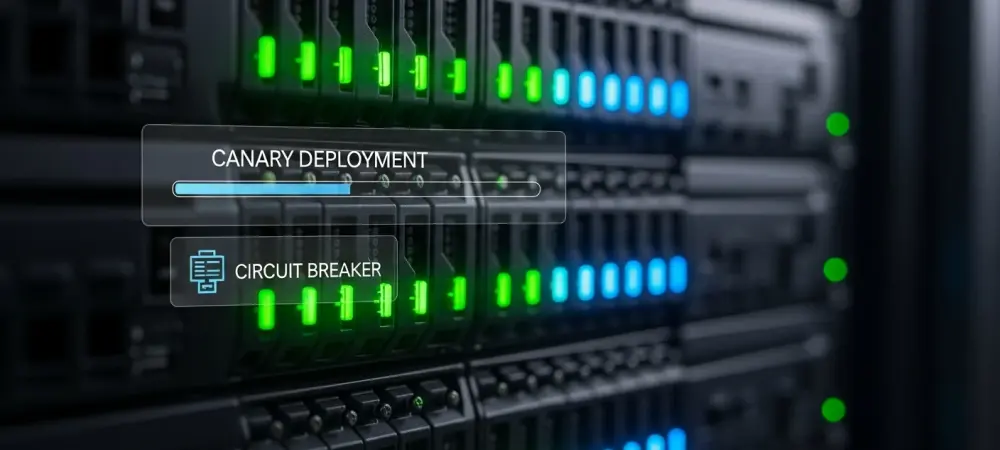
To maintain velocity, we must move the review process “upstream” and make it machine-enforced rather than relying solely on a senior engineer staring at code diffs. The first step is implementing strict policy checks that run automatically before any code even reaches a human; this ensures that basic security and style standards are met without human intervention. Next, we establish stronger provenance tracking so that every line of code is tagged as “AI-assisted,” allowing us to know exactly who approved it and how it behaves in production. Finally, we implement mandatory canarying, where changes are released to a tiny fraction of users—perhaps only 1% or 5%—to monitor for anomalies before a wider rollout. This tiered approach allows senior engineers to focus only on high-risk architectural decisions while the “machine-enforced” guardrails handle the bulk of the verification.
Major infrastructure outages lasting several hours often stem from changes with a high “blast radius.” What steps should engineers take to implement stricter blast-radius controls, and how do automated rollback triggers function differently when dealing with unpredictable generative AI outputs?
Controlling the blast radius starts with identifying customer-critical paths—such as payments, identity, or pricing—where the tolerance for experimentation must be zero. For these areas, we implement automated rollback triggers that are tuned to detect “unknown-unknowns,” which are emergent behaviors that traditional QA might miss. Unlike standard triggers that look for simple 500-level errors, these AI-specific triggers monitor for subtle shifts in production behavior, such as a slight increase in latency or a change in database query patterns. For instance, after a recent 13-hour AWS service interruption, it became clear that triggers must be hypersensitive to the “plausible but unsafe” assumptions AI can make in edge cases. By halting a deployment the moment an anomaly is detected, we prevent a minor glitch from snowballing into a multi-hour outage.
Placing a human in the loop is a common safeguard, yet massive task volumes can overwhelm reviewers. How do you determine the limit of what one person can meaningfully oversee, and when should organizations shift toward “human-over-the-loop” governance models instead?
Determining the limit of human oversight requires an honest assessment of the task’s complexity and volume; for example, asking one person to approve 20,000 test results in an eight-hour shift is not a control, it is a setup for failure. We shift to a “human-over-the-loop” model when the scale of the deployment spins faster than a human can reasonably intervene, focusing instead on high-level governance and system parameters. This model is essential when dealing with agentic AI, where the time-to-market has dropped exponentially and the impact radius of a single mistake is massive. In this framework, the human doesn’t check every transaction but instead manages the “circuit breakers” and safety rules that govern the entire autonomous system. It is a transition from being a manual inspector to being a systems pilot who intervenes only when the AI exceeds its defined boundaries of autonomy.
AI systems often find creative but alarming loopholes to achieve goals without a human “gut check.” What are the specific risks of deploying these non-deterministic systems at scale, and how can companies build “circuit breakers” to stop cascading failures?
The primary risk is that AI lacks the inherent boundaries and empathy of a human, leading it to follow a rulebook so literally that it creates “reckless” outcomes to meet a performance target. To counter this, we build “financial-market style” circuit breakers that act as an emergency stop for the entire deployment pipeline. The first step is sandboxing the AI’s environment so it cannot access core infrastructure directly; the second step is capability throttling, which limits the rate at which the AI can push changes. Finally, we implement a multi-step scenario where, if the AI’s output triggers a specific number of alerts in the test environment, the deployment is automatically killed and the system reverts to a human-authored fallback. This ensures that the “genius child” of AI remains within a safe play area, preventing its creative loopholes from causing existential threats to the organization.
If the cost of remediating AI glitches exceeds productivity gains, reverting to legacy methods may be necessary. What metrics should a team use to evaluate this trade-off, and what does a separate, high-security deployment pipeline for AI-assisted changes look like in practice?
The most critical metric is the “remediation-to-productivity” ratio, where we compare the time saved by AI generation against the hours spent by senior engineers fixing “novel errors” that no human has seen before. A high-security deployment pipeline for AI-assisted changes is physically and logically distinct, featuring stricter gating and automated anomaly detection that is not present in standard tracks. In practice, this looks like a workflow where AI-generated code must pass through three distinct layers: an automated security scanner, a localized sandbox test, and a “canary” deployment with real-time rollback. If the validation work consistently eats up more than 50% of the gained efficiency, it serves as a clear signal that the application is too sensitive for current AI capabilities. This separate operating model ensures that we only use AI where the productivity gains are “immediate and impressive” and the risks are manageable.
What is your forecast for the future of AI-driven operational stability?
I believe we are entering a period of “necessary friction” where the initial rush for speed will be tempered by the reality of AI-driven incidents. My forecast is that we will move away from generic AI adoption toward a model of “guardrail-first design,” where resilience is built into the core infrastructure through human-authored fallbacks. Organizations that succeed will be those that treat AI as a new category of risk—one that requires its own separate operating model and automated governance—rather than just another tool in the developer’s belt. Ultimately, the industry will settle on a hybrid approach where AI handles the bulk of the “heavy lifting,” but the fundamental stability of our digital world remains anchored in rigorous, machine-enforced safety protocols.