

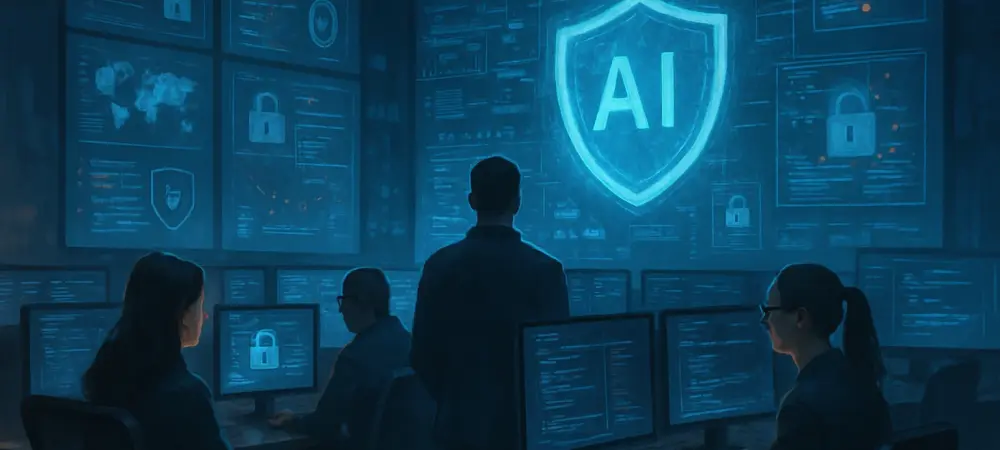
In today’s hyper-connected workplaces, a silent battle rages—one where artificial intelligence (AI) powers both the attackers and the defenders, creating a complex landscape of risk and opportunity. Picture a scenario where a single AI-crafted phishing email slips past traditional security, morphing in real time to evade detection and compromising an entire corporate network within hours. This isn’t science fiction; it’s a reality that over 60% of IT leaders now identify as a critical risk, according to Lenovo’s latest research. As AI reshapes how businesses operate, it also arms cybercriminals with tools to exploit vulnerabilities at unprecedented speed. The pressing question emerges: can AI, the very force driving these threats, also become the ultimate shield for modern workplaces?
The Urgency of AI’s Dual Role in Workplace Security
The stakes in workplace security have never been higher. AI’s integration into business operations boosts efficiency, automates mundane tasks, and drives innovation. Yet, this same technology equips malicious actors with the ability to launch sophisticated attacks that outpace conventional defenses. The rapid evolution of AI-powered cybercrime, coupled with internal risks from unchecked use of public AI tools, creates a volatile landscape. This clash of innovation and exploitation demands immediate attention, as organizations scramble to protect sensitive data and maintain trust in an increasingly digital world.
The Alarming Rise of AI-Powered Cyber Threats
The proliferation of AI in business environments has opened new doors for cybercriminals. Attackers now leverage AI to design polymorphic malware that adapts dynamically, rendering static security measures obsolete. Lenovo’s studies reveal a stark concern: more than 60% of IT leaders view AI-driven cybercrime as a top threat, with attacks becoming more frequent and complex. From AI-generated deepfake scams to automated social engineering, the arsenal of malicious tools grows daily, challenging organizations to keep up with an ever-shifting threat horizon.
Beyond external dangers, internal vulnerabilities add fuel to the fire. Employees often use public AI platforms without oversight, inadvertently exposing sensitive data or creating backdoors for attackers. Research indicates that fewer than 40% of IT leaders feel confident in managing these internal risks, highlighting a critical gap in governance and control. This combination of external sophistication and internal oversight failures paints a troubling picture for workplace security.
Unpacking AI’s Paradox: Both Weapon and Shield
AI’s role in cybersecurity presents a complex duality. On one side, external threats loom large as cybercriminals deploy AI to craft attacks like phishing emails that mimic legitimate communication with eerie precision. These threats often evolve faster than human teams can respond, exploiting gaps in fragmented IT systems. Real-world incidents, such as the surge in AI-generated scams targeting remote workers, underscore how quickly these dangers can spiral out of control.
Conversely, internal challenges stem from the very tools meant to enhance productivity. Unregulated use of AI agents or internal model development can introduce compliance risks and data leaks, with Lenovo’s data showing only 36% of IT leaders confident in securing public AI tools. This lack of control creates blind spots that attackers eagerly exploit. The tension between utility and risk becomes a central hurdle for businesses navigating this landscape.
Yet, there’s a silver lining: AI itself holds immense potential as a defensive ally. By harnessing machine learning for real-time threat detection and automating incident responses, organizations can close visibility gaps and counter attacks at machine speed. Examples like AI-driven anomaly detection systems illustrate how technology can turn the tide, offering hope that the same force driving threats can also fortify defenses.
Insights from the Trenches: IT Leaders Sound the Alarm
Those on the front lines of workplace security face daunting realities. Lenovo’s “Work Reborn” research paints a grim picture, with nearly two-thirds of IT leaders admitting a lack of confidence in vulnerability analysis. Many also struggle with identity management and incident detection, leaving systems exposed to rapid, intelligent attacks. These statistics reveal a pervasive unpreparedness that threatens to widen the gap between evolving threats and current capabilities.
Expert voices add urgency to the data. Rakshit Ghura, a senior executive at Lenovo, emphasizes that “the velocity of AI-powered attacks necessitates a pivot to proactive, intelligent defenses.” This perspective resonates across the industry, as IT professionals grapple with fragmented systems and limited resources. Their collective concern highlights an undeniable truth: traditional approaches fall short against adversaries wielding cutting-edge technology.
The human element further complicates the equation. With employees often unaware of the risks posed by casual AI tool usage, training and policy enforcement remain critical yet under-addressed areas. Insights from the field suggest that bridging this awareness gap, alongside technological upgrades, is essential to building a resilient security posture in today’s workplaces.
Crafting an AI-Ready Defense: Steps to Stay Ahead
Moving from a reactive to a proactive stance is no longer a choice but a necessity. One key strategy involves establishing holistic visibility across IT environments. By integrating AI-driven monitoring, businesses can connect disparate data points and spot anomalies before they escalate into full-blown breaches. This unified approach addresses the blind spots that fragmented systems often create, offering a clearer picture of potential risks.
Another vital step lies in adopting versatile AI tools capable of analyzing massive data streams in real time. These technologies automate threat responses, reducing the burden on overworked IT teams and enabling focus on strategic risk management. Such adaptability ensures that defenses evolve alongside threats, maintaining relevance in a landscape where attackers constantly innovate.
Finally, collaboration with trusted technology partners can bridge skill shortages and simplify complex environments. Vendors with expertise in AI security solutions provide tailored support, accelerating the adoption of modern measures. This partnership model empowers organizations to build robust, AI-ready defenses, ensuring they not only keep pace with threats but also anticipate and neutralize them effectively.
Reflecting on the Battle and Charting the Path Forward
Looking back, the struggle between AI-driven threats and defenses revealed a landscape of both peril and promise for workplaces. The sophistication of attacks, fueled by the same technology that enhanced productivity, had caught many organizations off guard. Internal vulnerabilities, from lax oversight of AI tools to fragmented systems, had compounded the challenge, leaving IT leaders searching for answers.
Yet, the journey also uncovered powerful solutions. Harnessing AI for proactive threat detection and automated responses had shown remarkable potential to turn vulnerabilities into strengths. By prioritizing holistic visibility, versatile tools, and strategic partnerships, businesses had begun to reclaim control over their digital environments. Moving forward, the focus must remain on continuous adaptation—investing in training, refining policies, and staying vigilant against emerging risks to ensure that AI becomes a steadfast guardian rather than a double-edged sword.