

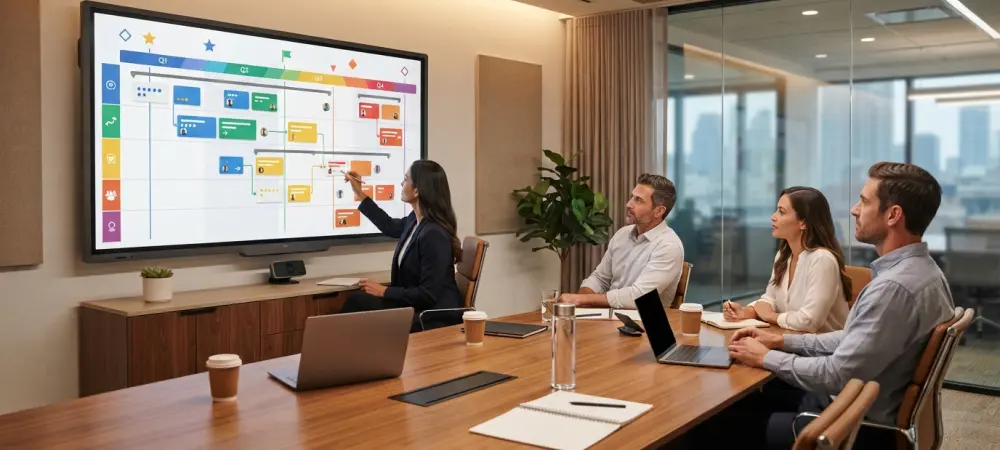
From Transcription to Transformation: The New Era of AI Meeting Agents
The traditional corporate landscape has long been haunted by the inefficiency of the post-meeting administrative void where critical decisions often vanish into thin air without proper documentation or follow-up. For a significant period, the integration of artificial intelligence within the boardroom was restricted to the rudimentary task of transcription, providing nothing more than a digital paper trail of spoken words. However, the current professional environment in 2026 has witnessed a radical shift toward agentic systems that do not just record history but actively participate in the creation of the future. The transition from passive listeners to proactive agents signifies a fundamental change in how organizations perceive the value of a conversation.
This transformation is underpinned by a massive surge in capital investment, most notably seen in recent funding rounds exceeding $320 million for leaders in the meeting intelligence space. The objective is no longer to simply bridge the gap between speech and text but to convert raw dialogue into structured, executable workflows. As businesses grapple with increasing complexity, the demand for tools that can synthesize information and trigger actions across disparate software ecosystems has never been higher. This analysis explores how the industry is moving toward a model where the meeting serves as the primary engine for organizational productivity.
The Evolution of Meeting Intelligence: Beyond Simple Data Capture
Historically, the burden of post-meeting organization fell squarely on the shoulders of project managers and administrative assistants who spent hours distilling lengthy discussions into actionable bullet points. The initial wave of AI innovation provided some relief by digitizing these records, yet the heavy lifting of categorizing tasks and updating internal systems remained a manual process. This created a persistent bottleneck that often delayed project timelines and led to information silos. As the technological landscape matured, it became clear that transcription alone was insufficient for the needs of a modern, fast-paced enterprise.
The arrival of sophisticated large language models and integrated data pipelines marked the end of this static era. Instead of treating a meeting as an isolated event, the industry began to view it as a data-rich catalyst for the entire business infrastructure. By 2026, the focus has shifted entirely to the interoperability of these tools, ensuring that every word spoken can potentially trigger a response in another part of the organization. This background of continuous improvement set the stage for the current generation of agentic AI, which operates with a level of autonomy that was previously unimaginable.
The Rise of Agentic Capabilities and Workflow Integration
Bridging the Gap Between Conversation and Execution
The most notable advancement in current AI meeting tools is the development of agentic behavior, which allows a system to navigate multi-step tasks across diverse software environments. Rather than providing a static summary, these agents now possess the capability to interact directly with core business platforms such as Salesforce, Jira, and Gmail. If a client mentions a specific budget adjustment or a new deadline during a call, the AI can independently draft an update for the CRM or create a new ticket in the project management system. This ensures that insights are immediately translated into the platforms where the actual work is executed, eliminating the risk of human error or forgetfulness.
Expanding the Meeting Lifecycle: Pre-Call Briefs and Post-Call Automation
To maximize the utility of every professional interaction, AI agents are now assuming control over the entire lifecycle of a meeting. Before the participants even join the call, the AI synthesizes historical data from previous meetings and connected applications to generate comprehensive briefing documents. This ensures that all attendees are perfectly aligned and reduces the time wasted on introductory recaps. Once the discussion concludes, the automation engine takes over the administrative drudgery by drafting follow-up emails and generating various file formats, such as PDFs or Notion pages. This holistic approach allows teams to dedicate their energy to high-level strategic thinking rather than routine data entry.
Real-Time Guidance and the Human-in-the-Loop Protocol
Despite the increasing autonomy of these systems, the industry has maintained a strict adherence to the human-in-the-loop protocol to ensure accuracy and accountability. While an AI agent can draft a complex follow-up or update a sensitive record, the final approval must always come from a human user. Furthermore, the technology has expanded into the realm of live assistance, providing real-time, private guidance to participants during the meeting. This feature, which was once reserved for external customer support roles, now assists internal teams by suggesting relevant questions and tracking specific objectives as the conversation progresses. This ensures that meetings stay on track and that no critical agenda items are overlooked.
Emerging Trends and the Shift Toward Universal AI Interoperability
Recent market research indicates a profound shift in user expectations, with over 91% of business professionals now requiring their communication tools to access context from outside the immediate conversation. This demand for deep integration is forcing a convergence among major technology providers, as industry giants like Microsoft and Cisco race to incorporate similar agentic features into their own ecosystems. The trend suggests a future where AI agents act as a central hub for all workplace activity, seamlessly moving data between once-isolated silos and predicting user requirements before they are even articulated.
The competitive landscape is being reshaped by the ability of these agents to provide a unified experience across different applications. As the technology continues to evolve, we are seeing the rise of a new standard in interoperability, where the specific platform used for a meeting becomes less important than the AI agent that manages the resulting data. This movement toward a more connected and intelligent workplace is not merely a trend but a fundamental restructuring of professional productivity, driven by the need for speed and accuracy in a digital-first economy.
Maximizing Productivity: Strategies for Implementing AI Agents
To successfully leverage these advancements, organizations must transition from viewing AI as a simple recording device to treating it as a functional member of the team. One effective strategy involves the deep integration of AI agents with primary CRM and project management tools to ensure that the flow of information remains uninterrupted. By automating the data transfer between the meeting room and the execution platform, businesses can significantly reduce the time between decision-making and action. This requires a proactive approach to software configuration and a commitment to maintaining clean data across all connected systems.
Additionally, establishing clear protocols for human oversight is essential to maintaining the quality of AI-generated content. Professionals should utilize AI-produced briefs to eliminate the initial ten minutes of “catching up” that typically plagues corporate gatherings. By arriving at meetings fully informed by AI-synthesized data, participants can dive directly into the core issues, thereby increasing the overall efficiency of the interaction. Adopting these best practices ensures that the investment in AI technology yields tangible business outcomes rather than just adding another layer of digital noise.
The Future of Work Is Action-Oriented
The shift from passive transcription to active agentic execution represented a definitive turning point in the history of professional collaboration. AI agents successfully solved the perennial problem of the unproductive meeting by ensuring that every conversation led to a measurable result. This evolution demonstrated that the true value of a discussion lay not in the notes taken, but in the automated workflows that were triggered as a direct consequence of the dialogue. Organizations that embraced this change found themselves better equipped to handle the demands of a fast-paced market, as they no longer struggled with the administrative overhead that typically followed every major project update.
The integration of these intelligent systems into the daily routine of the modern workforce solidified the meeting’s role as a powerful catalyst for business growth. By removing the drudgery of manual data entry and follow-up, AI allowed human talent to focus on creativity and complex problem-solving. This strategic shift was not just about saving time; it was about reimagining the very nature of work to be more fluid, connected, and result-oriented. As the technology matured, the distinction between communication and execution continued to blur, creating a more efficient and responsive corporate environment that rewarded those who utilized the full potential of agentic assistance.