

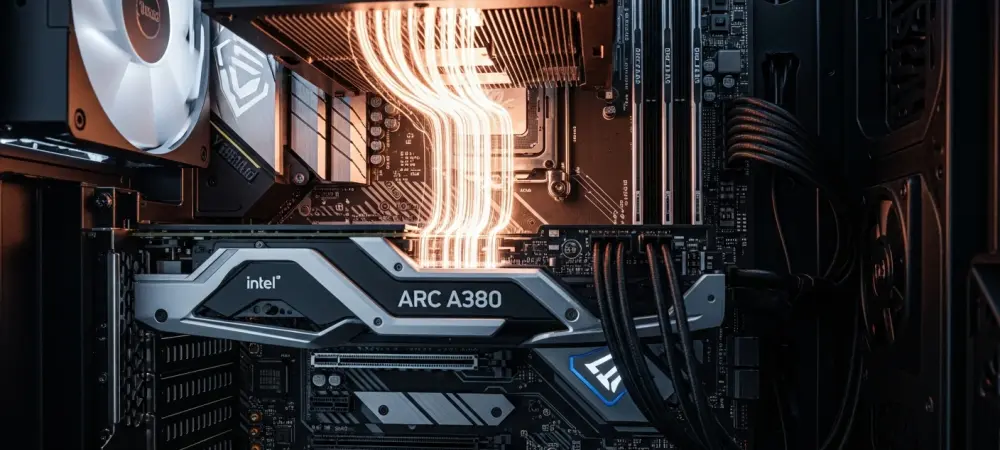
The pursuit of higher frame rates often leads gamers down a path of expensive hardware upgrades, yet a recent discovery suggests that significant performance gains might be lying dormant within existing entry-level graphics cards. A compelling demonstration has surfaced showcasing the untapped power of an Intel Arc A380 GPU when an unreleased feature is manually enabled through a simple software modification. This development centers on Intel’s forthcoming XeSS 3 Multi-Frame Generation (MFG) technology, a feature officially announced for future support on first-generation Alchemist GPUs but not yet available through a public driver release. A tech enthusiast bypassed this official delay with a surprisingly simple workaround, revealing the immense potential of frame generation to breathe new life into budget-friendly hardware. The experiment highlights a future where even lower-end cards could handle demanding, modern titles with remarkable fluidity, questioning the necessity of constant, costly upgrades for a smooth gaming experience.
Unlocking a Dormant Potential
The method employed to unlock this performance was not a complex hardware modification but a straightforward software tweak accessible to savvy users. The user, Alva Jonathan, managed to activate the unreleased XeSS 3 MFG feature by copying two specific Dynamic Link Library (DLL) files from one driver version into the directory of another. This simple act effectively tricked the system into enabling the advanced frame generation capabilities on the entry-level Intel Arc A380. The test bed for this experiment was the graphically intensive world of Cyberpunk 2077, running at a standard 1080p resolution with graphics settings on Low. In its baseline state, using the officially supported XeSS 2 upscaling, the Arc A380 delivered a playable but unremarkable performance, hovering between 50 and 60 frames per second (FPS). This baseline provided a clear and measurable starting point to accurately gauge the impact of the unofficially activated frame generation technology, setting the stage for a dramatic performance comparison.
A Glimpse of the Future and Its Tradeoffs
The results of this unofficial activation painted a striking picture of what official support might bring to the table for Alchemist GPU owners. Once the XeSS 3 MFG was enabled, the frame rate in Cyberpunk 2077 skyrocketed, transforming the game’s performance on the humble Arc A380. The once 50-60 FPS gameplay was propelled to an astonishing 130 to 150 FPS, a near-tripling of the original output. However, this impressive gain was not without its drawbacks. The experimenter noted significant input lag when using the 4x Frame Generation setting, a common side effect of early or unoptimized frame interpolation technologies. A more balanced experience was found at the 3x setting, which still maintained a very fluid 120 FPS while reportedly keeping input lag to a minimum. Minor visual artifacts, such as ghosting, were also observed. Ultimately, this successful test served as a powerful proof-of-concept, demonstrating that Intel’s frame generation technology held the potential to dramatically extend the useful lifespan of its first-generation GPUs.