

With Australia rapidly becoming a global hub for artificial intelligence, the physical infrastructure powering this revolution is under intense scrutiny. Today, we’re joined by Dominic Jainy, an IT professional whose expertise spans AI, machine learning, and the complex digital foundations they require. We’re here to unpack the recent approval of NextDC’s M4 campus in Melbourne, a project that isn’t just another data center but a liquid-cooled ‘AI Factory.’ We’ll delve into the immense engineering feats involved, the economic ripple effects of its AU$2 billion investment, and what this massive expansion signals for the nation’s race toward sovereign AI capabilities.
The M4 campus is designed as a liquid-cooled ‘AI Factory’ supporting rack densities over 1,000kW for advanced GPUs. What unique engineering hurdles does this create compared to traditional data centers, and how does this infrastructure specifically advance sovereign AI capabilities in Australia?
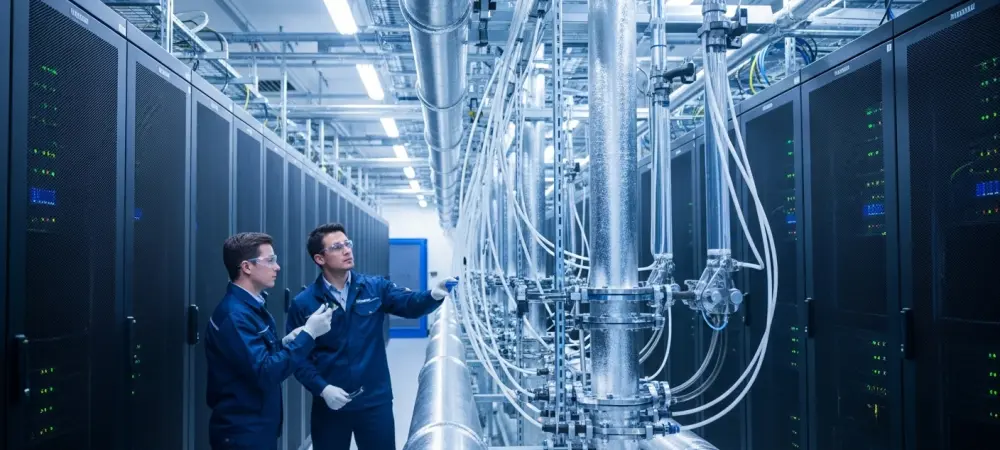
The leap from traditional air-cooled facilities to a liquid-cooled AI Factory supporting over 1,000kW per rack is monumental. We’re moving from managing heat like an oven to engineering a complex plumbing and power system more akin to a nuclear submarine. The primary hurdle isn’t just cooling; it’s the integration of power, fluid dynamics, and redundancy at an unprecedented scale. You have to manage coolant flow, pressure, and temperature with zero margin for error, directly to chips like Nvidia’s Blackwell and Rubin Ultra GPUs. This infrastructure is the bedrock of sovereign AI because it allows Australia to train and operate the most powerful large language models entirely within its borders, securing sensitive national data and intellectual property without relying on offshore facilities.
With a AU$2 billion investment and government backing for job creation, the M4 project is a major development. Can you walk us through the types of long-term, high-skilled jobs this facility will create and how it will directly support future developments in advanced manufacturing or defense?
This AU$2 billion investment creates a whole new ecosystem of high-value careers that go far beyond basic IT support. We’re talking about mechatronic engineers who design and maintain the sophisticated liquid-cooling systems, data scientists and AI specialists who manage the massive computational workloads, and cybersecurity experts who protect this critical national asset. As Minister Danny Pearson noted, this directly seeds the ground for advanced manufacturing and defense. Imagine local firms using this on-demand supercomputing power for digital twin simulations in manufacturing or defense contractors training sophisticated AI models for national security applications, all powered and secured locally. It creates a self-sustaining cycle of innovation and high-skilled employment.
NextDC is adding M4’s 150MW of capacity to its existing significant Melbourne footprint, which includes the 150MW M3 facility. How does this massive expansion reflect the current demand for AI and high-density computing in the region, and what does this signal about Melbourne’s competitive position?
Adding another 150MW facility right next to the already massive M3 is a powerful statement about the insatiable demand for AI compute. It’s not just a gradual increase; it’s a doubling down that reflects an exponential surge in requirements from cloud providers and AI developers. You don’t make a AU$2 billion bet unless you are absolutely certain the demand is there and growing. This signals that Melbourne is cementing its position as the premier high-tech hub in the region, a place where companies like OpenAI and Sharon AI can secure the colossal power and specialized infrastructure they need. It shows Melbourne is successfully competing with other major cities to attract the most critical digital infrastructure projects of our time.
The initial phase of M4 is set for 10MW, while recent deals include a 550MW center for OpenAI and a 50MW lease with Sharon AI. Could you detail the strategic thinking behind this phased rollout and explain how you manage scaling from a small initial launch to these massive capacities?
The phased rollout, starting with an initial 10MW, is a brilliant and necessary strategy for a project of this magnitude. It allows NextDC to manage capital expenditure, align construction with supply chain realities, and bring capacity online precisely as customer demand materializes. You can’t just build a 150MW facility and flip a switch; the power utility connections and infrastructure have to be scaled in lockstep. This approach de-risks the project significantly. Scaling from that initial 10MW involves a modular design where data halls, cooling units, and power distribution can be added incrementally. It’s like building a city block by block rather than all at once, ensuring that every new section is built using the latest technology and immediately meets contracted demand from clients like the ones involved in the recent 550MW and 50MW deals.
What is your forecast for the Australian data center market over the next five years, particularly regarding the race for AI-ready, high-density capacity?
Over the next five years, I forecast an unprecedented “great divergence” in the Australian data center market. The legacy, low-density facilities will struggle for relevance, while the market’s entire growth will be dominated by a fierce race to build AI-ready, liquid-cooled campuses capable of handling extreme power densities. We’ll see a consolidation of providers, as only those with the capital, engineering expertise, and strategic land holdings to build facilities like M4 will thrive. The demand from AI workloads will not just be a segment of the market; it will be the market. The key battleground will be securing land, power, and the specialized talent required to build and operate these next-generation AI Factories.