

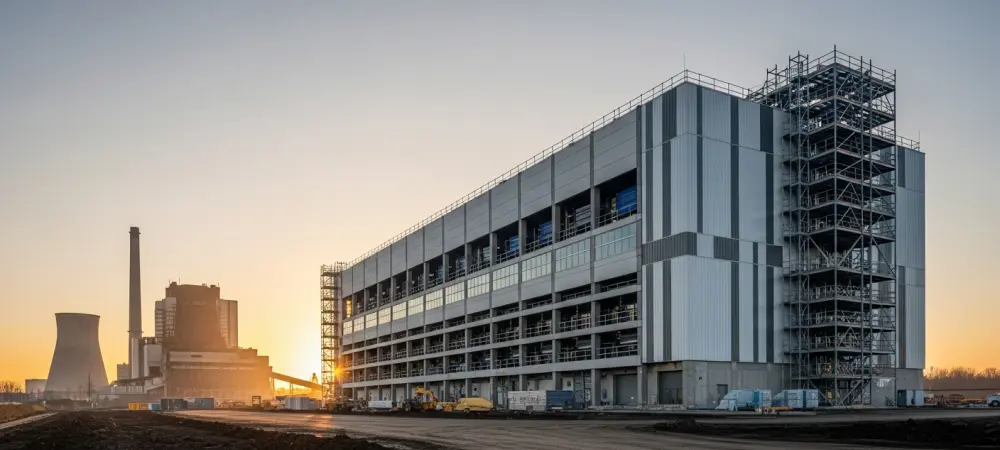
The silent smokestacks of America’s industrial past are increasingly finding new life humming with the digital pulse of the twenty-first century’s most demanding industry. In towns once defined by coal dust and steam, a new transformation is underway as the colossal infrastructure of the industrial age is being repurposed to power the information age. This shift poses a critical question: can the server farms of Big Tech truly replace the factories and power plants that once formed the economic bedrock of entire communities?
When the Smokestacks Go Silent
For countless towns across the industrial heartland, the closure of a major facility like a power plant is an economic earthquake. When the Bruce Mansfield Power Plant in Shippingport, Pennsylvania, ceased operations in 2019, it left a void in the local economy and a 660-acre brownfield site as a reminder of a bygone era. Such closures represent more than just lost jobs; they signal the end of a town’s established identity, creating uncertainty about the future and challenging community leaders to find a viable path toward reinvention.
The transition from an industrial to a post-industrial economy is a difficult journey. The physical remnants—sprawling complexes, robust infrastructure, and acres of underutilized land—can either be liabilities or become the foundation for a new chapter. The challenge lies in attracting investment that can leverage these existing assets while providing sustainable economic opportunities for a new generation.
A Tale of Two Tides: Industrial Decline Meets Digital Demand
America is navigating two powerful economic currents simultaneously. One is the continued decline of traditional heavy industries, particularly coal power, driven by economic and environmental pressures. This trend has left numerous communities grappling with economic dislocation. The other is the exponential growth of the digital economy, which has created an insatiable demand for data centers—the physical backbone of the internet, cloud computing, and artificial intelligence.
These massive facilities require vast amounts of land, power, and connectivity, needs that are increasingly difficult to meet in crowded urban centers. As a result, data center developers are looking beyond traditional tech hubs toward overlooked regions. This alignment of needs creates a unique opportunity where the legacy of the old economy can quite literally power the new, turning industrial relics into digital engines.
Project Phoenix: A Case Study in Post Industrial Rebirth
In Shippingport, this convergence is taking concrete form. Aligned Data Centers is spearheading a $10 billion development, aptly codenamed “Project Phoenix,” to construct a massive data center campus on the former site of the Bruce Mansfield plant. The project plans to erect two large data center buildings, representing a monumental investment in a community seeking a new economic anchor.
The initiative is a partnership with the Frontier Group of Companies, a firm specializing in breathing new life into industrial brownfields. This collaboration highlights a growing trend of redeveloping legacy industrial sites for modern technological purposes. With the Shippingport borough council having already approved a conditional use permit, the project signals a tangible step toward transforming the former coal plant site into a hub of digital infrastructure.
Why Old Power Plants Are Prime Real Estate for Big Tech
Former power plant sites offer a unique and highly attractive combination of features for data center developers. These locations were originally chosen for their robust infrastructure, including high-capacity electrical substations, access to major power grids, and often, established water sources for cooling systems. This existing framework dramatically reduces the time and cost associated with building a data center from scratch.
Moreover, these industrial sites are typically zoned for heavy use and are situated away from dense residential areas, mitigating potential conflicts over noise and land use. For a company like Aligned, securing a 660-acre property with pre-existing energy infrastructure is a strategic advantage. The site provides the space, power, and logistical access necessary to build and operate the kind of hyperscale data centers that modern technology demands.
A New Blueprint for Post Industrial Renewal
The Shippingport project represented more than a single development; it offered a potential blueprint for other post-industrial towns facing similar circumstances. By converting a symbol of past economic strength into an engine for future growth, communities demonstrated a way to bridge the gap between their industrial heritage and a digital future. The successful repurposing of brownfield sites for high-tech use provided a model for leveraging legacy assets to attract new, sustainable industries.
This strategy of adaptive reuse proved to be a powerful tool for economic revitalization. It showed that the path forward for former industrial towns did not require erasing their past but rather building upon it. The transformation of a coal plant into a data center became a compelling narrative of resilience, illustrating how strategic investment and forward-thinking planning could forge a new economic identity on the foundations of the old.