
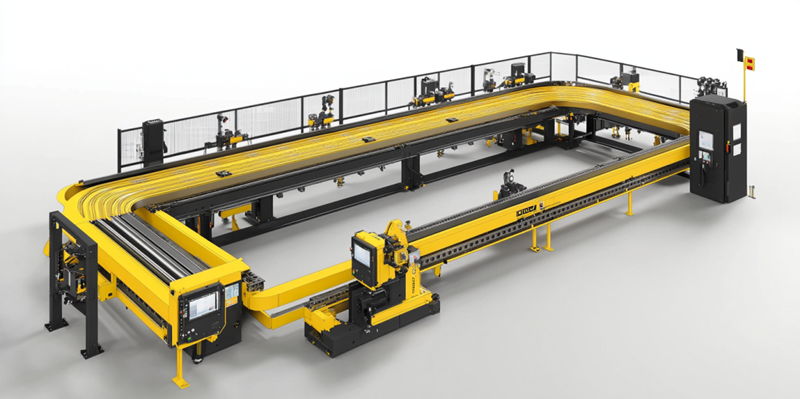
Bystronic Unveils ByCell Bend Star M Automated Bending System

The introduction of the ByCell Bend Star M by Bystronic marks a significant advancement in automated bending technology. Designed to operate seamlessly in various production environments, the ByCell Bend Star M is based on the ByBend Star 120 press brake. This compact, modular system bridges the gap between smaller mobile bending robots and larger, more complex bending cells, thus catering to a wide range of manufacturing needs. The system offers an efficient solution for both small and large companies, capable of handling everything from small batches to large series of parts without losing precision or efficiency.

With its footprint of 21.32 by 20.34 feet, the ByCell Bend Star M is a space-efficient addition to any production floor. Equipped with RF-AC tooling, it features automatic tool changes executed through the robot, enhancing its versatility. One of the standout features is the innovative vision system, which eliminates the need for referencing, thereby saving 10 to 15 seconds per part. This not only speeds up the production process but also reduces the potential for human error, ensuring a more streamlined operation. Furthermore, the press brake included in the system is capable of managing small to medium-sized parts with various sheet thicknesses and lengths up to 6.72 feet. Overall, the ByCell Bend Star M presents itself as an efficient, error-free automated solution for diverse bending applications in the manufacturing industry.

Explore more

Trend Analysis: AI in Real Estate

Navigating the real estate market has long been synonymous with staggering costs, opaque processes, and a reliance on commission-based intermediaries that can consume a significant portion of a property’s value. This traditional framework is now facing a profound disruption from artificial intelligence, a technological force empowering consumers with unprecedented levels of control, transparency, and financial savings. As the industry stands

Insurtech Digital Platforms – Review

The silent drain on an insurer’s profitability often goes unnoticed, buried within the complex and aging architecture of legacy systems that impede growth and alienate a digitally native customer base. Insurtech digital platforms represent a significant advancement in the insurance sector, offering a clear path away from these outdated constraints. This review will explore the evolution of this technology from

Trend Analysis: Insurance Operational Control

The relentless pursuit of market share that has defined the insurance landscape for years has finally met its reckoning, forcing the industry to confront a new reality where operational discipline is the true measure of strength. After a prolonged period of chasing aggressive, unrestrained growth, 2025 has marked a fundamental pivot. The market is now shifting away from a “growth-at-all-costs”

AI Grading Tools Offer Both Promise and Peril

The familiar scrawl of a teacher’s red pen, once the definitive symbol of academic feedback, is steadily being replaced by the silent, instantaneous judgment of an algorithm. From the red-inked margins of yesteryear to the instant feedback of today, the landscape of academic assessment is undergoing a seismic shift. As educators grapple with growing class sizes and the demand for

Legacy Digital Twin vs. Industry 4.0 Digital Twin: A Comparative Analysis

The promise of a perfect digital replica—a tool that could mirror every gear turn and temperature fluctuation of a physical asset—is no longer a distant vision but a bifurcated reality with two distinct evolutionary paths. On one side stands the legacy digital twin, a powerful but often isolated marvel of engineering simulation. On the other is its successor, the Industry