

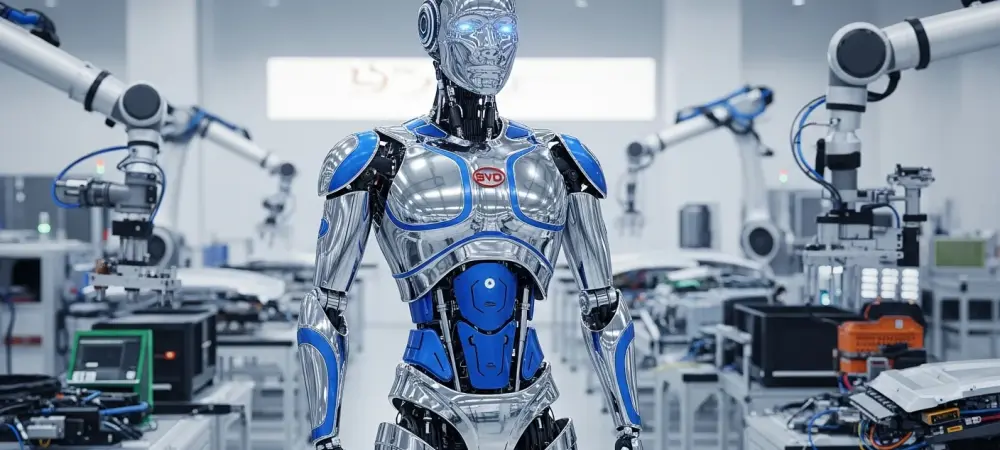
The rhythmic clatter of robotic limbs marching across the floors of massive manufacturing hubs signals a profound transformation where transport companies reinvent themselves as masters of physical labor. As automotive leaders pivot toward embodied artificial intelligence, the convergence of high-capacity battery technology and autonomous systems is redefining the boundaries of industrial and domestic labor. This review explores the evolution of BYD’s robotics technology, its key hardware and software features, and the strategic impact this transition has on the broader automation landscape. By analyzing the shift from electric vehicles to humanoid platforms, the review highlights how BYD leverages its existing infrastructure to gain a competitive edge. The purpose of this analysis is to provide a thorough understanding of BYD’s robotics strategy and its potential for future development as a provider of mass-market consumer robots.
The Convergence: Automotive Expertise and Embodied AI
The entry of BYD into the robotics sector represents a calculated transition from purely vehicular transport to a diversified ecosystem of automated intelligence. This shift is not merely a lateral move into a new market but a vertical evolution that utilizes the company’s dominance in electric vehicle production. The core principles of this strategy rely on the assumption that a humanoid robot is, in many ways, an upright electric vehicle with more complex actuators. By repurposing the software and hardware stacks developed for autonomous driving, the company creates a seamless bridge between mobile transport and stationary or mobile labor systems.
This strategy is particularly relevant within the current technological landscape, which is increasingly defined by global labor shortages and the rise of the embodied AI era. While traditional automation relies on fixed arms, the humanoid form factor offers the flexibility required to navigate environments designed for humans. This approach allows the company to address the demographic challenges of an aging workforce by providing a scalable, mechanical alternative that can operate within existing industrial frameworks without requiring a total redesign of factory floors.
Core Pillars: Hardware and Intelligence
Synergy Between EV Manufacturing and Robotics Hardware
The technical foundation of the robotic fleet rests on the company’s established expertise in battery density and sensor integration. Humanoid robots require high power-to-weight ratios to maintain balance and perform strenuous tasks, a challenge that is met by adapting the blade battery technology used in the automotive sector. This vertical integration allows for the production of durable frames capable of sustaining 10-hour industrial shifts. Furthermore, because the company manufactures its own motors and sensors, it significantly reduces the unit production costs that typically hinder the commercialization of sophisticated robotics.
Data-Driven AI and Internal Stress-Testing
Utilizing massive factory environments as high-fidelity laboratories provides a unique advantage in gathering datasets on human-robot collaboration. Unlike competitors who rely heavily on digital simulations, this firm deploys units directly onto the assembly line to encounter the unpredictability of a real-world workplace. This internal deployment facilitates faster iteration cycles for the AI “brains,” as the robots are exposed to a constant stream of tactile and visual data. These real-world scenarios refine the machine-learning models, allowing the robots to adapt to lighting changes, human movement, and mechanical variances with a level of precision that simulation alone cannot replicate.
Emerging Trends: The Humanoid Robotics Market
A significant trend in this sector is the transition from utilizing third-party models, such as the UBTech Walker S1, toward the development of proprietary, in-house humanoid designs. This move toward self-sufficiency allows for tighter integration between the robotic software and the mechanical hardware. It also mirrors the trend of infrastructure commoditization, where tools originally developed for internal industrial efficiency are refined for eventual retail applications. By perfecting the technology in a controlled factory setting, the firm prepares to enter the commercial market with a proven, reliable product.
The industry-wide shift is moving toward making humanoid robots an accessible commodity rather than a luxury niche. As manufacturing scales, the cost of these units is expected to plummet, following a trajectory similar to that of personal computers or smartphones. The goal is to strip away the “experimental” label from humanoid robotics and present them as a standard piece of equipment for any modern business. This democratization of high-end robotics is essential for capturing a market that has previously been limited by the high price of entry and the complexity of maintenance.
Real-World Applications: Industrial Implementation
The current deployment of approximately 200 humanoid units in Shenzhen and Changsha offers a glimpse into the future of automotive assembly. These robots are not merely experimental prototypes but active participants in the production process, performing visual inspections, pallet handling, and technical assembly tasks. Their ability to use power tools with human-like dexterity allows them to take over repetitive or ergonomically challenging roles, such as applying decals or securing small components in tight spaces. This high-precision work ensures consistent quality across thousands of vehicles, reducing the margin of error associated with human fatigue.
Beyond the assembly line, the strategy includes an upcoming expansion into retail environments. Humanoids are slated for deployment in dealerships to provide customer support and normalize their presence in the public eye. This phase is critical for brand normalization, as it allows consumers to interact with the technology in a low-stakes environment before it enters their homes. By serving as information kiosks or greeting staff, these robots help bridge the gap between industrial utility and consumer-facing service, preparing the market for the next stage of robotic adoption.
Strategic Hurdles: Barriers to Widespread Adoption
Moving robots from the controlled environment of a factory to the unpredictable nature of a domestic household presents significant technical hurdles. Homes are filled with varied layouts, sensitive objects, and unpredictable pets or children, necessitating a higher level of spatial awareness and safety protocols. Furthermore, the firm faces intense competition from programs like Tesla’s Optimus, which benefits from its own massive AI training infrastructure. Driving down unit costs to a level that the average consumer can afford remains a primary obstacle, as the initial investment for such complex machinery is still substantial.
There are also regulatory and social implications to consider as automated labor replaces a significant portion of the manual workforce. The transition must be managed carefully to avoid widespread social pushback or stringent government oversight that could stifle innovation. Balancing the efficiency of robotic labor with the economic stability of the human workforce is a delicate task. Additionally, ensuring the privacy and security of data collected by robots within private residences is a concern that must be addressed through robust encryption and transparent data policies.
Future Outlook: The Vision of Three Robots per Household
The long-term vision involves a phased rollout that moves from industrial efficiency to a consumer-facing “domestic helper” model. This projection suggests a future where households may eventually employ multiple robots for different functions, ranging from maintenance to social companionship. Breakthroughs in social AI will be necessary to enable robots to handle complex chores like cooking or cleaning, which require a high degree of adaptability and fine motor skills. As these capabilities mature, the robot will transition from a tool to a common household appliance, fundamentally changing the domestic landscape. The potential impact on global labor markets is profound, as the firm aims to become a lifestyle brand that manages the AI-driven labor of the future. By providing the hardware that performs daily chores, the company frees up human time for more creative or leisure-oriented pursuits. This shift could lead to a new economic structure where physical labor is largely handled by autonomous systems, leaving humans to manage the oversight and high-level decision-making processes. The success of this vision depends on the company’s ability to maintain its lead in manufacturing while continuously innovating in the realm of embodied AI.
Conclusion and Final Assessment
The review of the strategy revealed a logical and aggressive transition from automotive dominance to robotic leadership. It was observed that the firm successfully utilized its manufacturing prowess to bypass many of the common pitfalls associated with the robotics race, such as high production costs and limited testing environments. The analysis demonstrated that the vertical integration of battery and sensor technology provided a substantial advantage over competitors who relied on third-party components. By using its own factories as a proving ground, the company established a robust data pipeline that accelerated the development of its AI systems.
The findings suggested that the company’s progress was not merely an expansion of its product line but a fundamental reimagining of its role in the global economy. The shift from EVs to robots appeared as a natural progression of the company’s core mission to provide intelligent, electric-powered solutions for modern life. Ultimately, the strategy positioned the firm to lead the future of both industrial production and consumer lifestyle. The move toward a robot-centric household model reflected a bold bet on the continued advancement of embodied AI and its eventual integration into the daily lives of consumers worldwide.