

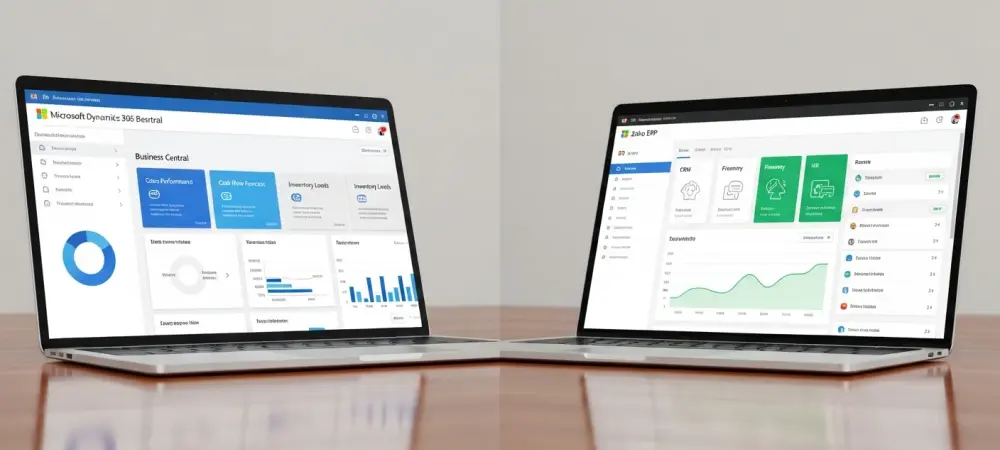
The decision to migrate a growing business to a full-scale Enterprise Resource Planning (ERP) system often marks the definitive boundary between a scrappy startup and a mature, data-driven organization. For many small-to-mid-sized businesses (SMBs), this transition involves a high-stakes choice between two vastly different technological architectures: the unified, enterprise-grade framework of Microsoft Dynamics 365 Business Central and the modular, app-centric ecosystem of Zoho One. As digital transformation moves from a luxury to a survival requirement, understanding whether to invest in a “single source of truth” or a flexible “toolkit” is critical for long-term operational viability.
This review examines how these platforms have evolved to meet the demands of a landscape where basic accounting is no longer sufficient. Modern organizations now require deep integration between sales, finance, and supply chain logistics, all while leveraging real-time data to navigate global market volatility. While both systems aim to solve the problem of business fragmentation, they do so by addressing different fundamental needs, ranging from entry-level accessibility to high-end scalability.
The Evolution of SMB Business Management Systems
The trajectory of business management software has shifted dramatically from isolated desktop applications to interconnected cloud ecosystems. In previous years, a business might have used one program for billing and another for managing inventory, often necessitating manual data entry to keep both in sync. Today, the focus has moved toward seamless data flow, where a single customer interaction triggers updates across every department simultaneously. This evolution reflects a broader technological shift toward total connectivity, ensuring that management has a bird’s-eye view of the entire enterprise at any given moment.
In the current landscape, the rise of integrated cloud platforms has redefined the role of the ERP. It is no longer just a digital ledger; it is the central nervous system of a company. As businesses expand beyond local borders, the need for systems that handle multi-currency transactions, complex tax compliance, and automated workflows has become paramount. This context sets the stage for the rivalry between Business Central and Zoho, as both attempt to capture a market that demands more power and less manual intervention than ever before.
Architectural Philosophies and Core Components
Unified Enterprise Infrastructure: Microsoft Dynamics 365 Business Central
Microsoft Dynamics 365 Business Central is built upon the philosophy of a “single source of truth.” Unlike systems that patch together different modules, Business Central utilizes a unified database architecture where every functional area—from manufacturing to human resources—resides within the same technical core. This design eliminates the risk of data latency, meaning a sales order placed in the field instantly adjusts inventory levels and updates financial forecasts without the need for periodic “syncs” or external connectors.
The primary strength of this platform lies in its native synergy with the broader Microsoft 365 suite. For teams already reliant on Outlook, Excel, and Teams, Business Central feels like a natural extension of their existing workspace. Users can generate quotes directly from an email inbox or export complex data sets to Excel for advanced manipulation, with changes flowing back into the ERP. This level of integration transforms the software from a mere tool into a centralized powerhouse, capable of supporting deep, cross-departmental workflows that would otherwise require manual oversight.
Modular App-Centric Ecosystem: Zoho One (Zoho ERP)
In contrast, the Zoho ERP model, primarily delivered through the Zoho One suite, adopts a modular, “best-of-breed” approach. Rather than one massive application, Zoho provides a collection of specialized tools—such as Zoho Books, Zoho CRM, and Zoho Inventory—that are designed to be interconnected. This modularity offers exceptional flexibility, allowing a startup to begin with only what they need and gradually add more functionality as their requirements become more complex. It is a toolkit approach that prioritizes entry-level accessibility and user-friendly interfaces.
However, this technical characteristic comes with inherent trade-offs. While the apps are designed to work together, they remain separate entities that communicate through internal connectors. For a growing business, this can occasionally lead to a “fragmented” feeling where users must navigate between different interfaces to complete a single business process. While Zoho is incredibly effective for businesses that value agility and a low barrier to entry, its architectural model requires more diligent management to ensure that data remains consistent across the various modules in the suite.
Emerging Trends in ERP Intelligence and Automation
The integration of generative AI has fundamentally altered the competitive landscape of business software. Microsoft Copilot within Business Central has moved beyond basic automation, now offering predictive insights that can suggest inventory restocks before a shortage occurs or draft personalized customer communications based on transaction history. This trend toward “proactive” software means that the ERP is no longer just a passive record-keeper but an active participant in business strategy, helping managers identify patterns that would be invisible to the naked eye.
Zoho has responded with its own AI assistant, Zia, which focuses heavily on optimizing sales performance and identifying anomalies in financial data. Meanwhile, the shift toward low-code workflow orchestration is empowering non-technical users to build complex automations. Whether through Microsoft’s Power Automate or Zoho Flow, the goal is to reduce the “manual tax” on employees. The future of this technology lies in the total convergence of productivity tools and business data, where the software anticipates user needs and automates repetitive tasks with minimal human intervention.
Real-World Applications Across Diverse Sectors
In the wholesale distribution and manufacturing sectors, Business Central proves its worth by managing high-volume transactions and complex production schedules. For instance, a multi-national trade company can use the platform to handle intercompany postings and various international tax jurisdictions within a single environment. The deep functionality in warehouse management—including bin tracking and automated picking routes—makes it a preferred choice for organizations where logistics precision is the primary driver of profitability.
Conversely, the Zoho ecosystem is often the go-to solution for rapid startup deployment and service-oriented businesses. An e-commerce startup might find Zoho’s tight integration with social media and marketing tools more valuable than the heavy-duty manufacturing modules of a larger ERP. Because Zoho is easier to configure without professional assistance, it allows smaller teams to digitize their operations in a fraction of the time. This makes it ideal for businesses that prioritize a quick time-to-market and simplified user adoption over deep, specialized industrial functionality.
Technical Hurdles and Implementation Challenges
Despite their capabilities, both systems present specific challenges that organizations must navigate. For Zoho, the primary risk involves the creation of “data silos” within its modular structure. If the connectors between apps are not configured perfectly, discrepancies can arise between sales records and financial reports. Additionally, as a company scales, the simplicity of Zoho may become a limitation, forcing the business to look for third-party add-ons to handle advanced needs like complex audit trails or sophisticated production planning.
Business Central faces the opposite challenge: high initial complexity and a heavy dependency on certified partners. Setting up the system correctly requires a “white-glove” implementation model to ensure that the software aligns with unique business processes. This partner-led approach, while beneficial for long-term ROI, results in a higher upfront cost and a steeper learning curve for the staff. While Microsoft continues to work on “simplified” onboarding experiences, the reality remains that a system this powerful requires professional expertise to unlock its full potential.
The Future of Scalable Business Infrastructure
The trajectory of ERP technology is moving toward a total erasure of the boundaries between business data and daily work. Future developments will likely focus on deeper AI-driven forecasting that can model “what-if” scenarios with pinpoint accuracy. For an organization, the choice between a “forever system” like Business Central and a “starter kit” like Zoho will determine their long-term ability to scale. While a modular system offers immediate relief, a unified platform provides the structural integrity needed to support global expansion and complex regulatory requirements.
As AI becomes more embedded in the core architecture of these systems, the value of data clean-up and governance will skyrocket. The systems that can most effectively turn raw data into actionable intelligence will define the winners in the SMB sector. We are moving toward a world where the ERP is not just a place to store information, but a strategic asset that provides a continuous competitive advantage. Organizations that view their infrastructure as a long-term investment rather than a one-time expense will be best positioned to capitalize on these technological advancements.
Summary of the Comparative Review
The comparison between Microsoft Dynamics 365 Business Central and Zoho ERP revealed a clear divide between two distinct operational philosophies. Zoho offered a cost-effective, modular entry point that appealed to micro-businesses and startups prioritizing flexibility and ease of use. Its toolkit approach allowed for rapid deployment, though it carried the risk of fragmented data as the organization grew. In contrast, Business Central stood out as a robust, centralized engine designed for scaling firms that required deep integration, enterprise-grade financial controls, and a direct link to the Microsoft productivity ecosystem.
Ultimately, the analysis demonstrated that while both platforms provided significant value, their impact depended on the strategic goals of the organization. Business Central functioned as a comprehensive infrastructure investment that eliminated the need for future software migrations, whereas Zoho served as an accessible starting point for those with simpler requirements. The review concluded that the current state of ERP technology is one of high intelligence and increasing automation, favoring platforms that can unify data and provide a consistent, AI-enhanced experience across all business functions. The competitive landscape for SMBs was shown to be increasingly dependent on these digital foundations to drive efficiency and informed decision-making.