

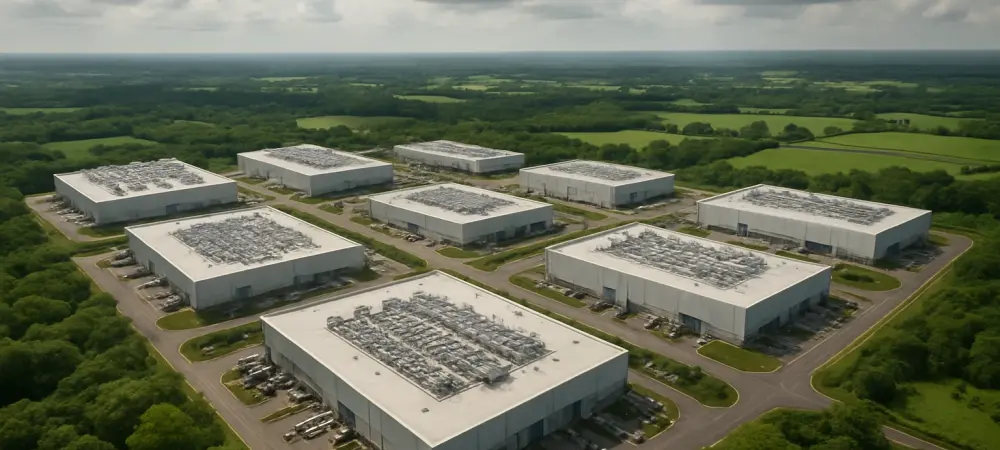
Setting the Stage for a Cloud Computing Giant
Imagine a digital backbone so vast that it underpins everything from streaming services to critical business operations across the globe, yet its sheer scale remains hidden from plain sight until now. Amazon Web Services (AWS), the titan of cloud computing, operates a staggering 914 data centers in over 50 countries, a number revealed through leaked data from a couple of years ago that far surpasses earlier estimates of 100 to 475 facilities. This revelation paints a vivid picture of an industry leader driving unparalleled growth while grappling with the pressing challenge of environmental sustainability. In 2025, as the demand for cloud services continues to surge, understanding AWS’s market dominance and the ecological implications of its infrastructure is more critical than ever.
This market analysis dives deep into AWS’s expansive network, dissecting the trends that fuel its growth and the sustainability concerns that cast a shadow over its achievements. It explores how the company’s footprint shapes the cloud computing landscape, evaluates the environmental costs tied to its energy-intensive operations, and projects future trajectories amid evolving technologies and regulatory pressures. By blending hard data with industry insights, this piece aims to equip stakeholders with a clear view of where AWS stands and what lies ahead in balancing scale with responsibility.
Unpacking AWS’s Market Dominance and Data Center Scale
To appreciate AWS’s position in the cloud computing market, it’s vital to recognize the evolution of its infrastructure since its inception in 2006. What began as a novel idea of on-demand computing resources has transformed into a sprawling network of 38 cloud regions, 120 availability zones, over 700 CloudFront Points of Presence, and 43 local zones. The recent disclosure of 914 data centers, a number likely higher today given ongoing expansions, highlights a scale that outstrips competitors and redefines industry benchmarks. This growth reflects a deliberate strategy of both building proprietary facilities and leasing space from approximately 180 partners, a hybrid model that has enabled rapid scaling but obscured true facility counts in public records.
The discrepancy in data center estimates—such as online databases listing just four AWS facilities in Germany while leaked data suggests around 50—underscores the complexity of tracking such a vast operation. This opacity affects market analysis, as accurate data is crucial for assessing competitive positioning and resource allocation. Moreover, AWS’s dominance isn’t just about numbers; it signals a deeper trend where cloud infrastructure becomes integral to global economic activity, powering sectors from e-commerce to artificial intelligence (AI). Understanding this context lays the groundwork for evaluating the sustainability challenges tied to such an extensive presence.
Deep Dive into Market Trends and Environmental Impacts
Energy Consumption: A Growing Market Concern
One of the most significant issues in the cloud computing market is the colossal energy appetite of data center networks like AWS’s. Reports indicate that colocation facilities used by AWS consumed over 7.8 million megawatt hours of electricity a few years back, accounting for roughly a fifth of its total power usage. This immense demand strains energy grids, particularly in regions reliant on fossil fuels such as natural gas, a dominant source in many parts of the United States. The market implication is clear: as data center proliferation continues, utility providers are compelled to expand capacity, often through non-renewable sources, which contradicts broader sustainability goals.
This energy challenge also shapes competitive dynamics within the industry. Companies that fail to address power usage risk reputational damage and potential regulatory pushback, while those innovating in efficiency could gain a market edge. The pressure to meet rising demand, especially with AI-driven workloads, means that short-term reliance on traditional energy sources may persist, creating a tension between operational needs and long-term environmental commitments. This trend warrants close monitoring as it could redefine market leadership in the coming years.
Sustainability Claims: Market Perception vs. Reality
AWS positions itself as a sustainability frontrunner, claiming to be the largest corporate buyer of renewable energy for several consecutive years with over 600 projects worldwide. The company also asserts that it achieved 100% renewable energy usage for its operations by mid-2024, well ahead of its 2030 target. From a market perspective, this narrative strengthens AWS’s brand, appealing to eco-conscious clients and investors while setting a benchmark for competitors. Such initiatives reflect a growing industry trend where sustainability is not just a moral imperative but a strategic differentiator.
However, skepticism persists within the market regarding the real impact of these claims. Critics argue that many AWS data centers operate in areas dependent on coal and other non-renewable sources, raising doubts about whether renewable energy credits truly offset on-the-ground emissions. This disconnect affects customer trust and could influence procurement decisions, especially for businesses prioritizing genuine carbon neutrality. As transparency becomes a valued commodity, how AWS addresses these criticisms will likely impact its market share and partnerships over the next few years.
Regional Variations: A Fragmented Market Impact
The environmental footprint of AWS’s operations varies significantly across global markets, adding another layer of complexity to industry analysis. In regions with access to hydropower or wind energy, data centers can operate with a lower carbon impact, enhancing AWS’s sustainability credentials in those areas. Conversely, in markets with outdated grids reliant on fossil fuels, the ecological toll is far greater, posing reputational risks and potential cost increases due to future carbon taxes or regulations. This geographic disparity highlights a broader market challenge: uniform sustainability standards are hard to achieve in a fragmented energy landscape.
Additionally, indirect impacts often go unaccounted for in market assessments. The construction of new power plants to support data center clusters, for instance, can offset renewable gains, a factor rarely highlighted in corporate reports. Addressing this requires a nuanced understanding of local energy policies and infrastructure, which could shape AWS’s expansion strategies. Dispelling the misconception that renewable adoption equals zero emissions is critical for accurate market forecasting, as timing and location of energy use are just as pivotal as the source itself.
Future Projections: Growth, Tech, and Regulation
Looking toward the horizon, the cloud computing market is set for exponential growth, with AWS at the forefront of this expansion. Driven by technologies like AI, which demand unprecedented computing power, data center capacity needs are projected to soar. Major investments—such as $15 billion in Northern India, $50 billion for US government regions, and $3 billion for a Mississippi campus—signal AWS’s intent to maintain dominance. However, this trajectory also amplifies energy demands, potentially locking in fossil fuel reliance in the near term unless offset by rapid innovation.
Technological advancements offer a glimmer of hope for market evolution. Energy-efficient cooling systems and modular data center designs could curb consumption, while hybrid energy models blending renewables with grid power might become standard. Regulatory pressures are another wildcard, with stricter global carbon emission policies likely to push companies toward cleaner practices. Analysts predict that between 2025 and 2027, the interplay of tech innovation and policy shifts will redefine competitive advantages, with AWS’s adaptability being a key factor in sustaining its market lead.
Reflecting on AWS’s Market Position
Looking back, the analysis of AWS’s sprawling network of over 900 data centers underscored a dual narrative of unparalleled market dominance and persistent sustainability challenges. The scale of its infrastructure, far exceeding earlier estimates, highlighted its pivotal role in shaping the cloud computing industry. Yet, the energy consumption tied to these operations, coupled with regional disparities in energy sourcing, revealed significant environmental hurdles that tempered its sustainability claims. The implications of these findings urged stakeholders to prioritize transparency in energy usage and to advocate for localized renewable integration. Businesses depending on cloud services were encouraged to scrutinize the carbon footprint of their providers, while industry players needed to push for innovations in efficiency. As a next step, forging partnerships with energy providers for cleaner grids and investing in cutting-edge technologies emerged as viable strategies to align growth with ecological responsibility, ensuring that the digital economy’s expansion did not come at an unsustainable cost.