

More Than a Machine: Redefining the Role of Digital Infrastructure
Data’s voracious appetite for energy has long positioned the digital infrastructure powering it as monolithic facilities, detached from the communities they inhabit. However, a new paradigm is emerging, one where data centers are not just consumers of resources but active contributors to a sustainable, circular economy. atNorth’s award-winning ICE03 facility in Akureyri, Iceland, stands as a powerful testament to this transformation. This article explores how the ICE03 data center, recently honored with a Data Center Dynamics award for Environmental Impact, masterfully combines cutting-edge environmental design with deep community integration, creating a blueprint for the future of digital infrastructure that is both commercially viable and socially responsible.
The Icelandic Advantage: A Foundation Built on Sustainability
The rise of high-performance computing (HPC) and artificial intelligence has created an insatiable demand for processing power, placing immense strain on global energy grids and raising urgent environmental concerns. For decades, the industry has grappled with the challenge of improving efficiency, a battle often quantified by the Power Usage Effectiveness (PUE) metric. With a global average PUE hovering around 1.56, it is clear that for every watt of power used for computing, a significant portion is lost to cooling and other overhead. This context makes the strategic location and design of facilities like ICE03 critically important, shifting the focus from mitigating environmental harm to creating positive environmental and social impact. Iceland, with its unique geothermal and hydroelectric resources, offers a natural solution, providing a foundation of 100% renewable energy that fundamentally changes the data center cost and sustainability equation.
A Holistic Approach to Sustainable Operations
A Blueprint for Environmental Excellence
The environmental credentials of the ICE03 facility are rooted in a design philosophy that harmonizes with its natural surroundings. Leveraging Iceland’s cool climate for natural cooling is just the beginning. The facility incorporates an advanced Direct Liquid Cooling system, enabling it to support the most demanding, high-density workloads with exceptional efficiency. This commitment extends to its physical construction, which utilizes laminated Glulam wood in place of steel beams and local rockwool for insulation, minimizing the building’s embodied carbon. The result is a remarkable PUE of less than 1.2—a figure that positions ICE03 at the forefront of global efficiency. This allows atNorth to support resource-intensive AI training and complex simulations at a lower cost and with a fraction of the carbon footprint of centers reliant on fossil fuels.
Weaving the Data Center into the Community Fabric
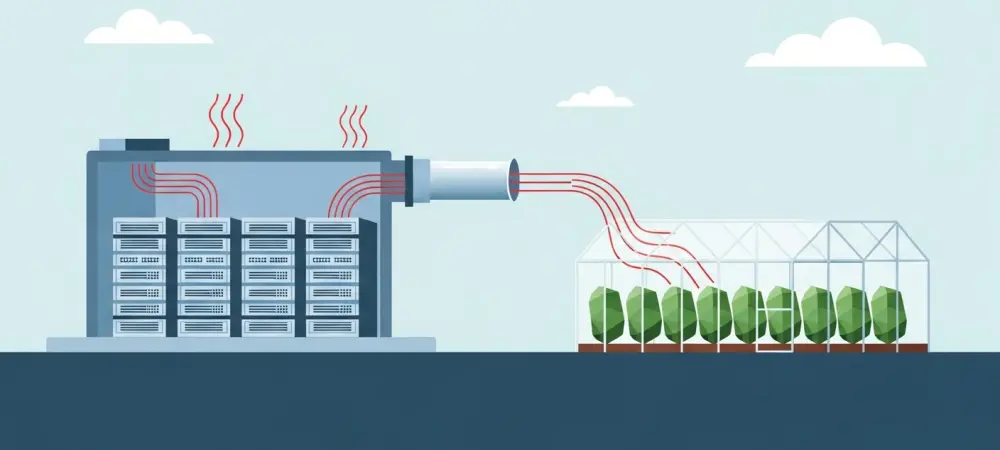
Perhaps the most innovative aspect of ICE03 is its role as a cornerstone of a local circular economy. The facility’s heat reuse system is a prime example of this synergy. Instead of venting waste heat into the atmosphere, atNorth captures it and directs it to the local municipality of Akureyri. This captured thermal energy is used to warm a community greenhouse, creating a mutually beneficial partnership that not only lowers the data center’s operational footprint but also supports sustainable, year-round local food production. The greenhouse has also become an educational resource, hosting school groups to teach them about ecology and sustainable practices, fully integrating the data center into the community’s social and educational fabric.
Beyond Green-Washing: Tangible Economic and Social Impact
atNorth’s commitment to Akureyri extends far beyond environmental initiatives into meaningful economic and social investment. With an estimated regional investment of around 109 million EUR, the company made a concerted effort to prioritize local talent for both the construction and ongoing operation of the facility. This commitment to community partnership is further demonstrated through active engagement, including sponsoring local sports teams and supporting the region’s volunteer search and rescue team. Recognizing the need to build a sustainable local talent pipeline, atNorth also donated state-of-the-art mechatronics equipment to a nearby vocational college, empowering the next generation with the skills needed for high-tech jobs and ensuring the data center’s positive impact endures for years to come.
The Future is Integrated: Why Responsible Colocation is a Business Imperative
The ICE03 project signals a critical shift in the data center industry: choosing an environmentally and socially responsible provider is no longer a niche preference but a core business imperative. For atNorth’s clients, this model offers tangible advantages that go straight to the bottom line and bolster corporate reputation. Partnering with a facility powered by clean energy helps them decarbonize their IT workloads and drastically simplifies ESG reporting, as colocation services fall under Scope 3 emissions. Access to transparent metrics on low-carbon energy use satisfies growing scrutiny from investors and customers alike. Furthermore, recent enhancements to Iceland’s technological infrastructure, including a new point of presence (POP) and advanced submarine fiber cables, have established low-latency connectivity to Europe, erasing previous barriers and positioning the Nordics as a premier destination for enterprise cloud and HPC portfolios.
Actionable Insights from the Akureyri Model
The success of the ICE03 data center offers a clear set of takeaways for the industry. First, achieving elite environmental performance requires a holistic approach that integrates renewable energy sources, efficient cooling technology, and sustainable building materials. Second, the most impactful sustainability initiatives are those that create a circular economy, turning waste streams like heat into valuable community assets. Finally, genuine, long-term community integration—through local hiring, investment, and educational partnerships—builds the social license necessary for sustainable growth. For businesses evaluating colocation partners, the recommendation is to look beyond PUE and assess a provider’s commitment to these deeper principles. For data center operators, the Akureyri model provides a proven strategy for creating facilities that are not only profitable but are also valued community partners.
Conclusion: Powering Progress, Together
atNorth’s ICE03 data center is far more than a collection of servers and cooling systems; it is a living example of how digital infrastructure can be a force for positive change. By flawlessly integrating environmental stewardship, circular economic principles, and deep community partnership, it has set a new global standard. As the world’s reliance on data continues to accelerate, the pressure to build and operate these critical facilities responsibly will only intensify. The ICE03 project proves that the goals of technological advancement and community well-being are not mutually exclusive but can be powerfully synergistic, offering a hopeful and actionable vision for a more sustainable digital future.