

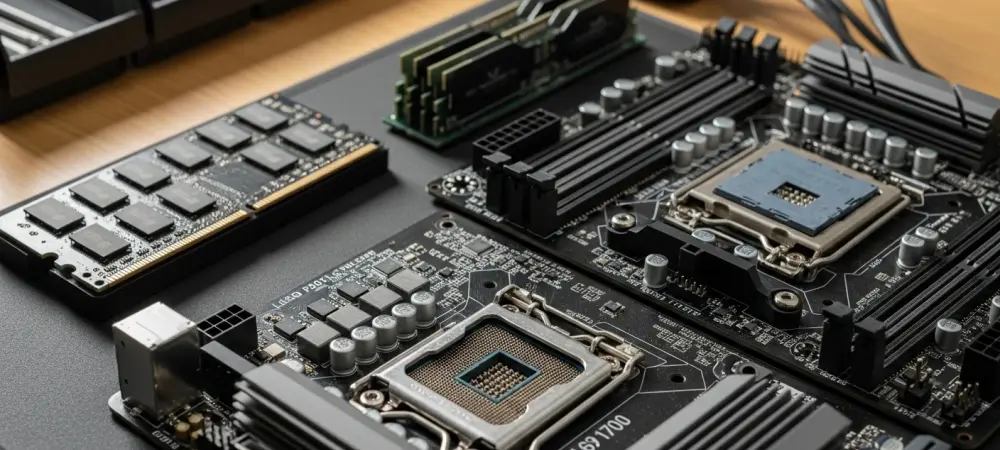
The landscape of custom PC building has undergone a significant transformation as enthusiasts increasingly prioritize sustainable value over the pursuit of flagship-level benchmarks that often come with diminishing returns. During the recent Spring Sale on Newegg, the ASUS B760M-AYW WIFI D4 II emerged as a dominant force, clinching the top spot among Intel-based motherboards by offering a robust feature set for a remarkably accessible price of $99.99. This shift highlights a growing segment of the market that demands modern connectivity and reliable power delivery without the unnecessary overhead associated with premium aesthetic branding or experimental features. By focusing on the core requirements of a mid-to-entry-level gaming rig, ASUS has successfully tapped into a pragmatic consumer mindset that seeks to maximize every dollar spent on internal hardware. This motherboard represents more than just a budget choice; it serves as a testament to the fact that high-quality user experiences are no longer gated behind high prices in the current hardware climate.
Strategic Foundation for Versatile System Architecture
Leveraging the Longevity of the LGA 1700 Socket
One of the primary drivers behind the sustained popularity of this motherboard is its foundational reliance on the LGA 1700 socket, which continues to provide a versatile platform for builders across various performance tiers. By maintaining compatibility with three generations of Intel processors—specifically the 12th-gen Alder Lake, 13th-gen Raptor Lake, and 14th-gen Raptor Lake Refresh—the board offers a level of flexibility that is rare in the hardware market. This multi-generational support allows a budget-conscious user to start with a highly efficient chip like the Core i3-12100, while retaining the option to upgrade to a more powerful Core i5 or i7 later. Such a trajectory ensures that the system remains relevant without requiring a complete overhaul of the core components. The mature nature of the LGA 1700 platform means that BIOS updates are stable and widely available, significantly reducing potential troubleshooting hurdles for the average user during the assembly process and ensuring long-term operational stability.
The Strategic Selection of Memory Standards
The deliberate decision to utilize DDR4 memory rather than the more expensive DDR5 standard remains a critical component of the value proposition offered by the B760M-AYW. While DDR5 has made strides in bandwidth, the actual performance gains in common gaming scenarios often do not justify the higher cost of modules and compatible boards for most users. By sticking with DDR4, ASUS enables builders to allocate more of their budget toward critical components like the graphics card or storage, where the impact on the user experience is more pronounced. The board features two DIMM slots that support up to 64GB of RAM, providing ample headroom for modern applications and intensive multitasking. This approach does not sacrifice usability but instead embraces a balanced architecture that prioritizes real-world responsiveness over theoretical speed caps that are rarely reached by the average consumer, ensuring the system remains efficient and cost-effective throughout its entire operational lifespan starting from 2026.
Modern Technical Standards for Enhanced Connectivity
High-Speed Networking and Peripheral Integration
Despite its classification as a budget-friendly microATX board, this model does not compromise on essential connectivity features that have become standard expectations for modern computing. The inclusion of integrated Wi-Fi 6 and Bluetooth 5.3 provides a seamless wireless experience, ensuring that users can maintain high-speed internet connections and pair peripherals without the need for additional expansion cards. For those who prefer a wired connection for competitive gaming, the 2.5Gb Ethernet port offers a substantial upgrade over older 1Gb standards, providing the stability and low latency required for intensive online interactions. This level of networking sophistication is often omitted from entry-level hardware, yet its presence here highlights a commitment to providing a complete out-of-the-box solution. Consequently, builders can enjoy a clean setup with fewer external dongles, maintaining the sleek profile of a compact build while enjoying enthusiast-level networking speeds for gaming and content consumption.
Future-Proofing Through Advanced Interface Specifications
A standout technical specification that distinguishes this motherboard from its peers is the inclusion of a PCIe 5.0 x16 slot, which prepares the system for the next wave of high-performance graphics hardware. Although current mid-range GPUs typically maximize their potential on PCIe 4.0 interfaces, the availability of the 5.0 standard ensures that the motherboard will not become a performance bottleneck when upgrading to future hardware. In addition to expansion slot longevity, the board features dual M.2 slots for NVMe SSDs, facilitating rapid data access and fast boot times that are essential for maintaining a fluid operating system environment. The physical design also incorporates ASUS Aura Sync and aRGB headers, allowing users to customize their system’s lighting without paying a premium for pre-installed LEDs. This modular approach to aesthetics allows for a professional appearance or a vibrant gaming look, depending entirely on the user’s preference and additional investment in custom components.
The Evolving Dynamics of Consumer Preference
Market Trends Toward Pragmatic Hardware
The remarkable sales performance of this motherboard signals a broader industry trend where the “essentialist” philosophy of PC building is gaining significant traction among mainstream consumers. Rather than overspending on motherboard features that remain largely unused—such as extreme overclocking or excessive power phases—builders are gravitating toward components that provide exactly what is necessary for a high-quality experience. This pragmatic shift is largely driven by the stabilization of the LGA 1700 ecosystem, which remains a cost-effective entry point for modern gaming even as newer, more expensive platforms enter the market. It proves that the mid-range segment has matured to a point where efficiency and reliability are the primary metrics of success, overshadowing flashy marketing and enthusiast-grade branding.
Actionable Insights for Future Upgrade Paths
As the market transitioned toward more specialized hardware configurations, the success of the B760M-AYW demonstrated that a well-balanced foundation was the most critical factor for a budget build. Builders who chose this platform secured a versatile environment that supported a wide array of existing Intel processors, ensuring that initial investments remained protected against rapid obsolescence. Moving forward, the focus for anyone utilizing this board should be on maximizing the potential of the PCIe 5.0 slot as new GPU architectures arrive, while taking advantage of the dual M.2 slots to expand high-speed storage. The strategic use of DDR4 memory allowed for immediate cost savings, which were better spent on peripheral upgrades or higher-tier graphics cards. Ultimately, the priority shifted from chasing expensive standards to building a system that delivered consistent performance. This approach ensured that the hardware remained productive for the long term, regardless of emerging enthusiast-level trends.