

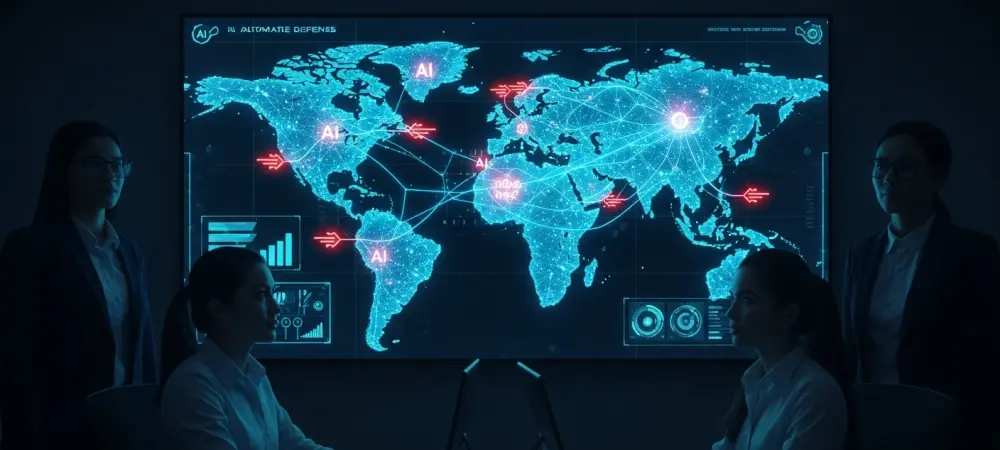
The silent, relentless hum of servers around the globe masks a precarious reality where the digital locks we trust to protect our most vital secrets are steadily becoming obsolete against threats that have already arrived. We are navigating a profound technological revolution, a period where the convergence of artificial intelligence, quantum computing, and an expanding space-based infrastructure is not a distant future but a present-day reality. This collision of forces is fundamentally reshaping the landscape of global security, forcing a complete reevaluation of how corporations, governments, and global institutions manage risk, safeguard national interests, and maintain their competitive edge in an increasingly volatile world.
This is not a matter of simply updating software or buying the next security product; the challenge is a critical disconnect between the blistering pace of technological change and the slow, deliberate evolution of our institutional readiness. Cybersecurity, often an afterthought in the original architecture of the internet, now confronts adversaries that operate at machine speed. The result is an overarching trend of escalating risk, where both the magnitude and velocity of cyber threats are growing exponentially, fueled by the democratization of sophisticated attack tools through AI and the existential threat quantum computing poses to modern encryption.
When Innovation Outpaces Oversight
A widening chasm has opened between the speed of technological progress and the ability of organizations and regulatory bodies to keep pace. While innovators push the boundaries of what is possible, the frameworks that govern these technologies and the skills needed to manage them lag dangerously behind. This gap creates fertile ground for exploitation, where new vulnerabilities emerge faster than they can be addressed. The slow evolution of policy and workforce training means that many institutions are fighting a modern war with outdated tactics and an unprepared army.
This disparity leads directly to a new risk equation where threats are not only more severe but also manifest with unprecedented speed. AI, for instance, allows a single actor to launch an attack with a level of sophistication once reserved for state-level agencies. Simultaneously, the looming threat of quantum computing devalues our current security investments daily. This combination of increasing threat velocity and magnitude puts immense pressure on leadership to move beyond reactive security measures and adopt a proactive, strategic posture that anticipates the threats of tomorrow.
The Quantum Paradox of Creation and Destruction
The rise of quantum computing presents a monumental paradigm shift, carrying both the power to create and the potential to destroy foundational aspects of our digital society. The concept of “Q-Day”—the moment a quantum computer can shatter today’s standard encryption—looms on the horizon. When that day comes, everything from government communications to financial transactions secured by current cryptographic methods could be laid bare. The threat is not just a future problem; it is an active, ongoing risk. This immediate danger is encapsulated in “harvest now, decrypt later” strategies, where sophisticated adversaries, including nation-states, are already siphoning and storing vast quantities of encrypted data. They are betting on the future, collecting today’s secrets with the full intention of unlocking them once their quantum keys are forged. This long-term geopolitical gambit has profound implications for national security, intellectual property, and economic sovereignty. However, the quantum story is not solely one of peril. The same principles that threaten to break encryption also promise a new era of security. Quantum-enhanced sensors could revolutionize navigation and logistics, while quantum communication networks offer the potential for a truly unbreakable information exchange, creating a new frontier of opportunity for those prepared to embrace it.
AI: The Double-Edged Sword in Cyber Warfare
Artificial intelligence stands as the most potent dual-use technology of our time, serving as a powerful force multiplier for both cyber adversaries and defenders. The rapid integration of AI into business operations has inherently increased data exposure, demanding more intelligent and adaptive security controls. On the offensive front, malicious actors are leveraging AI to automate and scale their attacks with terrifying efficiency, creating hyper-realistic deepfakes for disinformation, launching personalized phishing campaigns at scale, and identifying system weaknesses faster than any human team could.
In contrast, defenders are harnessing AI to fortify their digital fortresses. Intelligent systems are becoming indispensable for enhancing threat prediction by analyzing massive datasets to uncover attack patterns before they materialize. They automate the critical but often tedious process of software patching and streamline incident response, enabling security teams to contain breaches more effectively. Yet, the ultimate factor determining resilience in this new era is not the technology itself but the human governance overseeing it. As organizations adopt agentic AI—autonomous systems capable of independent action—the need for robust oversight and a clear strategy becomes paramount. AI must remain a tool to augment human judgment, not a replacement for it, to prevent catastrophic and unintended outcomes.
The Final Frontier of Digital Vulnerability
As humanity’s reach extends further into orbit, a critical and often-overlooked front in the cyber conflict has opened up in space. The world’s increasing reliance on space-based infrastructure—from the satellites that power global communication and GPS navigation to those gathering vital intelligence—has created a high-value target for hostile actors. A successful attack on these assets could trigger cascading failures across financial systems, energy grids, and military operations, causing widespread and unprecedented disruption.
The security of these orbital assets has not kept pace with their growing importance. Space infrastructure is vulnerable to a range of cyber threats, including signal jamming, spoofing, and the direct hijacking of satellite controls. Managing the security of this final frontier is an emerging challenge that will define global stability leading up to 2030. As nations and corporations race to expand their presence in space, ensuring the cyber resilience of these critical systems is no longer a niche concern but an absolute necessity for maintaining economic and national security on Earth.
A New Mandate for Executive Leadership
The convergence of these powerful technologies has irrevocably transformed the modern risk calculus, which can be understood through the formulThreat × Vulnerability × Consequence. AI and quantum computing act as powerful amplifiers for each variable, dramatically raising the stakes for every organization. This new reality demands a fundamental shift in leadership, elevating the role of the Chief Information Security Officer from a technical manager to a strategic C-suite executive responsible for safeguarding the organization’s core value and reputation.
The primary obstacle is no longer a lack of technology but a cultural one. The temptation to simply “buy AI” or “invest in quantum” without a coherent strategy that aligns security with business objectives is a recipe for failure. What is needed is a new class of leader who can bridge the chasm between complex technical realities and actionable business strategy. These leaders must be able to translate the intricate risks of quantum decryption or autonomous AI agents into clear, compelling terms that resonate in the boardroom. Without this informed governance, innovation will continue to outpace responsibility, creating an ever more dangerous digital world.
The technological revolution defined by these interconnected forces is more globally impactful than any that came before it, as the convergence of AI, quantum computing, and space infrastructure actively redefines our collective notions of privacy, security, and economic power. Our analysis reveals that the imperative is not to fear this change but to act with a clear sense of urgency. The necessary steps—investing in education, implementing quantum-resistant cryptography, establishing robust AI governance, and upskilling the workforce—are not future aspirations but essential requirements for survival and success today. The future has already arrived; the only question remaining is whether we have prepared adequately to navigate it with wisdom and foresight.