

Dominic Jainy has made his mark as a seasoned IT professional, deeply versed in the intricacies of artificial intelligence, machine learning, and blockchain technologies. His exploration of these realms has provided invaluable insights into their application across industries, making him a sought-after expert for discussions on security vulnerabilities in network infrastructure.
Can you explain the types of vulnerabilities found in SonicWall’s SMA100 series devices?
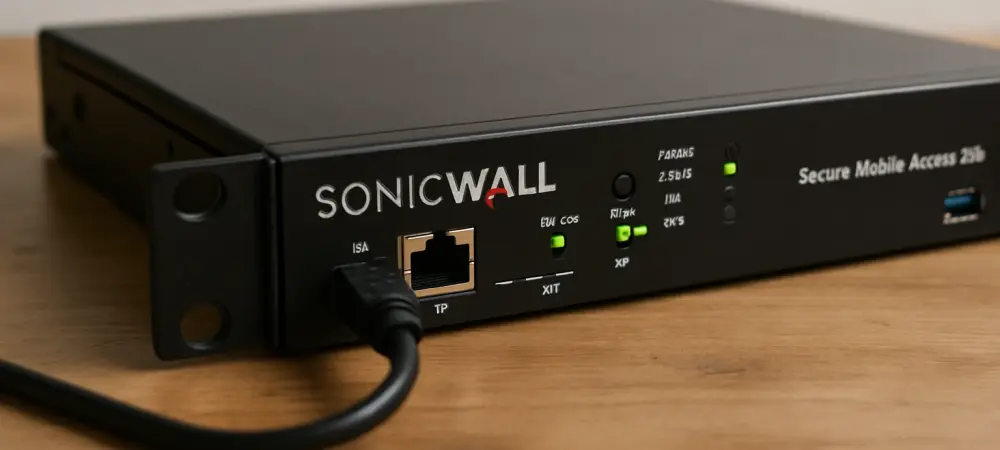
The SonicWall SMA100 series devices have three critical vulnerabilities that create significant risks for enterprise security: stack overflow, heap overflow, and cross-site scripting (XSS). These flaws allow attackers to exploit the devices without needing authentication, which is particularly concerning as they could do so just by sending specially crafted HTTP requests.
What is a stack overflow and how does it impact SonicWall SMA100 SSL-VPN devices?
A stack overflow occurs when data exceeds the stack’s bounds, causing data corruption or system crashes. In SonicWall’s case, the vulnerability CVE-2025-40596 is a classic stack-based buffer overflow which is triggered by malformed HTTP requests to the /api/ endpoint. This impacts the SSL-VPN devices by allowing attackers to potentially execute arbitrary code, leveraging a buffer that isn’t checked for limits.
Could you describe the heap overflow vulnerability in CVE-2025-40597?
Heap overflows happen when data exceeding allocated heap space gives attackers an opportunity to manipulate memory and execute code. In CVE-2025-40597, the heap overflow is linked to the mod_httprp.so module, which, despite using a secure sprintf variant, fails by disabling bounds checking, thus allowing out-of-limit data sizes. This setup compromises the device’s integrity by corrupting adjacent heap metadata.
How does cross-site scripting (XSS) manifest in SonicWall’s SMA100 series devices?
The XSS vulnerability in SonicWall devices comes from unsanitized user input within the radiusChallengeLogin CGI endpoint. By exploiting the flaw designated as CVE-2025-40598, attackers can inject scripts into web pages accessed by users, potentially stealing session information or redirecting users to malicious sites.
Why are pre-authentication attacks concerning for network infrastructure devices like these?
Pre-authentication attacks are concerning because they occur before validating user credentials. This means that attackers can exploit vulnerabilities without being authenticated, leading to unauthorized access or control of devices, which can breach entire networks.
What measures did SonicWall take to address these vulnerabilities?
SonicWall responded with a technical advisory through their Product Security Incident Response Team. They published patches to close these vulnerabilities, suggesting organizations should apply them promptly to minimize risks and uphold security protocols.
For businesses using SonicWall SMA100 series devices, what immediate actions should they consider?
Businesses must apply SonicWall’s patches as the first step. Beyond patches, they should consider network segmentation and additional intrusion detection systems to guard against exploitation attempts while the threats are contained.
In your opinion, why do fundamental programming errors continue to occur in critical network devices such as these?
Such errors often arise from oversight during the coding process, pressures on development timelines, and sometimes familiarity with certain coding practices that may inadvertently introduce flaws. Education and rigorous code review processes might mitigate these risks.
How does the disabled Web Application Firewall on management interfaces influence the execution of these vulnerabilities?
The disabled Web Application Firewall leaves management interfaces vulnerable by not filtering malicious HTTP requests effectively. This increases the feasibility of exploits like XSS, where simple payloads can successfully compromise interfaces.
What lessons can be learned from these vulnerabilities about developing secure network appliances?
Developers must prioritize security from the initial design stage, implementing robust input validation and adhering to secure coding practices. Continuous vulnerability testing and adopting evolving security standards can further safeguard against such flaws.
How can integrating ANY.RUN TI Lookup with SIEM or SOAR systems assist in analyzing advanced malware threats?
Integrating ANY.RUN TI Lookup with SIEM or SOAR systems enriches threat intelligence and improves automated detection capabilities. It offers deeper malware analysis, enabling organizations to swiftly respond to and mitigate threats, backed by comprehensive data insights.