

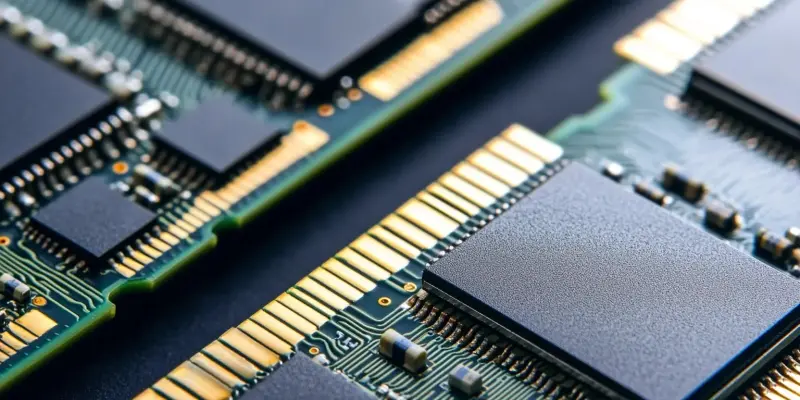
In a significant development for the PC hardware community, G.Skill recently introduced its low-latency DDR5 6000 memory kits tailored specifically for the AM5 platform and Ryzen 9000 processors. These advanced memory kits are available under the Trident Z5 Royal Neo RGB, Trident Z5 Neo RGB, and Ripjaws M5 Neo RGB product families, designed to offer users ultra-low latency with timings as low as CL26 at a memory speed of 6000 MT/s. This is particularly advantageous for AMD platform owners seeking to optimize performance.
G.Skill’s new memory kits come in a variety of capacities, addressing different user requirements with options such as 16 GB, 32 GB, and 48 GB kits. For mainstream PC users, including gamers and office workers, the 2x 16 GB and 2x 32 GB kits are well-suited. On the other hand, the 2x 48 GB kit, totaling 96 GB, caters to content creators and professionals who need more substantial memory capacity for resource-intensive tasks.
Notably, the 2x 32 GB RAM kit stands out as the world’s first 64 GB kit to achieve such low latency with CL26-36-36-96 timings. However, this level of performance is achievable only on select X670 motherboards. One key example is the ASUS ROG Crosshair X670E Hero motherboard paired with an AMD Ryzen 9 7950X CPU. This highlights the importance of high-end motherboard support for users aiming to achieve these ultra-low latency timings.
A significant feature of these new memory kits is the implementation of AMD EXPO support. This enables high clock speeds and facilitates easy overclocking directly out of the box, allowing users to optimize their systems for improved performance without needing extensive manual adjustments. It’s a crucial feature for those looking to maximize the potential of their hardware setups.
In summary, G.Skill’s new DDR5 6000 memory kits represent an impressive advancement for users of the AM5 platform and Ryzen 9000 processors. By offering a combination of high memory speeds and ultra-low latency, these RAM kits are designed to meet the varied needs of mainstream gamers, professionals, and demanding content creators. The emphasis on AMD EXPO support and compatibility with specific high-end motherboards underscores the importance of an optimal hardware setup to leverage these gains fully. This release sets a new standard for memory performance, reinforcing G.Skill’s reputation as a leader in the high-performance memory market.