

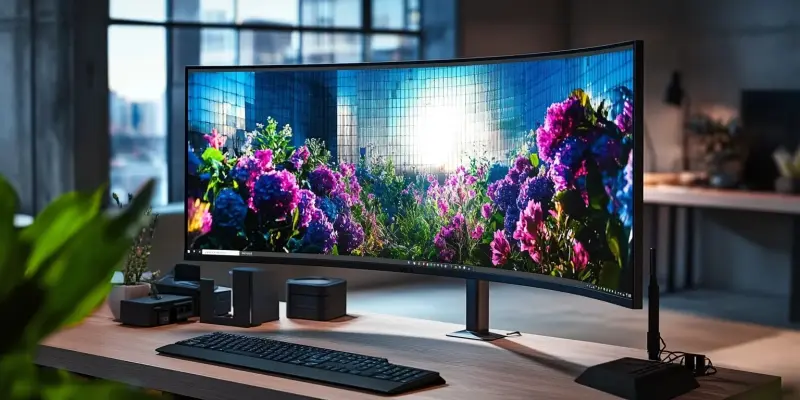
Dell and its subsidiary, Alienware, have recently introduced an impressive lineup of high-end monitors at CES, capturing the attention of professionals, content creators, and gamers alike. The lineup boasts four remarkable 4K panels, integrating cutting-edge QD-OLED and IPS technologies to deliver superior visual experiences. At the forefront is the Dell 32 Plus 4K QD-OLED monitor (Model: S3225QC), which has garnered significant attention. This monitor is the world’s first 31.5-inch QD-OLED model, featuring AI-enhanced 3D Spatial Audio and a stunning 3840x2160p resolution. It supports Dolby Vision, HDR True Black 400, and AMD FreeSync Premium, with a fluid 120 Hz refresh rate, catering to both entertainment and work needs seamlessly.
Connectivity is another arena where the Dell 32 Plus 4K QD-OLED monitor excels, offering a 90W USB-C port and an additional 15W USB-C port, ensuring users have ample options for various peripheral connections. In addition to this flagship model, Dell has pushed the boundaries with two groundbreaking IPS Black monitors that cater to professional usage: the 27-inch UltraSharp 27 4K Thunderbolt Hub Monitor (Model: U2725QE) and the 32-inch UltraSharp 32 4K Thunderbolt Hub Monitor (Model: U3225QE). These monitors come with an impressive 3000:1 contrast ratio and heightened color accuracy, featuring 99% DCI-P3 and 100% sRGB/Rec709 color spaces, providing rich, vibrant visuals that surpass the industry standard. The Thunderbolt 4 hub in these monitors offers versatile connectivity with a 140W USB-C charging port, multiple USB-C and USB-A ports, dual DisplayPorts, and one HDMI port, making them an ideal choice for professionals requiring a seamless and multifunctional workspace.
Cutting-Edge Technology for Professionals and Content Creators
Dell’s innovative approach to the new lineup is apparent in its attention to detail, with monitors designed to meet the diverse needs of professionals and content creators. The Dell 32 Plus 4K QD-OLED monitor, with its AI-enhanced 3D Spatial Audio, adds a new dimension to visual displays. Coupled with a stunning 3840x2160p resolution, this monitor ensures that every detail is captured with remarkable precision, making it an excellent choice for visual artists, designers, and anyone who demands top-tier visual performance. The monitoring experience is elevated further with support for Dolby Vision and HDR True Black 400, which delivers deeper blacks and brighter whites, creating an exceptionally immersive visual experience.
Moreover, the versatile connectivity options of this model make it a valuable asset in any professional setup. The inclusion of a 90W USB-C port and an additional 15W USB-C port ensures that users can easily connect multiple devices, streamlining their workflow and increasing productivity. On the other hand, the UltraSharp 27 4K Thunderbolt Hub Monitor and the UltraSharp 32 4K Thunderbolt Hub Monitor demonstrate Dell’s commitment to meeting the high expectations of professionals in need of outstanding color accuracy and detail. With a 3000:1 contrast ratio and coverage of 99% DCI-P3 and 100% sRGB/Rec709 color spaces, these monitors provide crisp, vibrant, and true-to-life colors, essential for photographers, video editors, and other content creators.
Elevating the Gaming Experience
Alienware, Dell’s subsidiary, has designed its monitors with the gaming community in mind, pushing the boundaries of visual fidelity and performance. The flagship product for gamers is the Alienware 27 4K QD-OLED Gaming Monitor (Model: AW2725Q), which features an impressive 3840x2160p resolution and a rapid 240 Hz refresh rate. This monitor is equipped with an ultra-low 0.03ms GtG response time, making it an ideal choice for gamers seeking smooth, responsive gameplay. Furthermore, the monitor supports NVIDIA G-Sync and AMD FreeSync Premium Pro, ensuring a tear-free gaming experience with reduced latency and stuttering.
In addition to remarkable performance metrics, the Alienware 27 4K QD-OLED Gaming Monitor stands out with exceptional color accuracy, providing 99% DCI-P3 coverage, and includes features such as Dolby Vision and DisplayHDR True Black 400. These features ensure that gamers receive an immersive and visually stunning experience, bringing their favorite games to life with true blacks and brilliant colors. The monitor also includes advanced anti-burn-in technologies and a comprehensive three-year warranty against OLED burn-in, offering peace of mind for users who invest in this high-end display.
A Unified Approach to Professional and Gaming Monitors
Dell and its subsidiary, Alienware, recently unveiled an impressive lineup of high-end monitors at CES, appealing to professionals, content creators, and gamers. This lineup includes four outstanding 4K panels featuring advanced QD-OLED and IPS technology for superior visuals. The highlight is the Dell 32 Plus 4K QD-OLED monitor (Model: S3225QC), the world’s first 31.5-inch QD-OLED display, which has generated significant buzz. Boasting a resolution of 3840x2160p, AI-enhanced 3D Spatial Audio, and support for Dolby Vision, HDR True Black 400, and AMD FreeSync Premium, it offers seamless functionality for both work and play with a smooth 120 Hz refresh rate.
On the connectivity front, the Dell 32 Plus 4K QD-OLED monitor excels with a 90W USB-C port and an additional 15W USB-C port for various peripheral connections. Besides this flagship model, Dell’s new IPS Black monitors target professionals with the 27-inch UltraSharp 27 4K Thunderbolt Hub Monitor (U2725QE) and the 32-inch UltraSharp 32 4K Thunderbolt Hub Monitor (U3225QE). These IPS monitors offer a 3000:1 contrast ratio and exceptional color accuracy with 99% DCI-P3 and 100% sRGB/Rec709 color spaces, delivering vivid images that surpass industry standards. The Thunderbolt 4 hub offers versatile connectivity, including a 140W USB-C charging port, multiple USB-C and USB-A ports, dual DisplayPorts, and an HDMI port, making these monitors ideal for a multifunctional workspace.