

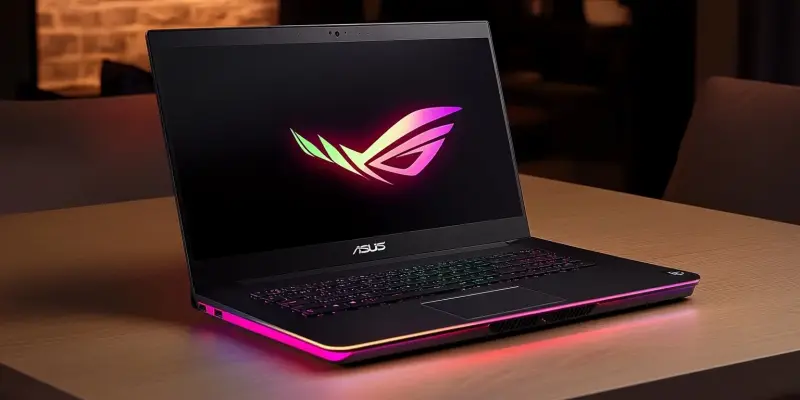
At CES 2025, ASUS stunned the gaming community with the introduction of its new lineup of ROG gaming laptops, designed to elevate gaming performance to unprecedented heights. These innovative models, spanning the ROG Strix, ROG Flow, and ROG Zephyrus series, are poised to redefine the standards of gaming laptops through the integration of the latest technological advancements from industry leaders like NVIDIA, Intel, and AMD. By balancing powerful performance capabilities with sophisticated designs and enhanced user experiences, ASUS is setting a new benchmark for what gamers can expect from their hardware.
ROG Strix Series: Pioneer in High-Performance Gaming
ASUS’s ROG Strix series is at the forefront of their latest technological venture, boasting models such as the Strix SCAR 16, Strix SCAR 18, Strix G16, and Strix G18. Each of these laptops harnesses the power of Intel’s Arrow Lake-HX processors, among them the prominent Core Ultra 7 255HX, and AMD’s high-performing Ryzen 9 9955HX3D and Ryzen 9 9955HX. In tandem with these processors, users will find NVIDIA’s next-generation RTX 50 GPUs from the “Blackwell” lineup, driving graphics performance to new extremes. The inclusion of DDR-5600 memory and PCIe Gen 4 storage further accentuates the high-speed data handling and processing capabilities, ensuring seamless gameplay experiences.
An integral part of these laptops’ appeal is their advanced cooling systems, which utilize the dedicated solutions provided by Intel and AMD, effectively managing heat generation during intensive gaming sessions. In addition to the robust internal cooling mechanisms, the ROG Strix laptops are equipped with ROG Nebula HDR mini-LED displays, offering a stellar visual experience with a brightness of 1200 nits and a remarkable 240Hz refresh rate. These features collectively ensure that gamers can enjoy crisp, vivid visuals without compromising on performance or speed.
ROG Flow Series: Versatility Meets Power
The ROG Flow series stands out by introducing unique versatility into the gaming laptop market, particularly with the new Z13 model. This “2-in-1” gaming device integrates a powerful AMD Ryzen AI Max+ 395 APU, featuring a 16-core CPU and Radeon RX 8060S iGPU, marking a significant evolution in gaming and AI application compatibility. The model further impresses with up to 128GB of LPDDR5X 8000MHz RAM configured in a quad-channel setup, enabling up to 96GB of VRAM, thereby setting new standards for multitasking and performance in a compact form factor.
The cooling system in the ROG Flow Z13 is notably advanced, incorporating second-generation Arc Flow fans, which ensure that heat dissipation remains efficient even under demanding scenarios. Adding to the seamless performance, the Z13 boasts a 13-inch, 2.5K resolution Nebula Display with a 180Hz refresh rate, promising smooth and intense visual experiences whether for gaming or creative workloads. This combination of mobile versatility and desktop-level performance makes the ROG Flow series particularly appealing to gamers who value flexibility without compromising on power.
ROG Zephyrus Series: Balancing Aesthetic and Performance
ASUS’s latest updates to the mainstream ROG Zephyrus lineup highlight an ideal balance between aesthetic appeal and robust performance. Models such as the Zephyrus G14 and G16 have been upgraded with state-of-the-art specifications designed to meet the high demands of modern gaming. The Zephyrus G14 is outfitted with AMD’s Ryzen AI 9 HX 370 processor and an NVIDIA RTX 5080 GPU, while the G16 offers an Intel Core Ultra 9 285H alongside an NVIDIA GeForce RTX 5090. Both models provide support for up to 64GB of memory and extensive storage options, ensuring they can handle even the most intensive applications and games.
One of the standout features of the Zephyrus series is the display technology, with the ROG Nebula Display setting a new standard in visual performance. While the G16 model showcases an impressive 3K, 120Hz OLED panel, the G18 pushes the envelope with a 2.5K, 240Hz display. These high-refresh-rate screens ensure minimal motion blur and exceptional clarity, elevating the gaming experience. Enhanced cooling systems, such as the ROG Intelligent Cooling and Tri-Fan design, complement these features by effectively managing device temperatures during prolonged gaming sessions, enhancing both performance and longevity.
A Glimpse into the Future of Gaming
At CES 2025, ASUS captivated the gaming world with the unveiling of its new lineup of ROG gaming laptops, intended to push gaming performance to unprecedented levels. This exciting collection, encompassing the ROG Strix, ROG Flow, and ROG Zephyrus series, is set to challenge and redefine the benchmarks for gaming laptops. The incorporation of cutting-edge technology from industry giants like NVIDIA, Intel, and AMD ensures that these devices offer top-tier performance. ASUS has managed to harmonize immense power with sleek, sophisticated designs, thereby enhancing the overall user experience. This new line of ROG gaming laptops signifies ASUS’s commitment to innovation, providing gamers with hardware that not only meets but exceeds their expectations. The company’s efforts in combining advanced performance with elegant aesthetics are setting a new standard. Gamers can look forward to a future where their gaming machines deliver extraordinary capability effortlessly, revolutionizing the gaming experience and solidifying ASUS’s reputation as a leader in gaming technology.