

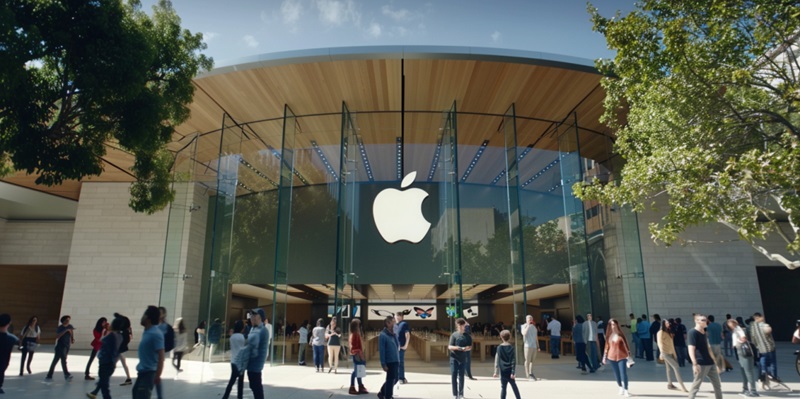
Apple has made significant strides in the realm of artificial intelligence, unveiling a new AI system that showcases an advanced ability to grasp context in language. This development signals an impressive leap forward, potentially positioning Apple as a competitor against formidable AI platforms like GPT-4. Apple’s efforts go beyond simple catch-up games; they are actively redefining the capabilities of AI in understanding and responding to human language.
The latest AI from Apple bridges a gap, enabling machines to decode and emulate nuanced human-like judgment and intuition in their interactions. With this new AI, more complex and sophisticated conversations can now take place, suggesting a future where AI can seamlessly integrate into areas that once exclusively required human intellect. The potential applications of this technology span from enhanced personal assistants to more effective and personalized user experiences across Apple’s suite of products and services.
Ultimately, this leap by Apple is not just a testament to their innovation but also an indicator of the rapid pace of growth within the artificial intelligence sector. It heralds a future of unparalleled human-machine collaboration, where communication barriers are dissolved and AI’s insight into context and nuance resembles that of human understanding. The implications of this are vast, promising profound transformations in how we interact with technology.
The Advent of Context-Aware AI Systems
For years, the development of AI has been rigorously steered towards fundamental comprehension and response mechanisms. However, Apple’s recent innovations signify a monumental shift towards a more nuanced model. The promise held within their latest AI’s capacity to fathom the intricacies of context challenges the former standards set by AI systems like GPT-4. This sophisticated understanding stems from state-of-the-art deep neural networks savvy in the dissection of linguistic subtleties. The resulting system is not just a tool; it’s an interlocutor capable of sustaining conversations that flow with unprecedented naturalness and relevance. Such advances in AI herald an era where the line between human and machine dialogues is gracefully blurred, leaving us anticipating each interaction with a sense of ease and familiarity previously unattainable.
In direct comparison to previous models like GPT-4, Apple’s AI doesn’t just process language; it interprets it. While GPT-4 prides itself on a vast database and complex algorithms, this new contender differentiates itself by its profound grasp of context, something akin to a keen understanding of culture and mood that colors human conversations. The implications are vast: from customer support to personal assistants, the technology is set to redefine what it means to interact with a machine.
Implications Across Multiple Sectors
Envision a future where customer service is not only efficient but also feels genuinely personalized. Apple’s AI is tailor-made for such scenarios, boasting the ability to interact with patrons in a way that reflects true understanding, not just scripted responses. Virtual assistants and chatbots powered by such technology can offer solutions and comfort with human-like consideration, directly affecting customer retention and satisfaction positively.
Content creators can look forward to an AI that assists not only with laborious tasks but also stimulates the creative process, offering insights and ideas inspired by context and intent. Moving over to healthcare, the accuracy and depth of language comprehension can be indispensable. Here, Apple’s AI could potentially assist in correctly interpreting patient symptoms recounted in layman’s terms, leading to more precise diagnoses and bespoke treatment plans. The education sector too stands to gain, as this advanced system could become an invaluable ally in comprehensive language learning, making the acquisition of new languages not just effective but enjoyable.
Apple’s Approach to Deepening Human-AI Connection
Apple’s strategic pivot is clear: to steer AI away from the realms of rigid responses and towards a dynamic, intuitive understanding of human conversation. The company recognizes that the future of AI lies in its ability to digest intent and meaning, thus creating an interaction that mirrors human dialogue more closely than ever. This is not about constructing a database of potential questions and their corresponding answers but about creating an AI that listens, understands, and engages with a depth that previously belonged solely to the domain of human interaction.
The result propels user experience light-years ahead. The new system endeavors to participate in a conversation that takes into account the vast array of human emotion and the subtleties of implication. This nuanced level of interaction promises to not just respond but also understand and predict needs, transforming how we engage with technology on a fundamental level.
Navigating the Challenges of Advanced AI
While Apple’s strides in AI language comprehension spark excitement, they also illuminate the perennial challenges of AI development, including safeguarding data privacy and bolstering public trust. As these AI systems delve deeper into the fabric of daily life, the handling of personal information becomes a crucial concern. Moreover, the longstanding issue of algorithmic bias resurfaces, especially as these systems become interpreters and decision-makers, wielding influence over content creation, healthcare diagnoses, and customer service outcomes.
User acceptance is another challenge that cannot be overlooked, as people must feel comfortable with and confident in the AI’s choices, especially under ambiguous or culturally complex situations. It’s Apple’s imperative to not only deliver an intelligent system but also to spearhead the movement for responsible, ethical AI use, setting a global standard for impartial and secure AI conduct.
Market Growth and Future Projections
The anticipations for markets embracing AI, especially those with enhanced language processing capabilities, are burgeoning. The current trajectory points toward a sizable swell in this sector, spurred by the demand for more sophisticated AI applications. The natural language processing market alone is teeming with potential, projected to hit remarkable figures in the coming years. The global chatbot market follows suit, likely to expand significantly as businesses across the globe seek to imbibe AI’s efficiency and reliability.
The field of healthcare, in particular, stands at a transformative juncture with AI integration, primed to redefine patient care through better diagnostics, customized treatment plans, and overall management. Apple’s forward-thinking AI system is not just a technological novelty; it is a gateway to a future where AI’s potential is realized across industries, fueling advancements that mirror human growth.
The Path Ahead for AI and Society
As Apple’s AI sets a new precedent for contextual language understanding, it also casts light on the broader societal implications. This technological leap forward, while brimming with promise, calls for a continued balance between innovation and integrity, between seamless interactions and ethical considerations. It emphasizes that as AI becomes more ingrained in our lives, its design and deployment must be guided by the same principles that govern society at large, fairness, responsibility, and inclusivity.
The industry at large is gravitating toward intuitive AI systems capable of profound, human-like interactions. Yet, the journey is not without obstacles. Persistent attention must be given to the challenges that accompany these advancements to ensure technology amplifies human potential and contributes constructively to society. Apple’s entry into this new phase of AI development is not merely a testament to human ingenuity but a reminder of the ongoing responsibility to harmonize technological progress with societal well-being.