

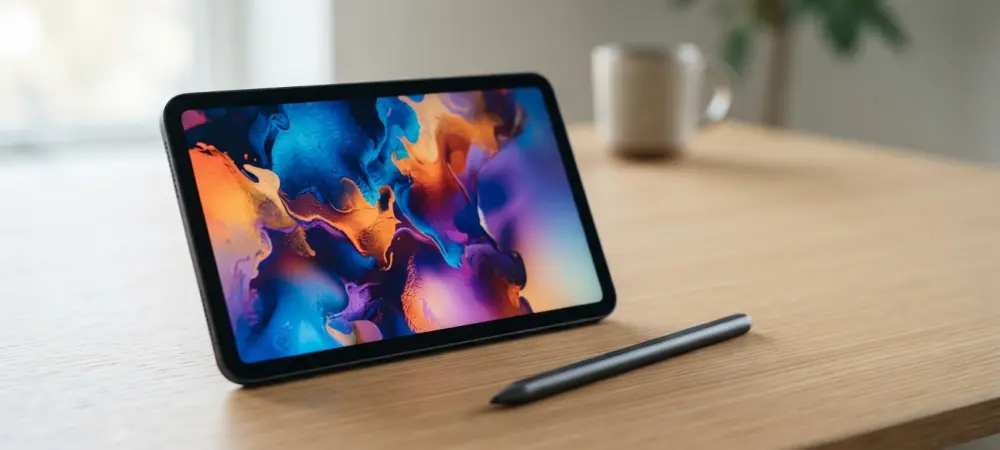
The technological landscape shifted today as the most compact member of the iPad family shed its identity as a secondary media consumption device to become a legitimate professional tool. By integrating a Super Retina XDR OLED display and the unreleased A20 Pro silicon, this model addresses years of user requests for deeper blacks and higher performance.
This shift signals a new era where “small” no longer means “compromised,” positioning the Mini as a premium tool for both creative professionals and power users who value portability above all else. The device finally bridges the gap between the portability of a smartphone and the utility of a professional workstation.
Market Redefinition: Why the Move to OLED and A20 Pro Silicon Redefines the Compact Market
For years, the iPad Mini occupied a middle ground, often lagging behind the Pro and Air models in display technology and processing speed. The transition to an 8.5-inch OLED panel is not just a visual upgrade; it is a response to a market increasingly dominated by high-contrast mobile screens and the demand for better outdoor visibility, highlighted by the 1,200-nit peak brightness.
Furthermore, as mobile software becomes more resource-intensive, the jump to the A20 Pro chip ensures the Mini can handle the next generation of AI-driven tasks and high-end gaming. These capabilities were previously reserved for larger, more cumbersome devices, but the new silicon provides the necessary overhead for complex local processing and advanced multitasking.
Technical Specifications: Dissecting the 2026 iPad Mini Hardware Strategy
The 2026 iPad Mini introduces several “firsts” for the product line, including a Super Retina XDR screen with an optional nano-texture finish for glare reduction. This is paired with an Acoustic Display speaker system that utilizes under-screen drivers to maximize internal space. The chassis has been thinned to 5.4mm and lightened to 255 grams, while the inclusion of IP67 water and dust resistance makes this the most rugged version to date.
Apple is utilizing a tiered strategy for the A20 Pro chip based on storage capacity. The 512GB flagship model features a full six-core CPU and maximum neural power, while the 128GB and 256GB models utilize a five-core variant with halved neural processing capabilities. Connectivity is handled by the C2 modem, supporting Wi-Fi 7 and eSIM-only 5G, while the USB-C port allows for 10Gb/s transfers and 35W fast charging.
Expert Analysis: Apple’s Value Proposition and Market Positioning
Industry analysts suggest that the $699 starting price reflects confidence in the new premium status of the device. While some enthusiasts may find the 60Hz refresh rate disappointing in an OLED era, the consensus is that the combination of the A20 Pro chip and the ultra-thin form factor compensates for the lack of ProMotion. Early reports indicate that the landscape-oriented 12MP Center Stage camera and Apple Pencil Pro compatibility are specifically designed to pivot the Mini toward professional field-work and digital artistry. It is no longer just a device for reading or browsing; it is a specialized instrument for the modern mobile professional.
Configuration Selection: Choosing the Right Model for Your Workflow
Selecting the 2026 iPad Mini required a clear understanding of performance needs due to the tiered chip architecture. If users planned on using heavy Apple Intelligence features or intensive video editing, the 512GB model became essential to unlock the full potential of the six-core A20 Pro chip. Buyers often opted for the nano-texture glass if they frequently worked in brightly lit environments or outdoors to cut down on reflections.
Since the cellular model utilized the C2 modem with eSIM technology, users verified carrier compatibility before the November 6 release date. To take advantage of the 35W fast charging, consumers ensured they had a compatible high-wattage power adapter to reach a 50% charge in 30 minutes. Future considerations for software updates suggested that the higher neural power of the top-tier model provided better longevity for AI-intensive applications.