

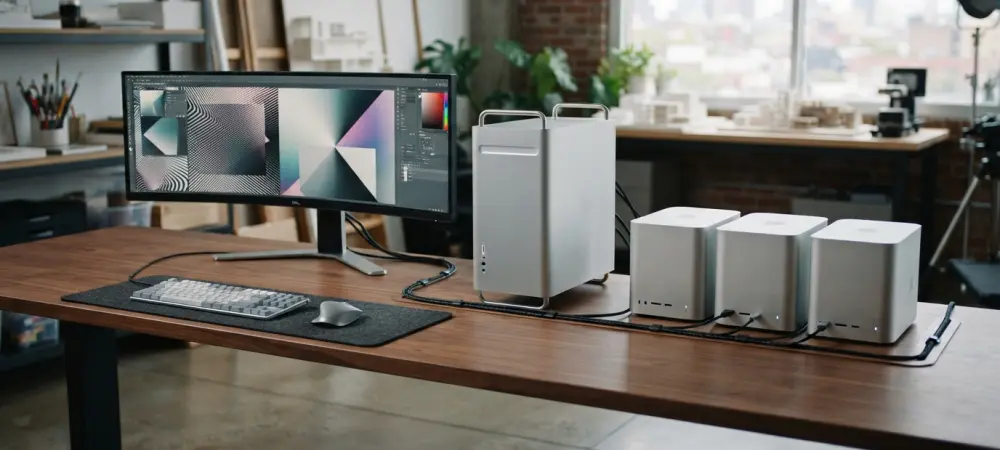
A single workstation sitting quietly on a desk now possesses the raw computational power that once required a room full of server racks and cooling fans. This transformation reflects Apple’s strategic pivot to integrate advanced artificial intelligence directly into its hardware ecosystem, moving away from the industry’s heavy reliance on external processing. By positioning the Mac Studio as a cost-effective, local alternative to cloud-based data centers, the company has effectively brought frontier-level AI capabilities to the professional desktop. The shift is anchored by a unique unified memory architecture that allows the processor to access massive pools of data with unprecedented speed. This design redefines how AI inferencing and development are handled by eliminating the bottlenecks typically found in traditional hardware configurations. Through collaborative innovation, Apple is making large-scale AI models accessible to professionals who require high performance without the ongoing costs or latency of the cloud.
The Shift Toward High-End On-Premises AI Integration
Modern enterprises are increasingly seeking ways to maintain control over their computational resources while scaling their intelligence capabilities. Apple’s current hardware strategy addresses this by prioritizing the local execution of complex algorithms, which minimizes the need for data to ever leave the physical premises of an organization. This on-premises approach provides a level of speed and responsiveness that cloud-based services struggle to match, particularly for real-time applications.
Moreover, utilizing the Mac Studio as a localized AI hub allows businesses to bypass the expensive subscription models associated with massive server farms. The ability to run trillion-parameter models on a compact device has shifted the economic landscape for startups and research labs alike. By leveraging unified memory, these units handle memory-intensive AI tasks that would otherwise require multiple specialized graphics cards, making the Mac a formidable tool for the next generation of developers.
Background and Context of the Mac-Based AI Evolution
For years, the development of frontier AI models was restricted to those with access to massive, cloud-based infrastructure. This reliance created significant hurdles, including high operational costs and concerns regarding data privacy and security. As enterprise workflows evolved, the demand for reduced latency and enhanced sovereignty over sensitive information became a primary driver for the move toward edge computing and local workstations.
In response to these market shifts, Apple transitioned from producing consumer-focused hardware to developing specialized workstations tailored for AI researchers. This evolution was not merely about raw speed; it was about creating an ecosystem where “distributed inferencing” could occur across multiple local units. Such a transition has proved essential for the future of scalable and responsible AI, ensuring that powerful tools remain in the hands of the individuals who use them.
Research Methodology, Findings, and Implications
Methodology
The recent analysis centered on a collaboration between Apple and Meta to optimize the “Muse Spark Open” trillion-parameter model for local environments. Researchers tested the performance of sophisticated agentic workflows by clustering multiple Mac Studio units together to simulate a larger computing environment. This methodology focused on the seamless integration of hardware and software to see how efficiently a trillion-parameter system could function outside of a traditional data center.
Technical evaluations also included rigorous testing of the MLX machine learning framework, particularly its new support for the M5 chip family. The implementation of Remote Direct Memory Access (RDMA) over Thunderbolt was a critical component of the study, as it facilitates low-latency communication between connected units. This setup allowed the research team to evaluate how effectively a modular cluster could handle the massive throughput required for modern AI architectures.
Findings
Data from the testing phase revealed that a four-unit Mac Studio cluster achieved processing speeds exceeding 36 tokens per second. This performance level is particularly significant because it surpasses average human reading speeds, enabling real-time data processing and interaction. Such results demonstrate that consumer-grade connectivity, like Thunderbolt, is sufficient for building “distributed inferencing data centers” that can handle massive datasets without specialized networking hardware.
Furthermore, the enhancements to the MLX framework successfully integrated support for mixture of experts (MoE) architectures. This technical milestone ensures that local hardware can efficiently manage models that activate only a fraction of their parameters at any given time. These findings validate the Mac Studio as a viable alternative for high-stakes AI development, proving that local clusters can compete with much larger enterprise arrays in specific professional contexts.
Implications
The results suggest a significant democratization of AI, as sophisticated capabilities move out of specialized research labs and into standard professional environments. Businesses currently dependent on cloud server farms can expect a substantial reduction in operational costs by shifting their workloads to local clusters. This transition not only saves money but also enhances data sovereignty, as sensitive information is processed entirely on-site.
Beyond the economic impact, this evolution is poised to transform the software development and creative industries. AI-driven automation in professional tools like DaVinci Resolve can now function with higher precision and lower latency. As local AI becomes more powerful, the barriers to entry for complex creative projects are lowered, allowing smaller teams to produce work that previously required the resources of a major studio.
Reflection and Future Directions
Reflection
The synergy between Apple silicon and the MLX framework has created a developer-friendly platform that is difficult for competitors to replicate. By making high-performance computing accessible through “plug-and-play” hardware configurations, the company has lowered the technical threshold for AI research. The successful integration of open-weight models like Muse Spark Open further validates the ecosystem as a primary destination for the global AI community.
However, challenges remain regarding the scaling of local clusters when compared to the infinite elasticity of massive cloud arrays. While the current hardware is exceptional for many professional tasks, the push toward even larger models will require continued innovation in how memory is shared across devices. Balancing the desire for high-performance computing with the need for accessible, user-friendly hardware continues to be a central theme in the evolution of the Mac.
Future Directions
Looking ahead, the exploration of the M5 chip family’s Neural Accelerators will likely define the next chapter of local AI performance. There is significant potential for broader industry adoption of RDMA over Thunderbolt as a standard for modular, scalable computing. This would allow organizations to expand their processing power incrementally, adding new units to their local clusters as their needs grow throughout 2027 and 2028.
Future research will also likely investigate the long-term impact of local AI agents on professional productivity and job roles. As these agents become more integrated into daily workflows, the way professionals interact with their tools will fundamentally change. Optimizing even larger models to run on decentralized, small-form-factor hardware remains a priority, ensuring that the move toward localized intelligence continues to accelerate.
Apple’s New Frontier in Localized High-Performance Computing
The recent advancements in Mac Studio clusters disrupted the traditional AI infrastructure landscape by offering a powerful, private alternative to the cloud. Apple reaffirmed the importance of hardware-level innovation, showing that the integration of Meta’s Muse Spark Open with the MLX framework could achieve professional-grade results on the desktop. The company successfully showcased that sophisticated AI did not have to be synonymous with massive, distant server farms.
This strategic direction ensured that the transition toward local and responsible artificial intelligence remained accessible to a wide range of industries. By focusing on private data processing and high-efficiency silicon, the foundation was laid for a new era of decentralized computing. The efforts made in 2026 solidified the role of specialized workstations in the broader technological ecosystem, providing a roadmap for how businesses would manage their intelligence needs in the years to follow.