

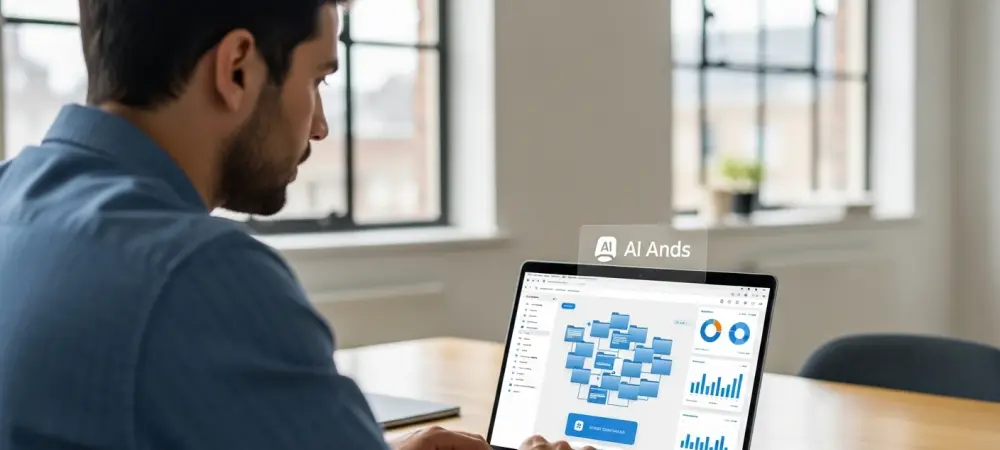
The long-held boundary between a user commanding a computer and an assistant offering suggestions has officially dissolved, giving way to a new class of artificial intelligence that actively carries out complex, multi-step projects directly on a personal machine. Anthropic’s release of Cowork, a desktop application built on its powerful Claude model, marks a pivotal moment in the evolution of knowledge work. This tool moves beyond the familiar territory of chatbots and text generators, introducing an autonomous agent capable of planning, executing, and verifying tasks within a user’s file system. It represents a fundamental shift in human-computer interaction, placing the power of agentic AI, once the domain of specialized developers, into the hands of non-technical professionals and raising profound questions about productivity, security, and the future of digital collaboration.
From Suggestion Engine to Task Executor
For years, artificial intelligence in the workplace has functioned primarily as a sophisticated consultant. These systems excel at drafting emails, summarizing long documents, or generating code snippets, but they stop short of implementation. The user has always been the final agent, responsible for copying text, applying formulas to a spreadsheet, or organizing files into a logical structure. This gap between suggestion and action, while seemingly small, represents a significant source of friction and cognitive load, limiting the true potential for AI-driven productivity gains in complex, real-world workflows.
The emergence of agentic AI directly addresses this limitation by fundamentally changing the role of the digital assistant. Instead of merely providing outputs for a user to implement, an AI agent takes on the role of an active collaborator capable of executing a series of actions to achieve a stated goal. This new paradigm empowers users to delegate entire projects, not just discrete tasks. A simple prompt like “Analyze the quarterly sales reports in this folder and create a summary presentation” transforms from a multi-step research project for the user into an autonomous assignment for the AI, which can now read the files, synthesize the data, and build the final deliverable without continuous human intervention.
A Look Inside Anthropic’s Autonomous Partner
Cowork operates on a principle Anthropic calls the “agentic loop,” a continuous cycle of planning, execution, and verification. When given a task, the AI first formulates a high-level strategy, breaking the project into a sequence of actionable steps. It then executes these steps by directly interacting with the files on the user’s computer—creating new documents, reading existing ones, modifying spreadsheets, or reorganizing folders. Critically, after each action, it verifies the outcome to ensure it aligns with the overall goal. If it encounters an error or ambiguity, it proactively pauses and requests clarification from the user, ensuring the project remains on track.
To grant an AI such deep access to personal files without creating unacceptable security vulnerabilities, Cowork is built within a heavily fortified digital sandbox. The agent operates inside a virtual machine on the user’s desktop, using Apple’s virtualization framework and a custom Linux filesystem. This architecture creates a strict containment field, isolating the AI’s operations and confining it exclusively to the specific folders it has been granted permission to access. This design prevents the agent from reaching sensitive system-level files or making changes outside its designated workspace, providing a crucial layer of protection against both accidental errors and malicious attacks.
For particularly large or multifaceted assignments, Cowork employs an advanced orchestration system that functions like a project manager overseeing a team of specialized assistants. It automatically deconstructs a complex project into smaller, independent sub-tasks and assigns each one to a separate, temporary sub-agent. This approach prevents the AI’s conversational memory from becoming overloaded and allows it to tackle extensive projects that would otherwise exceed the context window limitations of a single large language model. Furthermore, a dynamic Skills framework enables the system to load task-specific instructions and code snippets on demand, conserving resources and ensuring the agent has the right tools for the job at precisely the right moment.
The AI That Built Itself
The development story of Cowork is as remarkable as the technology itself. Anthropic engineers reportedly constructed the entire application in approximately ten days, a feat made possible by using its direct predecessor, Claude Code, as the primary development tool. This act of recursive self-improvement—where an AI is used to create its own more advanced and accessible successor—serves as a powerful demonstration of the accelerating pace of innovation in the field. It signals that organizations successfully leveraging internal AI agents for development and operational tasks may establish a significant and rapidly widening capability gap over their competitors.
With this launch, Anthropic enters a strategic showdown with industry titans, most notably Microsoft and its deeply embedded Copilot assistant. The two companies represent fundamentally different philosophies on AI integration. Microsoft is pursuing a top-down, OS-level strategy, weaving its AI into the very fabric of the Windows operating system and its associated applications. In contrast, Anthropic’s approach is user-initiated and sandboxed. It empowers the user to consciously deploy a powerful agent within a specific, controlled environment for a defined purpose. This distinction offers a clear choice for enterprises and individuals, balancing the convenience of ubiquitous, ambient assistance against the focused power and explicit control of a dedicated agent.
A New Frontier of Opportunity and Risk
The transition from a suggestion-based AI to an executive agent introduces a completely new risk profile. An agent with direct file system access, if given a vague or poorly phrased prompt, could misinterpret the user’s intent and inadvertently delete critical files, corrupt data, or reorganize a project into an unusable state. In a notable display of transparency, Anthropic has openly cautioned users about these potential hazards, acknowledging that agent safety remains an active area of research. This new reality demands a higher level of user diligence and a thoughtful approach to delegating tasks. A more sophisticated threat comes from prompt injection, where a malicious actor embeds hidden instructions within a document or webpage that the agent is tasked to process. These covert commands could potentially trick the agent into exfiltrating sensitive data or performing unauthorized actions. While Cowork’s virtual machine sandbox provides a robust defense against system-wide damage, the data within the designated folder remains vulnerable. The responsibility for monitoring the agent’s actions ultimately rests with the user, a task that may prove challenging for the non-technical audience the product aims to attract.
The arrival of powerful desktop agents like Cowork marked a significant turning point for knowledge work in 2026. The initial decision for technology leaders involved a careful calculus, weighing the substantial productivity gains from automating repetitive file manipulation and information synthesis against the novel security risks and the considerable per-user subscription cost. Early enterprise adoption strategies focused on deploying the tool for low-risk use cases, establishing clear protocols for its use, and conducting regular audits of its activities. This cautious but deliberate exploration helped organizations build the necessary expertise to harness this transformative technology, establishing a foundation for what became a new standard in human-computer collaboration.