

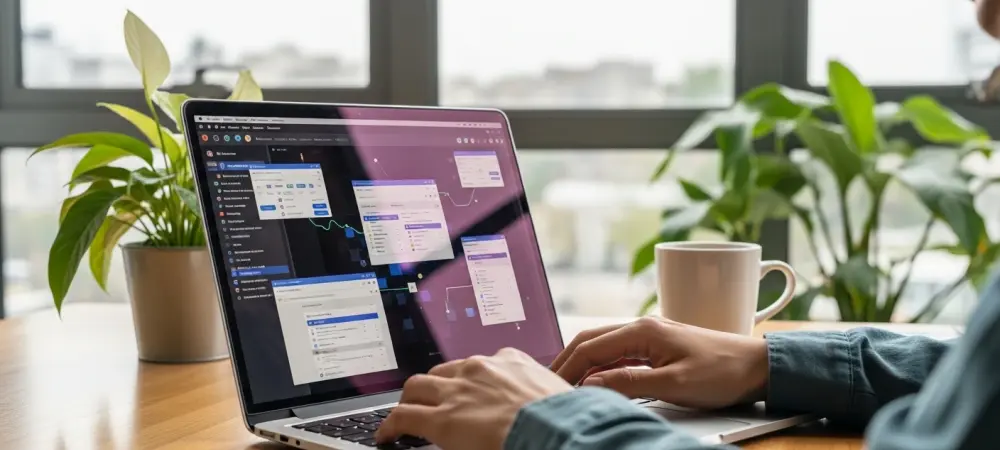
A digital hand has reached out from the sterile confines of the chat interface to grasp the steering wheel of the modern personal computer. The digital barrier between artificial intelligence and the operating system has finally collapsed, fundamentally altering how professionals manage their daily workloads across every major industry. While the technology sector previously defined progress by the eloquence of a chatbot’s prose, the focus has shifted toward functional autonomy and the ability to execute complex, multi-step actions. Anthropic has catalyzed this movement by granting Claude the ability to interact directly with desktop environments, effectively turning a language model into a hands-on operator of software. This transition from “generating” to “executing” means that AI is no longer a consultant sitting on the sidelines but a functional participant that can click, type, and navigate through a Mac or Windows desktop with a level of precision that mirrors human interaction.
The End of the Chatbox Constraint: Claude Steps Into the Operating System
Claude’s evolution into the operating system marks the conclusion of the “chatbox era,” where AI was essentially trapped within a singular browser window or a standalone application. This development allows the model to bridge the gap between disjointed tools, moving a cursor and entering text across various local applications that previously required human intervention. For the first time, a user can watch as the AI opens a spreadsheet, extracts specific data, and then pastes that information into a legacy accounting software that lacks modern API support. This capability transforms the computer from a tool that the human operates into a collaborative space where the AI functions as a digital colleague capable of independent movement.
The era of being confined to a text-based bubble is rapidly coming to an end as the AI learns to interpret visual cues on the screen just as a person would. While we have grown accustomed to AI that can write emails or summarize long documents, Anthropic has fundamentally changed the game by giving Claude the ability to reach out and touch the buttons on your screen. This shift is not merely cosmetic; it represents a deep integration into the user’s workflow. By navigating the file system, managing window layouts, and interacting with non-web-based software, Claude is becoming a versatile assistant that understands the spatial layout of a professional workspace.
Why Direct Computer Use is the Next Frontier for AI Agents
The transition toward autonomous agents marks a structural shift in how we interact with software at every level of the enterprise. Most professional work happens across a fragmented landscape of legacy applications, browser tabs, and local files that do not always talk to each other. By moving beyond simple text responses, Anthropic is addressing the “execution gap”—the manual labor required to move data between apps that lack modern integrations. This development matters because it allows AI to operate within existing frameworks, saving professionals from the “heavy lifting” of administrative navigation and allowing them to focus on high-level strategy and creative problem-solving.
Most productivity gains in recent years were incremental, but the ability for an AI to use a computer directly represents a leap in functional utility. It moves the technology from the realm of “content creation” to “process automation.” When an AI can handle the mundane tasks of navigating complex user interfaces, the friction of digital work begins to evaporate. This autonomy is the next frontier because it enables the AI to handle the “connective tissue” of business operations—the small but time-consuming actions that fill the gaps between specialized software tools.
The Mechanics of Interaction: How Claude Navigates Your Desktop
To ensure reliable execution, the system does not simply rely on visual guesswork; it follows a sophisticated three-tier priority logic model designed for maximum stability. The AI first attempts to use direct service connectors or specialized APIs, such as those for Slack or Google Calendar, to ensure data accuracy and high speed. If no direct API is available, it transitions to browser-based control to manipulate web elements. Only as a final fallback does it resort to interpreting raw screen pixels to click and type. This hierarchical approach ensures that the AI uses the most stable method of interaction before resorting to visual simulation, which is more prone to latency and environmental changes.
The rollout includes “Dispatch,” a companion tool that enables a seamless cross-platform workflow between mobile and desktop environments. A user can initiate a complex series of tasks, such as pulling weekly metrics or managing a pull request, via their mobile device while away from their desk. Claude then executes these commands on the user’s remote or office-based computer, ensuring that the work is completed by the time the professional returns to their workstation. To capture different segments of the market, Anthropic has bifurcated its desktop capabilities into specialized platforms: Claude Code serves as a command-line agent for developers, while Claude Cowork is designed for general business users, focusing on automating routine office tasks and navigating diverse business software within a unified desktop application.
Market Impact and the Challenge of Digital Security
The financial trajectory of this evolution has been staggering, with Claude Code’s annualized revenue jumping from $1 billion to over $2.5 billion in just a few months. This growth is a testament to the demand for AI that is “inside” the workflow rather than “alongside” it. The rapid expansion of the platform, including a Windows version launched just days after the macOS debut, indicates a fierce competitive environment. Industry analysts suggest that we are moving toward a future where the distinction between an operating system and an AI assistant becomes increasingly blurred.
However, giving an AI control over a mouse and keyboard introduces a significantly larger “attack surface.” Experts warn of “prompt injection” risks, where malicious instructions hidden on a webpage or within a document could trick the AI into performing unauthorized actions on a user’s computer. This could lead to data exfiltration or the unauthorized deletion of local files if the system is not properly contained. Anthropic continues to treat these features as a research preview, emphasizing the need for rigorous governance as the technology matures. The challenge for the industry will be to provide the convenience of autonomous control without compromising the security of the underlying hardware and data.
Practical Frameworks for Integrating Autonomous AI
To safely implement these new features, users should start by delegating repetitive, non-sensitive tasks that involve moving data between public browsers and local applications. This allows for a “human-in-the-loop” approach where the AI handles the navigation while the user provides final verification before any permanent actions are taken. Organizations looking to adopt desktop control features must establish strict guardrails, which included running Claude in sandboxed environments and avoiding its use with highly sensitive data during the initial research preview phase.
The most effective way to utilize Claude’s new capabilities involved the strategic batching of administrative tasks. By grouping activities like email triage, metric gathering, and file organization, users triggered single commands that allowed the AI to clear out digital clutter autonomously. Professionals who succeeded with this technology were those who identified low-risk automation opportunities and utilized automated scanning tools to monitor for unauthorized activities. This disciplined approach ensured that the AI remained a productive asset rather than a security liability. As the technology matured, the integration of autonomous agents became a cornerstone of modern digital strategy, allowing human talent to reclaim time previously lost to administrative navigation.