

The evolving landscape of high-performance computing systems in early twenty-twenty-six demands a sophisticated shift from the gaudy aesthetics of the previous decade toward engineering-led solutions that prioritize thermal stability and acoustic efficiency. This transition is perhaps best exemplified by the landmark collaboration between Antec and Noctua, which has culminated in the release of the Flux Pro Noctua Edition. Far from being a simple cosmetic refresh of a standard chassis, this full-tower enclosure represents an intensive refinement of Antec’s “Flow Luxury” architecture. It serves as a definitive answer to the challenges posed by modern, high-TDP hardware, offering a sanctuary of silent operation and thermal headroom. By merging structural innovation with legendary European acoustic engineering, the chassis provides a cohesive environment for workstations and gaming rigs that demand peak performance without the intrusive noise levels often associated with high-airflow designs. The fundamental value of this chassis is anchored in its comprehensive cooling ecosystem, which includes an extensive suite of Noctua’s flagship G2-series fans. This integration moves beyond standard industry practices by providing six specialized fans designed to work in concert. Specifically, the inclusion of the NF-A14x25 and NF-A12x25 G2 units addresses the nuanced problem of “beat frequency” humming. By utilizing fans with slightly offset rotational speeds, the system effectively mitigates the rhythmic acoustic interference that occurs when multiple fans spin at identical frequencies. This level of technical foresight, combined with over two hundred dollars worth of premium cooling components pre-installed, positions the chassis as a strategic investment for builders who prioritize longevity and silence. It is a product that respects the professional environment while delivering the raw thermal performance required for the most demanding computational tasks.
Industrial Design and External Innovation
Aesthetics and Functional Exterior Features
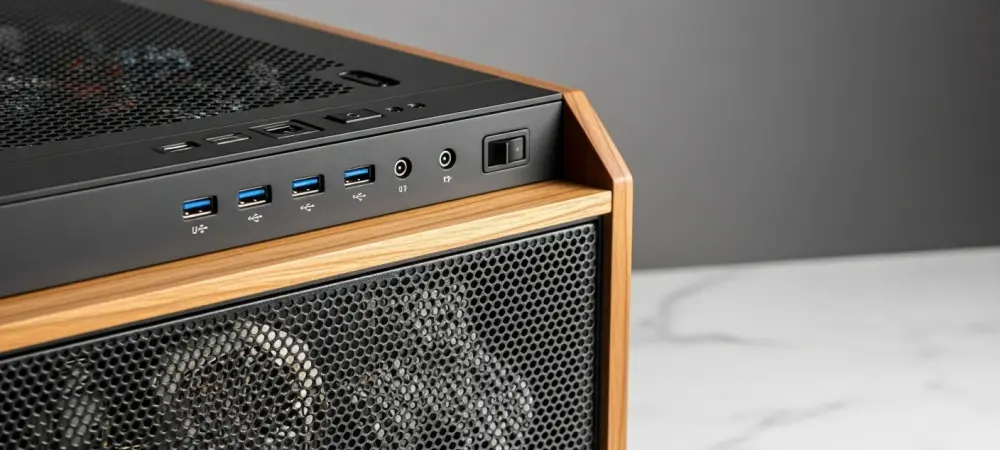
The external design of the chassis breaks away from the aggressive, plastic-heavy industrial trends of the past five years by incorporating authentic Walnut wood accents on the front panel. This material choice introduces a warm, furniture-like quality that bridges the gap between high-tech hardware and professional interior design. The wood serves more than just an aesthetic purpose; it frames a high-density metal mesh intake that is engineered for maximum air volume. This organic texture perfectly complements the iconic brown and beige color palette of the included Noctua fans, creating a unified visual identity that feels both timeless and sophisticated. The contrast between the natural wood grain and the precision-engineered mesh reflects a philosophy where form and function are not competing interests but complementary elements of a larger design goal.
Functionality is further enhanced by the meticulous construction of the chassis panels and the inclusion of high-quality materials throughout. A 4mm tempered glass side panel offers a clear view of the internal components, yet it is implemented with a unique two-tone border that hides unsightly cable edges and structural supports. The opposite side panel features a ventilated mesh section that adheres to the Noctua color scheme, ensuring that the airflow requirements of the PSU shroud are met while maintaining visual consistency. This attention to detail extends to the physical touchpoints of the case, such as the high-quality thumb screws and the magnetic dust filters that protect every major intake and exhaust point. The result is a structure that feels exceptionally robust and premium, capable of housing high-end systems for several hardware cycles without losing its structural integrity or visual appeal.
Monitoring and Connectivity Systems
One of the most distinctive functional innovations on the exterior is the integrated digital display located on the lower mesh portion of the side panel. This real-time monitoring system provides users with immediate data regarding CPU and GPU temperatures without the need for secondary software overlays or external screens. Controlled via a dedicated physical toggle on the top I/O panel, this display adds a layer of professional utility that is often missing from standard cases. It allows professionals and enthusiasts to monitor thermal trends during intense rendering tasks or gaming sessions at a glance. The display is bright and legible, yet it remains subtle enough to avoid distracting from the overall “organic” aesthetic of the walnut and beige enclosure, representing a thoughtful integration of modern telemetry into a classic design language.
The I/O suite reflects the requirements of the current year, providing a comprehensive range of connectivity options for modern peripherals and high-speed storage. It includes dual USB 3.0 Type-A ports alongside a high-bandwidth 10Gbps Type-C port, ensuring compatibility with the latest external drives and docking stations. In an era where dust ingress is a primary concern for component longevity, Antec has included custom-fitted rubber shields for these ports, preventing debris from accumulating over time. The placement of the power and reset buttons, along with the headphone/microphone combo jack, is ergonomic and easily accessible. These features, combined with the dedicated LED toggle for the temperature display, demonstrate a user-centric approach that prioritizes convenience and system maintenance, reinforcing the product’s status as a flagship solution for serious builders.
Internal Architecture and Cooling Dynamics
Spatial Capacity and Modular Flexibility
Moving to the interior, the chassis reveals its massive capacity as a true full-tower, designed to accommodate the largest components available in the current market. It supports E-ATX motherboards up to 285mm in width, providing ample room for high-end workstation boards and enthusiast-grade platforms. The spatial allowance for graphics cards is particularly impressive, with up to 455mm of clearance, which comfortably fits the most substantial NVIDIA RTX 50-series or AMD Radeon cards. Similarly, the 190mm vertical clearance for CPU coolers ensures that even the largest dual-tower air coolers, such as the Noctua NH-D15, can be installed without any risk of side-panel interference. This abundance of space is not just for ease of installation; it is a critical factor in maintaining the internal air volume necessary for efficient heat dissipation in high-power configurations.
Modularity is a core tenet of the internal layout, most notably seen in the vertically adjustable front cooling bracket. This bracket offers five distinct mounting positions, allowing builders to optimize the placement of front-mounted radiators or fans according to their specific motherboard and GPU requirements. The chassis is capable of supporting a 420mm radiator at the top and another 420mm radiator at the front simultaneously, a configuration that is rarely achievable in standard tower cases. Furthermore, the PSU shroud area is designed for flexibility, featuring adjustable drive cages that can be shifted or removed entirely to provide more room for cables or even additional bottom-mounted fans. This level of versatility ensures that the chassis can adapt to a wide variety of builds, from ultra-quiet air-cooled workstations to complex custom liquid-cooling loops.
The F-LUX Thermal Philosophy and Noctua Integration
The cooling performance of the chassis is driven by Antec’s “Flow Luxury” (F-LUX) philosophy, which emphasizes multi-directional airflow to eliminate thermal dead zones. Unlike traditional case designs that rely solely on front-to-back air movement, this system incorporates a dedicated fan tray above the PSU shroud. This tray pulls fresh air from the vented side panels and pushes it directly into the graphics card’s intake, a necessity for managing the heat output of modern high-TDP GPUs. This secondary airflow path ensures that the most power-hungry component in the system remains cool, even when the front intake is occupied by a thick radiator. This strategic placement of fans transforms the case into a high-performance thermal engine capable of handling sustained heavy loads without thermal throttling.
The integration of Noctua’s G2-series fans elevates this thermal philosophy by providing an unparalleled balance between static pressure and low noise. During operational testing, the case maintained an exceptionally low noise floor of approximately 30 dB(A) at idle, only rising to 40 dB(A) under intense gaming or production workloads with a high-end Ryzen 9 processor and an RTX 5080. This acoustic refinement is achieved through the fans’ advanced blade geometry and anti-vibration mountings, which prevent the transfer of resonance to the steel chassis. The result is a cooling system that provides “airflow beast” performance while remaining virtually silent in a typical office environment. This synergy of high air volume and low acoustic output represents the pinnacle of current thermal engineering, offering a premium experience for those who work in noise-sensitive settings.
User Experience and Technical Excellence
Ease of Assembly and Cable Management
The assembly process is designed to be as intuitive and tool-free as possible, catering to both professional system integrators and DIY enthusiasts. Both side panels utilize a push-to-release mechanism that eliminates the need for tools to access the internal hardware, making routine maintenance and upgrades significantly faster. Behind the motherboard tray, the chassis offers a generous amount of routing space and a series of large, rubberized grommets that allow for clean cable passes. Pre-installed velcro straps and strategically placed tie-down points ensure that even thick 24-pin power cables can be managed effectively without creating a bulge in the side panel. This focus on cable management is not merely for aesthetics; it ensures that the airflow paths remain unobstructed by “cable spaghetti,” maintaining the efficiency of the F-LUX system. Central to the cable management strategy is the inclusion of the Noctua NA-F# fan hub, a professional-grade component that can control up to eight PWM fans from a single motherboard header. This hub simplifies the wiring process significantly by centralizing the power and signal connections for the entire cooling array. Furthermore, the inclusion of several high-quality Noctua extension cables ensures that users can reach the furthest corners of the full-tower frame without straining their connections. By providing these accessories out of the box, Antec and Noctua have removed the common frustrations associated with high-fan-count builds. The overall experience is one of organized efficiency, where the hardware disappears into the background, leaving the user with a clean, high-performance machine that is easy to service.
Detailed Technical Specifications and Build Quality
The physical dimensions of the chassis—530mm in height, 245mm in width, and 545mm in length—confirm its status as a robust full-tower capable of housing extensive storage and cooling configurations. The construction utilizes high-grade steel for the main frame, ensuring that the case remains rigid even when loaded with heavy liquid-cooling components and multiple mechanical drives. Storage versatility is another highlight, with four dedicated drive bays that can accommodate a mix of 2.5-inch SSDs and 3.5-inch HDDs. The PSU chamber is equally spacious, supporting power supplies up to 470mm in length when the drive cages are removed, which is more than enough for the highest-wattage units required for multi-GPU or AI-workstation setups. Beyond the raw dimensions, the build quality is reinforced by a six-year warranty, a duration that is significantly longer than the industry standard for PC chassis. This warranty covers both the structural components of the case and the pre-installed Noctua fans, providing peace of mind for users making a significant financial investment. The use of real Walnut wood, rather than plastic imitations, further underscores the commitment to high-quality materials that will age gracefully over time. Every aspect of the technical specifications, from the radiator compatibility to the dust-proof I/O shields, points to a product designed for the long term. This is a chassis built for those who view their PC not just as a tool, but as a durable piece of engineering that should perform flawlessly for several years.
Market Positioning and Final Assessment
Target Audience and Investment Value
At a retail price point of $399, this chassis is positioned as a premium investment for a specific segment of the hardware market. It is aimed directly at professionals, researchers, and high-end enthusiasts who require a full-tower solution but find the typical RGB-laden offerings inappropriate for their workspace. While the price may seem high compared to entry-level cases, the value proposition becomes clear when the included components are analyzed: the six Noctua G2 fans and the NA-F# hub would cost over half of the total price if purchased separately. By bundling these flagship parts into a purpose-built chassis, the product offers a streamlined path to a top-tier cooling setup that would otherwise require significant research and separate logistical planning to replicate.
The investment value is also tied to the longevity of the full-tower form factor and the timeless nature of its design. In 2026, as hardware components continue to grow in size and power consumption, having a chassis that can accommodate future generations of GPUs and larger cooling solutions is a strategic advantage. The “organic” aesthetic of the walnut wood and the neutral color scheme ensures that the system will remain visually relevant as office and home decor trends shift. For the buyer who values a “buy it once, buy it right” philosophy, the initial outlay is justified by the avoidance of future upgrades and the consistent reliability of the Noctua cooling hardware. It is a premium solution for those who prioritize a quiet, stable, and professional computing environment above all else.
Synergy of Performance and Silent Operation
The partnership between Antec and Noctua resulted in a chassis that functioned as more than a simple housing for PC components; it operated as a unified thermal environment where structural design and acoustic engineering were perfectly synchronized. By moving away from the superficial trends of lighting and prioritizing the physics of airflow and sound resonance, the collaborators established a new benchmark for premium enclosures. The system demonstrated that massive hardware could be cooled effectively without the constant drone of high-speed fans, proving that a professional workstation could be both powerful and peaceful. This synergy between the two brands allowed for a product that addressed the specific thermal challenges of modern, high-density computing with a level of refinement that was previously unavailable in the mass market. System builders and professional integrators should consider this chassis as a foundational component for any build where thermal reliability is non-negotiable. For those planning a high-end deployment, the logical next step involved verifying the compatibility of their specific motherboard headers with the included fan hub to ensure seamless PWM control. It was also recommended to take advantage of the modular front bracket to align airflow precisely with the GPU intake for optimal performance. Because this enclosure was built to last for several hardware generations, users found that investing time in meticulous cable management early on paid significant dividends in future maintenance ease. Ultimately, the chassis stood as a testament to what was possible when engineering took precedence over marketing, providing a durable and silent cornerstone for the most capable systems of the era.