

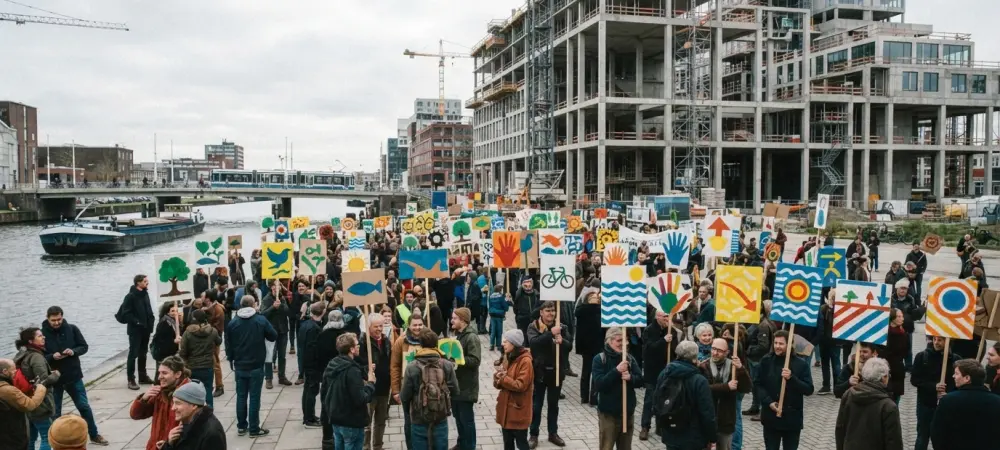
The shift toward direct action at data center sites indicates that public trust is becoming a necessary prerequisite for the successful rollout of national technological sovereignty. On November 6, 2026, the burgeoning tension between the rapid expansion of digital infrastructure and public environmental concerns culminated in a significant direct-action protest in Amsterdam. Over 100 activists, primarily associated with the Dutch group Geef Tegengas and supported by environmental campaigners from Fossielvrij NL, breached the perimeter of a Microsoft data center construction site located in the Sloterdijk district. The facility, a joint project developed by Pure Data Centres for Microsoft with an estimated investment value exceeding $1 billion, became a focal point for an escalation in tactics. Protesters scaled construction cranes and utilized flares to draw attention to their cause. The situation necessitated police intervention, resulting in the detention of approximately 150 individuals on charges of trespassing.
The Coordinated Strategy: A Pan-European Mobilization
The Amsterdam incident was not an isolated event but rather a centerpiece of a coordinated pan-European mobilization. Under the campaign banner “Stop Dirty Data Centres,” activists organized simultaneous actions across 16 different countries throughout the 6th and 7th of November. This movement represents a unified front calling for a moratorium on large-scale data center projects until stricter environmental and regulatory safeguards are established. The scale of these protests signals a shift in strategy for climate advocates, who are now targeting the physical nodes of the internet to demand greater corporate accountability. This international coordination suggests a sophisticated level of organization and a shared belief that the current trajectory of digital infrastructure growth is unsustainable. By synchronizing efforts across borders, the activists aimed to create a systemic disruption that forced governments to reconsider the rapid approval of these massive hyperscale facilities.
Building on this foundation, the tactical shift toward physical occupation marks a new era in environmental advocacy where digital infrastructure is no longer viewed as an abstract entity. For years, the “cloud” remained a metaphor for invisible processes, but the physical reality of concrete and massive power lines has now become a target for those who feel the environmental costs are being ignored. The activists involved in the Sloterdijk occupation demonstrated that traditional lobbying is being supplemented by high-stakes direct action designed to halt construction and drive up financial risks. This approach forces corporate stakeholders to account for delays caused by social friction, effectively incorporating a social risk premium into the cost of business. As these movements gain momentum, the predictability of large-scale infrastructure projects across Europe is being fundamentally challenged by local populations who are now demanding significantly more transparency and community control.
Resource Management: The Friction of Hyperscale Growth
Central to the protesters’ grievances is the massive environmental footprint of hyperscale data centers, which require vast amounts of electricity to power artificial intelligence and millions of gallons of water for cooling systems. In densely populated regions like Amsterdam, these facilities often compete with local residents for limited land and grid capacity, sparking resentment over the prioritization of industrial needs over housing. There is a growing perception that the digital economy is consuming a disproportionate share of the urban commons, leaving little for the communities that host these physical sites. The demand for electricity to support AI workloads has particularly exacerbated the strain on the Dutch power grid, which is already struggling to accommodate the energy transition. Consequently, the once-invisible cloud has become a tangible burden on local infrastructure and shared natural resources, fueling the fire of public discontent and driving the push for stricter regulation.
Beyond ecological concerns, the movement has taken on a significant geopolitical dimension, with activists criticizing the ethical implications of Microsoft’s corporate partnerships. Banners at the site targeted the company’s alleged involvement with international military and immigration authorities, framing the data center as a physical manifestation of unchecked corporate power. This shift suggests that digital infrastructure is no longer viewed as a neutral utility, but as a political entity subject to intense social and ethical scrutiny. Some protesters argued that the data processed within these walls serves interests that are fundamentally at odds with the values of the local population. By highlighting these connections, the “Stop Dirty Data Centres” campaign has successfully expanded its reach to include human rights and social justice advocates. This intersectional approach makes the governance of data centers a multi-front challenge for policymakers who must balance industrial growth with ethics.
Infrastructure Resilience: Security and Future Governance
The breach of the construction site has also raised serious questions regarding the physical security of critical digital infrastructure. While the facility was not yet operational during the protest, the ease of the occupation demonstrates a vulnerability that could have cascading effects on digital service resilience. As these sites become essential to a nation’s economic fabric, industry leaders must find ways to integrate physical site protection with their broader cybersecurity strategies to prevent potential disruptions. The incident showed that even non-violent protesters can effectively shut down operations by occupying key equipment, such as construction cranes or power substations. Moving forward, the boundary between physical security and digital reliability will continue to blur, requiring a more holistic approach to facility management. Developers will need to invest in more robust perimeter defenses and closer coordination with law enforcement to ensure that critical assets remain protected. Ultimately, the events in Amsterdam served as a definitive signal that the era of unquestioned data center expansion reached its limit. Moving forward, the success of the digital transformation depended on transparent decision-making and the industry’s ability to reconcile its immense resource needs with the ecological boundaries of its host cities. For the digital transformation to be successful, it was necessary to move beyond simple capital investment toward a model that secured a genuine social license to operate. Governments were urged to implement more rigorous impact assessments that accounted for the cumulative effects of hyperscale sites on a region’s power supply. Industry leaders realized that community engagement could no longer be a secondary concern but had to be a core pillar of project planning. By adopting proactive communication and offering tangible local benefits, companies could have mitigated the friction that led to the November 2026 occupation.