

AMD recently unleashed the power of Zen 4 Threadripper to the world, and now they are showcasing its impressive overclocking capabilities on both air and liquid cooling. The company has pushed the boundaries of performance by setting multiple world records in benchmarks like Cinebench and GPUPI. Their experimentation with different cooling solutions has yielded remarkable results, with power requirements ranging from 800W to 1,000W per run.
Setting World Records with Custom Cooling Loop
To demonstrate the true power of Zen 4 Threadripper, AMD embarked on a journey to set world records in various benchmarks. Equipped with a custom cooling loop, the team embarked on their quest for glory. Their efforts paid off as they achieved incredible results in the Cinebench and GPUPI benchmarks, while also showcasing the immense power draw associated with pushing the limits of performance.
Experiment with Air Cooling
The experiment began with AMD’s engineers installing a mammoth air cooler onto the formidable Threadripper Pro 7995WX, boasting an astounding 96 cores and 192 threads. This allowed them to explore the CPU’s potential while relying solely on air cooling. Despite the immense power demands, the performance was noteworthy, laying the foundation for even greater feats to come.
Liquid Cooling for Even Higher Performance
To unleash the full potential of the Zen 4 Threadripper, the team transitioned to a liquid cooling setup. By leveraging the superior cooling capabilities of liquid, they would be able to achieve much higher overclocks. Armed with this enhanced cooling solution, they embarked on a rigorous testing phase, subjecting the CPU to a battery of Cinebench and GPUPI tests, all while contending with the stratospheric power requirements that accompany record-breaking performance.
Impressive results in different Cinebench versions
In their pursuit of world records, AMD pushed the limits of Zen 4 Threadripper’s frequency capabilities in various Cinebench versions. In Cinebench R15, the engineers managed to push the chip up to an astonishing 5GHz across all 96 cores, resulting in a jaw-dropping level of performance. Moving onto Cinebench R23, they achieved a frequency of 4,966MHz, further solidifying their dominance in the benchmark and earning themselves another world record.
Record in Cinebench 2024 Despite Increased Demands
Cinebench 2024 presented a more demanding challenge, as it imposed stricter limitations on the achievable frequency. Nevertheless, the engineers persevered and managed to attain a remarkable frequency of 4,825MHz, adding yet another world record to their growing list of accomplishments. This achievement highlighted the immense processing power and overclocking capabilities packed within the Zen 4 Threadripper.
High Clocks in GPUPI Benchmark
The Zen 4 Threadripper continued to excel in the GPUPI benchmark, reaching incredible clock speeds of up to 5,265MHz. This test, known for its lower stress levels, has been widely used in overclocking record runs due to its ability to showcase the limits of a CPU’s frequency capabilities. AMD’s achievement in the GPUPI benchmark further solidified their position as trailblazers in the field of high-performance computing.
Hardware and cooling setup
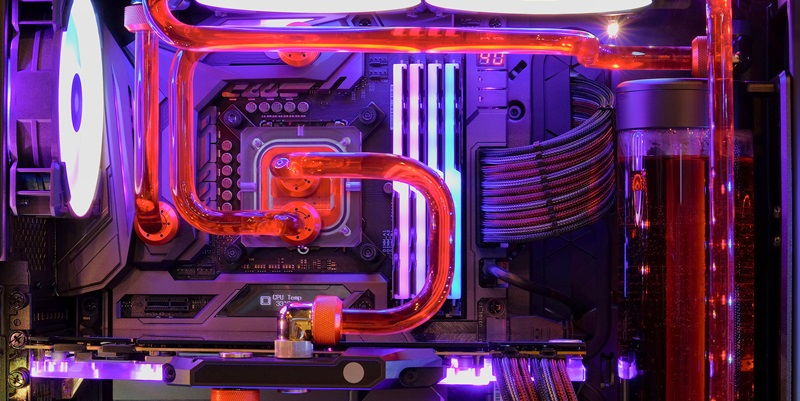
To achieve these groundbreaking results, AMD used top-of-the-line cooling components. They relied on a HeatKiller IV CPU block, which efficiently dissipates heat, a Thermaltake 360mm radiator for optimal cooling, and an Enermax pump to ensure adequate liquid flow. The hardware setup also featured the Asus Pro WS TRX50-Safe Wi-Fi motherboard and 128GB of G.Skill DDR5-3200 memory, providing a stable and high-performance foundation for the testing phase.
Confirmation of Record-Breaking Performance
The Zen 4 Threadripper’s overclocking achievements have surpassed all existing records for CPU performance. These results validate earlier predictions that AMD’s latest offering would redefine the boundaries of high-performance computing. By demonstrating the immense capabilities of their flagship CPU, AMD has cemented their position as a force to be reckoned with in the high-performance computing and gaming community.
The launch of Zen 4 Threadripper marked a new era in CPU performance, and AMD has proven its capabilities by setting multiple world records through overclocking on both air and liquid cooling. The engineering team’s relentless pursuit of performance has resulted in remarkable achievements in benchmarks such as Cinebench and GPUPI. With the combination of innovative cooling solutions and top-tier hardware, AMD has provided a glimpse into the future of high-performance computing and the possibilities that lie ahead.