

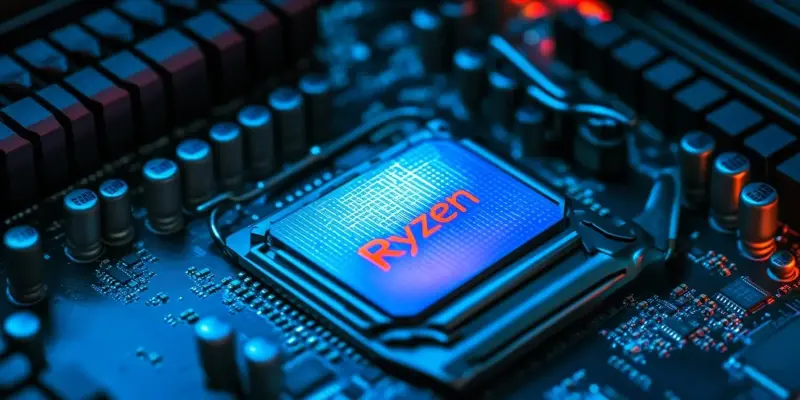
The launch of AMD’s Ryzen AI Max+ 395 chip has created a seismic shift in the portable gaming market, setting new standards for performance and efficiency in 2025. Making its debut in Asus’ ROG Flow Z13 tablet, this flagship processor combines cutting-edge technology and unparalleled capabilities, aiming to transform user experiences across a spectrum of gaming and productivity applications. This introduction sparks curiosity and promises an in-depth look into how the Ryzen AI Max+ 395 is redefining both gaming and computing industries.
Unprecedented Computing Power
The Ryzen AI Max+ 395 is a marvel in the world of portable processors, distinguished by its 16 Zen 5 CPU cores, each capable of running up to 32 threads. Operating at speeds between 3GHz and 5.1GHz, this system-on-chip (SoC) design delivers computing power that rivals traditional workstations, catering to users with high-performance needs. The processor’s architecture supports up to 128GB of unified RAM, facilitating exceptional memory bandwidth and multitasking capabilities. This prowess is particularly advantageous for resource-intensive tasks such as processing large language models and handling complex audiovisual editing workflows, elevating the device’s overall effectiveness.
One of the defining features of the Ryzen AI Max+ 395 is its integrated neural processing unit (NPU), which can perform up to 50 tera operations per second (TOPS). This capability propels the processor ahead of many competitors, including the Qualcomm Snapdragon X Elite, which peaks at 45 TOPS. This positions the Ryzen AI Max+ 395 as a formidable contender for applications that demand robust AI processing, ensuring that it meets the growing needs of future-proof computing. The expansive computational ability not only underscores its power but also emphasizes its relevance in today’s AI-driven technological landscape.
Benchmark Performance
Drawing inspiration from Apple’s M4 chips, the Ryzen AI Max+ 395 adopts a unified RAM system that provides an impressive 256GB per second of memory bandwidth. This feature not only enhances graphics performance but also significantly boosts the efficiency of any software that frequently accesses RAM. The result is a processor that stands among the fastest laptop CPUs on the market today for productivity tasks, as evidenced by strong showings in benchmarks like Geekbench 6 and Cinebench R24. These benchmarks are crucial for validating the processor’s capabilities and comparing its performance to peers.
In Geekbench 6, the ROG Flow Z13 equipped with the Ryzen AI Max+ 395 scored 2,974 in single-core tests, matching the performance levels of AMD’s Ryzen AI 9 HX 370 and Intel’s Arrow Lake H-based Core Ultra Series 2. Its multi-core score of 20,077 not only outpaces its x86 rivals but also aligns closely with the performance of Apple’s M4 Pro chip. Cinebench R24 results echo these findings, with the processor’s 1,463 multi-core score competing competently against AMD’s Ryzen 9 7900 X3D and Intel’s Core Ultra 5 245K. Such robust benchmark results indicate that the processor handles professional-grade applications like Adobe Photoshop 2025 with remarkable ease, making it an essential tool for creative professionals.
AI Development and Unified Memory
The emergence of the Ryzen AI Max+ 395 has significant implications for AI development, particularly when considering its unified memory system. Although benchmarks for large language models are often scarce due to their tendency to run in cloud environments, the unified memory system of this processor provides a tangible advantage for AI developers. By minimizing bottlenecks associated with demanding large amounts of RAM, the unified memory architecture enhances the efficiency of training and deploying AI models, streamlining complex operations and reducing latency.
This optimization becomes particularly valuable as AI applications grow more sophisticated, requiring substantial computational resources and efficient data handling. The Ryzen AI Max+ 395’s ability to manage such demands effortlessly translates to more effective development cycles and swifter iterations of AI models. Developers benefit from a more seamless integration of hardware capabilities with software requirements, making the chip an indispensable tool in the AI development landscape. This dedicated focus on enhancing AI processes underscores AMD’s commitment to advancing technology beyond conventional boundaries.
Integrated GPU Performance
The integrated GPU of the Ryzen AI Max+ 395, known as the Radeon 8060S, stands out as a formidable component in the SoC architecture. Designed with 40 RDNA 3.5 cores, this GPU rivals many dedicated graphics cards, offering modern features like upscaling and ray-traced lighting. The flexibility to allocate up to 24GB of RAM to the GPU, depending on the system’s available memory, allows the Ryzen AI Max+ 395 to handle graphically intensive games and applications with ease and efficiency. This level of GPU capability becomes a game-changer in portable devices, blending compact form factors with superior graphical performance.
Gaming benchmarks provide a clear demonstration of the GPU’s prowess. Titles like “Marvel Rivals” consistently run at 70 to 80 frames per second, maintaining high detail settings and leveraging AMD’s FidelityFX Super Resolution scaling at a native resolution of 2,560 by 1,600. Other popular games such as “Counter-Strike 2” and “Destiny 2” frequently surpass 100 frames per second at maximum settings, showcasing the CPU’s strength and the integrated GPU’s ability to handle demanding visual and processing tasks. Newer titles like “Indiana Jones and the Great Circle” and “Avowed” also run smoothly, albeit sometimes requiring adjustments to the visual settings.
Limitations and Battery Life
Despite its impressive capabilities, the Ryzen AI Max+ 395 does face notable limitations, particularly in terms of battery life and thermal management. The processor’s thermal design power (TDP) ranges from 45W to 120W, contributing to significant energy consumption and heat production during high-performance tasks. This energy demand is substantially higher than that of Apple’s M4 Pro, which peaks at 46W, resulting in a stark contrast in battery performance. Consequently, the ROG Flow Z13’s battery life suffers, offering only three to four hours of productivity on tasks such as Adobe Photoshop, web browsing, and occasional video calls or music streaming.
Gaming and creative applications further deplete the battery, highlighting the need for improved power efficiency and thermal performance. For heavy users, this limitation necessitates frequent charging or operation in power-conserving modes, which might not always be practical. As impressive as the processor’s capabilities are, these drawbacks must be considered to ensure users can make informed choices about their devices.
Mitigation Strategies
To address these limitations, Asus has implemented several strategies, including an advanced fan system and additional operational modes like Silent mode. These features aim to reduce power consumption, heat, and noise, making the device more suitable for less intensive activities like watching videos or handling light workloads. However, such modes are not the primary use cases for a high-performance machine like the ROG Flow Z13, whose strengths lie in its ability to handle demanding tasks effectively.
Despite these mitigations, users must still weigh the trade-offs between raw power and battery efficiency. Enthusiasts and professionals who require the performance benefits of the Ryzen AI Max+ 395 need to consider the device’s operational constraints, balancing their experience with practical use. This focus on trade-offs underscores the ongoing challenge of integrating maximum performance within portable form factors.
While the AMD Ryzen AI Max+ 395 heralded a new era in portable gaming and productivity, users must understand the broader context of its capabilities to fully appreciate its potential. This processor breaks new ground, but its power-hungry nature underscores the need for continued advancements in battery and thermal management technologies.
Future Considerations
The introduction of AMD’s Ryzen AI Max+ 395 chip has caused a significant disruption in the portable gaming market, setting a new benchmark for performance and efficiency in 2025. This advanced processor makes its first appearance in Asus’ ROG Flow Z13 tablet, merging state-of-the-art technology with exceptional capabilities. The Ryzen AI Max+ 395 promises to revolutionize user experiences across a wide range of gaming and productivity applications. As a result, it has sparked a great deal of interest, paving the way for an extensive exploration into how it is reshaping both the gaming and computing sectors. The chip is set to deliver unparalleled speed, graphic quality, and computing power, ensuring that gamers and professionals alike enjoy smoother and more immersive experiences. By bringing more power to portable devices, the Ryzen AI Max+ 395 is expected to influence future developments, making it a pivotal advancement in the tech landscape. This launch underscores the ongoing evolution in chip design, pushing the boundaries of what portable devices can achieve.