

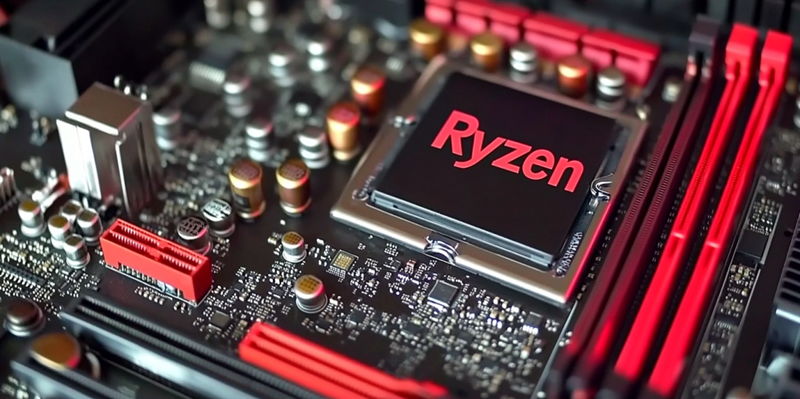
The overclocking potential of CPUs has always been a significant focal point for tech enthusiasts and gamers. Over the years, AMD has continually pushed the boundaries of computational performance, and its latest release, the Ryzen 9800X3D, is now making waves in the tech community for its groundbreaking overclocking capabilities. While past X3D models have promised high performance, the ability to push these chips to their absolute limits marks a significant advancement in the realm of consumer CPUs.
Unleashing Unprecedented Clock Speeds
The Role of Liquid Nitrogen in Overclocking
AMD’s Ryzen 9800X3D processor has achieved an unprecedented milestone, with initial reports highlighting clock speeds of up to 6.9GHz when cooled using liquid nitrogen. This advanced cooling method, though unconventional for mainstream users, has allowed the processor to reach its peak performance potential. Historically, achieving such high clock speeds required not just robust hardware but often extreme cooling solutions to maintain stability and prevent thermal throttling. The use of liquid nitrogen in this instance provided the necessary thermal headroom to push the Ryzen 9800X3D beyond its factory limits, showcasing the chip’s robust architecture and design.
This leap in performance is significantly attributed to the innovative 3D V-Cache technology, which has been strategically positioned underneath the CPU chiplet die (CCD). This placement improves thermal dissipation, allowing for more efficient cooling. By enhancing the cooling efficiency, AMD has managed to unlock higher overclocking potential without compromising the durability or longevity of the processor. This breakthrough is particularly exciting for overclocking enthusiasts who continually seek to extract maximum performance from their hardware setups.
Benchmarking Gaming Performance
In terms of gaming performance, the Ryzen 9800X3D has set a new standard, particularly in popular titles like Counter-Strike 2 and Valorant. When tested at 1080p with maxed-out settings, the processor delivered an astounding 1,262.9 frames per second (fps) in Counter-Strike 2. This performance is further eclipsed in Valorant, where the Ryzen 9800X3D managed to exceed 1,500 fps under similar testing conditions. These results underscore the processor’s capability to handle high-refresh-rate gaming scenarios, making it a formidable contender in the gaming arena.
The implications of such high frame rates are profound for professional gamers and esports athletes who demand split-second response times and buttery-smooth gameplay. The exceptional gaming performance of the Ryzen 9800X3D positions it favorably against Intel’s Core i9-14900K, particularly when considering the efficiency and lower power consumption of AMD’s offering. This combination of high performance and power efficiency is a significant draw for gamers looking to build or upgrade their gaming rigs while maintaining manageable power usage levels.
Efficiency and Power Consumption
Power Efficiency Compared to Rivals
Efficiency in power consumption is one of the defining aspects separating the Ryzen 9800X3D from its competitors. Despite its remarkable performance, the processor operates at around 100 watts under load, significantly lower than Intel’s Core i9-14900K, which can draw up to 360 watts. This stark difference places the Ryzen 9800X3D in an advantageous position for users who are not only conscious of performance but also environmental and economic considerations related to energy usage. Efficient power consumption also translates to lower heat production, easing the cooling requirements for high-performance computing tasks.
Even when overclocked, the Ryzen 9800X3D maintains a commendable balance between performance and power efficiency. Extensive testing has shown that the frame rates achieved in gaming scenarios are on par with or exceed Intel’s offerings, albeit at lower clock speeds. This balance is pivotal for users who push their systems through intensive workloads, including gaming, streaming, and content creation, without experiencing spikes in energy bills or excessive thermal output that would necessitate more advanced cooling solutions.
Performance in Synthetic Benchmarks
The Ryzen 9800X3D also holds its ground in synthetic benchmarks, with performance metrics confirming its prowess beyond gaming. In the Cinebench R23 benchmark, the processor achieved a score of 30,513 points. This performance is approximately one-third faster than previous results recorded with Precision Boost Overdrive using conventional cooling methods. Such improvements in benchmark scores demonstrate the processor’s well-rounded capability, suitable for multitasking environments, productivity applications, and professional workloads requiring intense computational power.
Additionally, this benchmark success reveals the Ryzen 9800X3D’s capability to cater to a broader audience, beyond just gamers. Content creators, designers, and other professionals requiring reliable and fast processing will find this CPU an attractive option. The significant leap in performance using more standard cooling setups, as indicated by the Cinebench R23 score, showcases that users do not necessarily need to invest in exotic cooling methods to harness the full potential of this processor. This accessibility makes high-end performance achievable for a more extensive user base.
Innovations and Market Impact
Design Innovations with 3D V-Cache
One of the standout features contributing to the Ryzen 9800X3D’s enhanced performance is the innovative design of its 3D V-Cache technology. By placing the 3D V-Cache underneath the main chip die, AMD has significantly improved the cooling efficiency and overclocking capabilities of the CPU. This design innovation is not just about achieving high clock speeds but also about maintaining stability and efficiency under sustained loads. The improved thermal management afforded by this design ensures that the processor can handle intensive tasks for extended periods without overheating or throttling.
The strategic positioning of the 3D V-Cache also enhances the overall performance of the processor in real-world applications, providing quicker access to frequently used data and improving latency. This improvement is particularly noticeable in gaming scenarios and other applications that demand high-speed data processing. Such advancements highlight AMD’s commitment to pushing the envelope in CPU design, ensuring that each new generation offers tangible improvements in performance and efficiency.
Addressing Pricing Concerns
While the Ryzen 9800X3D offers substantial performance gains and efficiency improvements, there are considerations regarding its pricing. As with most high-end technology, the cost is a critical factor for many potential buyers. The 9800X3D comes with a slight price increase over its predecessor, which may raise questions about its value proposition. However, the significant enhancements in performance and power efficiency might justify this increase for users seeking top-tier performance without the associated high power consumption of rival CPUs.
Moreover, the potential savings in energy costs over the CPU’s lifespan could offset the initial investment, making it a financially viable option in the long run. Additionally, the broader accessibility of its overclocking potential, even in standard configurations, adds to its value proposition. Unlike previous generations that required exotic cooling solutions for high performance, the Ryzen 9800X3D allows users to achieve impressive results with more conventional setups, broadening its appeal to a wider audience.
Conclusion
The overclocking potential of CPUs has always been a hot topic among tech enthusiasts and gamers. Over recent years, AMD has consistently pushed the envelope in computational performance. Its latest release, the Ryzen 9800X3D, is causing quite a stir within the tech community, thanks to its impressive overclocking capabilities. While AMD’s previous X3D models had already promised high performance levels, the ability to push these chips to their absolute limits represents a major advancement in the field of consumer CPUs.
Many enthusiasts have been eagerly awaiting a CPU that could meet their demanding needs, and the Ryzen 9800X3D seems to be just the answer. This new chip not only promises better performance but also offers unparalleled overclocking potential that was previously only a dream. As a result, gamers and tech aficionados are excited about the possibilities that the Ryzen 9800X3D brings to the table, potentially redefining standards for consumer-grade CPUs and setting a new benchmark for what high-performance computing can achieve.