

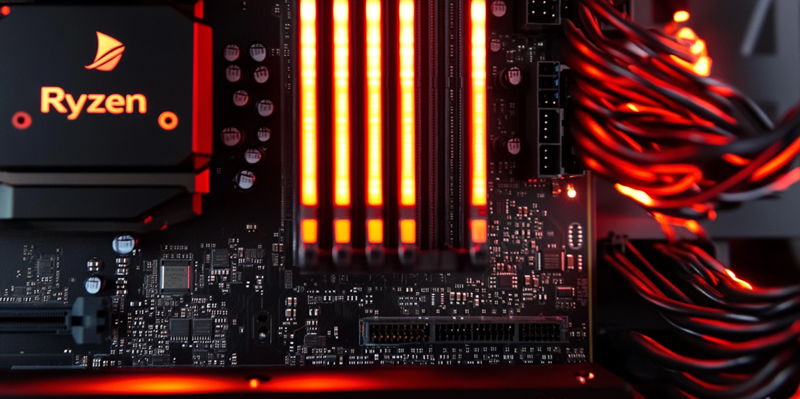
The upcoming AMD Ryzen 7 9800X3D CPU has been generating significant buzz due to its impressive performance benchmarks, showcasing both remarkable single-core (ST) and multi-thread (MT) capabilities. This processor boasts a state-of-the-art 8-core, 16-thread configuration, built upon the advanced Zen 5 architecture, which integrates a myriad of innovative features enhancing its overall performance. Among its standout attributes are the base clock speed of 4.7 GHz and a boost clock speed of up to 5.2 GHz, paired with a lower thermal design power (TDP) of 120W, ensuring efficient yet powerful processing. Notably, the AMD Ryzen 7 9800X3D is equipped with 32 MB of L3 cache, 64 MB of 3D stacked cache, and 8 MB of L2 cache, showcasing its well-rounded and expansive caching capabilities. Recent benchmarks derived from Geekbench 6.3 reveal the processor’s superior performance parameters, utilized in conjunction with an ROG Crosshair X870E Hero motherboard and 32 GB of DDR5-6000 memory, achieving a remarkable overclocked speed of 5.5 GHz.
Benchmark Insights and Comparisons
In terms of performance metrics, the Ryzen 7 9800X3D CPU secured a score of 3473 points in single-core tests and an astounding 19,216 points in multi-core assessments. These scores highlight the substantial improvements over its predecessor, marking a 27% increase in performance, thereby setting new standards in the CPU market. Interestingly, these results position the Ryzen 7 9800X3D on par with some higher-core-count processors, including the Ryzen 9 7950X and Intel’s Core Ultra 7 265K. This positioning is a testament to AMD’s continuous commitment to delivering high-performance, cost-effective solutions within the competitive landscape of desktop processors. According to AMD, the Ryzen 7 9800X3D offers an 8% performance improvement over the 7800X3D and a notable 20% enhancement compared to the Intel Core Ultra 9 285K, emphasizing the significant leap in processing power and efficiency.
The integration of 3D V-Cache stacking technology further augments the Ryzen 7 9800X3D’s performance, bolstering both its speed and efficiency. This innovative technology has been pivotal in cementing the 9800X3D’s reputation as a formidable contender within the high-performance CPU sector. Scheduled for launch on November 7th and priced at $479—$30 more than the MSRP of its predecessor, the 7800X3D—the Ryzen 7 9800X3D aims to offer enhanced value and superior computing capabilities. Given these enhancements and pricing adjustments, the advanced processing features embedded within the Ryzen 7 9800X3D make it a compelling option for users seeking a balance between robust performance and cost efficiency.
AMD’s Expanding Granite Ridge Lineup
Further broadening the scope of its desktop CPU offerings, AMD has introduced several other processors within the Ryzen 9000 "Granite Ridge" series. This lineup showcases various architectures, core/thread configurations, clock speeds, and price points, catering to diverse user requirements ranging from casual computing to demanding professional applications. Such variety within the Ryzen 9000 series guarantees that AMD continues to meet and exceed market expectations by addressing different performance needs while maintaining high standards of quality and innovation. Furthermore, these processors encapsulate AMD’s progressive strides in technological development, ensuring that they remain at the forefront of desktop processing capabilities.
Among the notable entries in this lineup, the Ryzen 7 9800X3D stands out for its exemplary gaming performance, making it a top recommendation for gaming PCs. Its advanced architecture and integrated features render it exceptionally capable of handling intensive gaming workloads, ensuring smooth and responsive gaming experiences. The strategic enhancements embedded within the Ryzen 7 9800X3D, particularly the 3D V-Cache and high clock speeds, significantly contribute to minimizing latency, thereby delivering a superior gaming environment. Such advancements reflect AMD’s dedication to pushing the boundaries of processing technology, offering users unparalleled performance coupled with state-of-the-art innovations.
Conclusion
The highly anticipated AMD Ryzen 7 9800X3D CPU is generating significant excitement, thanks to its impressive performance benchmarks that highlight exceptional single-core (ST) and multi-thread (MT) capabilities. This cutting-edge processor features an 8-core, 16-thread configuration built on the advanced Zen 5 architecture, which incorporates numerous innovative features to boost performance. With a base clock speed of 4.7 GHz and a boost clock speed of up to 5.2 GHz, coupled with a low thermal design power (TDP) of 120W, it ensures efficient yet powerful processing.
One noteworthy aspect of the AMD Ryzen 7 9800X3D is its comprehensive caching capabilities, including 32 MB of L3 cache, 64 MB of 3D stacked cache, and 8 MB of L2 cache. Recent Geekbench 6.3 benchmarks demonstrate the processor’s superior performance, tested with an ROG Crosshair X870E Hero motherboard and 32 GB of DDR5-6000 RAM. The processor achieved an impressive overclocked speed of 5.5 GHz, showcasing its potential for high-end computing tasks.