

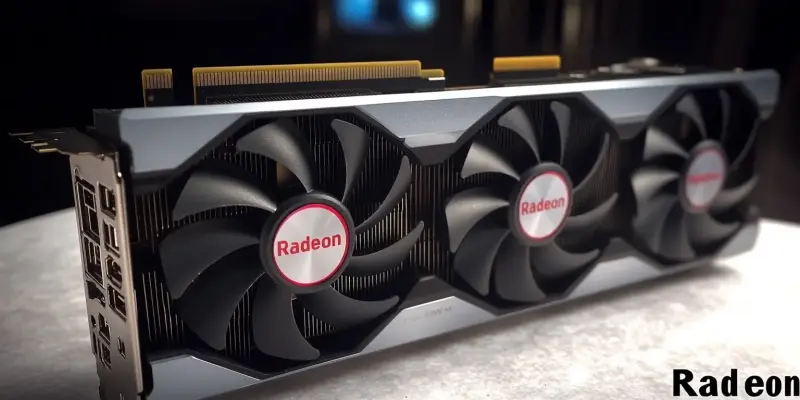
Anticipation has been building among tech enthusiasts as AMD prepares to officially unveil the Radeon RX 9070 and 9070 XT graphics cards, showcasing substantial improvements slated for next month. The buzz surrounding these next-generation GPUs has been fueled by leaked specifications, pricing, and performance benchmarks, signaling impressive advancements over previous models. With AMD set to take the stage, excitement is palpable in the tech community, eager to witness what these new GPUs have to offer.
Specifications and Architecture
The Radeon RX 9070 XT boasts an impressive array of features, designed to deliver unparalleled performance in both gaming and professional applications. It comes equipped with 64 RDNA 4 compute units, 64 ray accelerators, 128 AI accelerators, and a remarkable 4096 stream processors. Clock speeds are equally impressive, with a game clock of 2400 MHz and a boost clock that reaches up to 2970 MHz, providing a substantial compute performance of 48.7 TFLOPS in single-precision tasks. This performance is made possible by the 4nm manufacturing process, which includes a transistor count of 53.9 billion and a die size of 357 mm².
In comparison, the standard RX 9070, while slightly less powerful, still packs a significant punch. It features 56 RDNA 4 compute units, 56 ray accelerators, 112 AI cores, and 3584 stream processors. Clock speeds are marginally lower than the XT variant, yet it promises to deliver exceptional performance gains over its predecessors. Both the RX 9070 and RX 9070 XT represent a significant leap from previous AMD models like the Radeon 7900 GRE and 6900 XT, underlining AMD’s commitment to advancing GPU technology.
Performance Benchmarks
Performance benchmarks for the new GPUs illustrate substantial gains over previous AMD models, positioning the RX 9070 and RX 9070 XT as formidable contenders in the graphics card market. The RX 9070 XT, in particular, showcases a significant 42 percent increase in performance over the 7900 GRE when tested across a range of raster and ray tracing 4K workloads. This improvement highlights AMD’s strides in GPU technology, emphasizing the enhanced capabilities of the RDNA 4 architecture.
Improvements in ray tracing performance are especially noteworthy, as both the RX 9070 and RX 9070 XT demonstrate marked advancements. The RX 9070 outperforms the 7900 GRE by 4 to 28 percent in raster performance and surpasses it by a substantial 38 percent in ray tracing tasks. Meanwhile, the RX 9070 XT exceeds expectations with an increase of 23 to 46 percent in raster tasks and a remarkable 68 percent boost in ray tracing performance. These gains reflect AMD’s focus on elevating the quality and efficiency of ray tracing, offering users a more immersive and graphically rich experience.
Game Testing and Methodology
In their evaluation of the Radeon RX 9070 series, AMD tested the new GPUs across a diverse selection of games, incorporating both hardware-accelerated ray tracing and raster-only titles to provide a comprehensive overview of performance. Titles such as Cyberpunk 2077 and Star Wars Outlaws were used to showcase the capabilities of hardware-accelerated ray tracing, while games like God of War Ragnarök and Starfield highlighted the prowess of the GPUs in raster-only performance. This method offers a well-rounded assessment, emphasizing AMD’s ability to deliver top-tier performance in various gaming scenarios.
AMD’s testing methodology involved using ultra or maximum graphics settings without incorporating upscaling or frame generation techniques, providing an accurate representation of the raw power and capabilities of the new GPUs. This approach contrasts with Nvidia’s testing methods, offering a distinct perspective on performance metrics. By focusing on these high-demand settings, AMD underscores the significant improvements in ray tracing and overall graphical fidelity that the RX 9070 series brings to the table.
Pricing and Market Positioning
The leaked pricing information from temporary listings at Micro Center suggests that AMD has strategically positioned the RX 9070 and RX 9070 XT to compete directly with Nvidia’s mid-range offerings. The RX 9070 is expected to start at $649.99, while the RX 9070 XT will be priced slightly higher at $699.99. These price points are designed to attract gamers and tech enthusiasts looking for high-performance graphics cards without breaking the bank, offering a compelling alternative to Nvidia’s RTX 5070 Ti and 5070.
AMD’s pricing strategy reflects their intent to destabilize Nvidia’s hold on the mid-range GPU market, providing consumers with robust options that deliver exceptional performance at competitive prices. By positioning the RX 9070 series within the $600 to $700 range, AMD aims to attract a wide audience, from hardcore gamers to professional users seeking top-tier performance. This calculated move highlights AMD’s commitment to expanding their market share and challenging Nvidia’s dominance.
Strategic Advancements
Anticipation among tech enthusiasts is peaking as AMD gears up to unveil the Radeon RX 9070 and 9070 XT graphics cards. These highly awaited GPUs are set to debut next month, and the tech community can’t contain its excitement. The forthcoming reveal promises significant enhancements, and speculation has been rife due to leaked specifications, pricing, and performance benchmarks. Early data indicates that these new models will offer remarkable improvements over their predecessors, driving the excitement to a fever pitch.
Discussions on forums and social media are buzzing, with enthusiasts analyzing every snippet of information available. The general consensus is that these GPUs will set new standards in performance and efficiency, making them a hot topic among gamers and tech users. AMD’s impending announcement is not just another product launch; it’s a pivotal moment for the company, showcasing how far they’ve come in the competitive world of graphics technology. As the unveiling date approaches, the tech community is brimming with questions and energy, ready to see firsthand the capabilities of AMD’s latest innovations.