

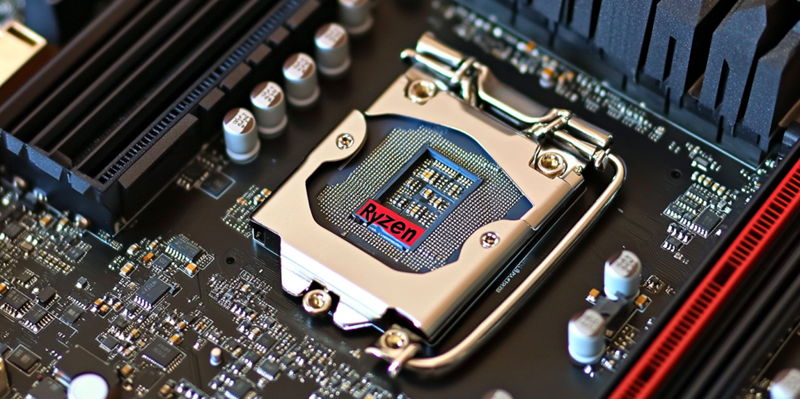
AMD has recently announced the availability of its latest and highly advanced CPU for gaming, the Ryzen 7 9800X3D, which is now on sale for $479. This groundbreaking CPU, built on the new Zen 5 architecture and featuring revolutionary 3D V-Cache technology, has been designed specifically to be the fastest for gaming, targeting enthusiasts and competitive gamers alike. With its robust specifications and significant performance improvements over its predecessor, the 7800X3D, the Ryzen 7 9800X3D is poised to become a game-changer in the world of high-performance gaming.
Exceptional Performance and Advanced Architecture
Built on the Zen 5 Architecture
The Ryzen 7 9800X3D utilizes AMD’s state-of-the-art Zen 5 architecture, a drastic improvement over the previous generation. This enhanced architecture includes eight cores and sixteen threads, delivering a base clock speed of 4.7 GHz and a maximum boost clock of 5.2 GHz. This combination of cores and clock speeds translates into an unparalleled level of performance and efficiency. The CPU also features 32 MB of L3 cache coupled with an additional 64 MB 3D V-Cache stack, which considerably amplifies the gaming performance by enabling faster data retrieval and processing.
The inclusion of the second-generation 3D V-Cache technology plays a pivotal role in augmenting the overall performance. By stacking more cache directly on the processor die, latency is reduced and bandwidth is increased, leading to smoother and more responsive gameplay. Additionally, this generation supports overclocking, further pushing the boundaries of what gamers can achieve in terms of speed and efficiency. Despite these enhancements, the Ryzen 7 9800X3D maintains a 120W TDP, ensuring it remains energy efficient while delivering top-tier performance.
Simplified Integration for Existing AM5 Platform Users
One of the standout features of the Ryzen 7 9800X3D is its seamless integration for users currently operating within the AM5 platform. This ensures that those who have invested in the AM5 platform over the past two years can upgrade swiftly and easily, without encountering compatibility issues. This ease of upgrade significantly reduces the total cost of ownership for gamers, providing an attractive option for those looking to keep their systems on the cutting edge of technology.
The straightforward integration is complemented by the CPU’s support for leading technologies and standards, making it compatible with the latest DDR5 memory modules and PCIe 5.0 devices. As a result, users can expect improved system responsiveness and multitasking capabilities. This compatibility extends to various major retailers, where consumers can purchase the Ryzen 7 9800X3D, making it accessible to a wide audience eager to experience the next level of gaming performance.
Future of the Ryzen 9000 Series
Anticipated High-End CPUs: Ryzen 9 9950X3D and 9900X3D
Looking ahead, AMD has shared an intriguing glimpse into the future of the Ryzen 9000 series by revealing upcoming high-end CPUs like the Ryzen 9 9950X3D and the 9900X3D. These future models are expected to offer even higher levels of performance, positioning themselves as the flagship products in AMD’s lineup. The Ryzen 9 9950X3D, for instance, is anticipated to feature an impressive 16 cores and 32 threads, with clock speeds surpassing those of the Ryzen 7 9800X3D, promising to set new benchmarks in the gaming CPU market.
Additionally, these models are likely to continue leveraging 3D V-Cache technology, further amplifying cache sizes and therefore improving gaming performance and efficiency. The inclusion of integrated graphics is also expected, providing a holistic solution for gamers who prefer an all-in-one package. These forthcoming CPUs are designed to support higher memory speeds and larger memory capacities, ensuring that they remain future-proof and capable of handling the increasing demands of upcoming gaming titles and software applications.
Specifications and Market Positioning
AMD has recently launched its latest and most advanced gaming CPU, the Ryzen 7 9800X3D, now available for $479. This cutting-edge processor, constructed on the new Zen 5 architecture and incorporating the innovative 3D V-Cache technology, is engineered to be the fastest CPU for gaming. It aims to serve the needs of both gaming enthusiasts and competitive gamers. With its impressive specifications, this new chip offers substantial performance enhancements over its predecessor, the 7800X3D. The Ryzen 7 9800X3D is expected to redefine high-performance gaming, offering gamers remarkable speed and efficiency. The 3D V-Cache technology particularly sets it apart, allowing for greater performance in gaming applications by increasing the amount of cache available, thus reducing latency and improving overall gameplay experience. Whether you’re a casual gamer or one who competes at the highest levels, this new processor promises to deliver exceptional performance, meeting the demands of modern gaming and future-proofing for upcoming gaming innovations.