
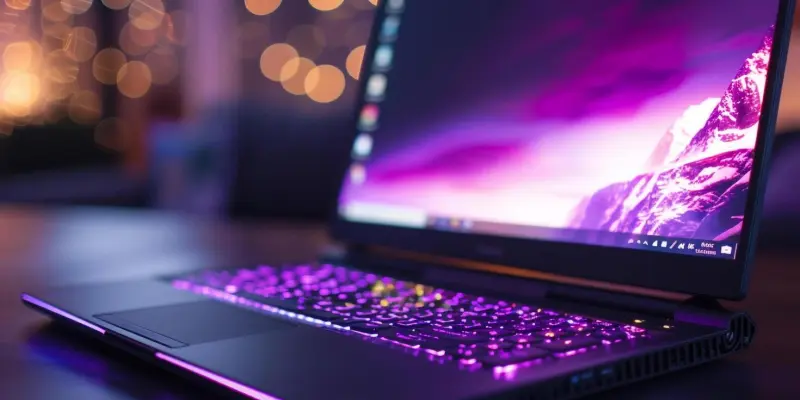
Alienware Launches Aurora Series Gaming Laptops

Article Highlights
Off On

In an exciting development for gaming enthusiasts, Alienware unveiled two remarkable gaming laptops, the Alienware 16 Aurora and the 16X Aurora. This launch marks Alienware’s introduction of Aurora-named models, the first of their kind in nearly two decades. These laptops are designed to offer cutting-edge performance while being accessible at competitive price points, beginning at $1,149 for the 16 Aurora and $1,949 for the 16X Aurora. The Alienware 16 Aurora showcases a 16-inch display boasting a resolution of 2,560 x 1,600 with a 120Hz refresh rate. Equipped with a Core i5 processor, RTX 3050 GPU, and 8GB of RAM in its basic configuration, it sets a solid foundation for high-quality gaming experiences. Furthermore, for those seeking enhanced capabilities, options are available to upgrade the laptop to a Core i9 CPU, RTX 5070, up to 32GB of RAM, and a generous 2TB of storage, paving the way for ultimate performance.

Advanced Features and Versatility

The 16X Aurora gaming laptop sets a new benchmark in design, boasting impressive specs. It weighs 5.9 pounds and enhances gameplay with a 240Hz refresh rate and 500 nits peak brightness. Integrated with advanced tech, it’s powered by an Arrow Lake Intel chip, upgradeable to Core Ultra 9 275HX for more processing prowess. Its base includes an RTX 5060 GPU and 16GB RAM, with options for up to 64GB RAM and 4TB storage. Connectivity features a variety of ports, including USB-A, USB-C, HDMI 2.1, Ethernet, and Wi-Fi 7. The addition of Thunderbolt 4 offers rapid data transfer and enhanced docking capabilities. Distinct from Alienware’s robust Area-51 lineup, the Aurora series offers sleek portability with high performance. Its thoughtful design includes a thermal system beneath the device with exhaust vents and ultra-thin fans to manage temperature during intense gaming. Available in North America, the Aurora series targets tech-savvy users valuing powerful and stylish gaming laptops, exemplifying Alienware’s innovative legacy.

Explore more

Resilience Becomes the New Velocity for DevOps in 2026

With extensive expertise in artificial intelligence, machine learning, and blockchain, Dominic Jainy has a unique perspective on the forces reshaping modern software delivery. As AI-driven development accelerates release cycles to unprecedented speeds, he argues that the industry is at a critical inflection point. The conversation has shifted from a singular focus on velocity to a more nuanced understanding of system

Can a Failed ERP Implementation Be Saved?

The ripple effect of a malfunctioning Enterprise Resource Planning system can bring a thriving organization to its knees, silently eroding operational efficiency, financial integrity, and employee morale. An ERP platform is meant to be the central nervous system of a business, unifying data and processes from finance to the supply chain. When it fails, the consequences are immediate and severe.

When Should You Upgrade to Business Central?

Introduction The operational rhythm of a growing business is often dictated by the efficiency of its core systems, yet many organizations find themselves tethered to outdated enterprise resource planning platforms that silently erode productivity and obscure critical insights. These legacy systems, once the backbone of operations, can become significant barriers to scalability, forcing teams into cycles of manual data entry,

Is Your ERP Ready for Secure, Actionable AI?

Today, we’re speaking with Dominic Jainy, an IT professional whose expertise lies at the intersection of artificial intelligence, machine learning, and enterprise systems. We’ll be exploring one of the most critical challenges facing modern businesses: securely and effectively connecting AI to the core of their operations, the ERP. Our conversation will focus on three key pillars for a successful integration:

Trend Analysis: Next-Generation ERP Automation

The long-standing relationship between users and their enterprise resource planning systems is being fundamentally rewritten, moving beyond passive data entry toward an active partnership with intelligent, autonomous agents. From digital assistants to these new autonomous entities, the nature of enterprise automation is undergoing a radical transformation. This analysis explores the leap from AI-powered suggestions to true, autonomous execution within ERP