

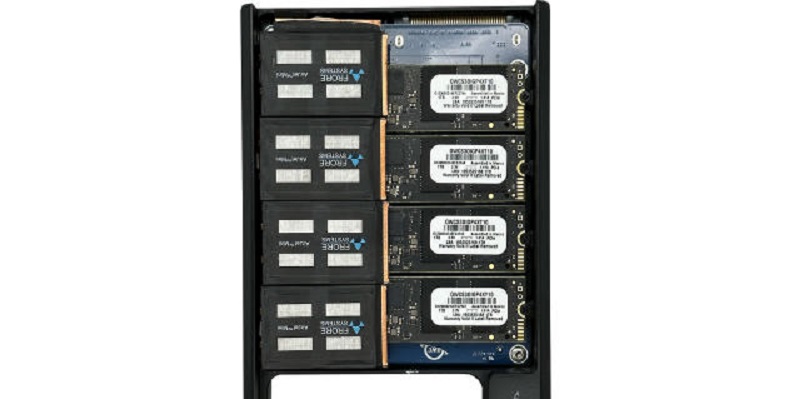
An innovative cooling device named AirJet, developed by Frore Systems, has once again taken the spotlight with its groundbreaking technology. This time, AirJet has powered the industry’s fastest and smallest storage device, a unique 64TB solid-state drive (SSD) enclosure sold by Other World Computing (OWC). This cutting-edge device combines massive storage capacity with efficient cooling, making it a game-changer in the storage industry.
Unique 64TB SSD Enclosure Revolutionizes Storage Capacity
OWC has introduced an extraordinary 64TB SSD enclosure that utilizes eight M.2 SSDs, each with a whopping 8TB capacity. This remarkable setup allows for a total storage capacity of 64TB. The OWC Mercury Pro U.2 Dual storage device, housing these eight SSDs, adopts a compact 3.5-inch U.2 enclosure design, defying conventional expectations of size in relation to storage capacity.
Silent Cooling Technology Enhances Performance
What truly sets this AirJet-powered storage device apart is its silent cooling technology. Each individual SSD in the enclosure is cooled by the AirJet Mini, a cooling system developed by Frore Systems. The AirJet Mini ensures efficient cooling without generating any noise, an invaluable feature for users seeking a quiet storage solution. By keeping the SSDs at optimal temperatures, this cooling mechanism enhances the overall performance and reliability of the device.
Compact Design Challenges Traditional Form Factors
The design of the 64TB OWC Mercury Pro U.2 Dual storage device, combined with the AirJet Mini cooling system, challenges the traditional concept of storage enclosures. Despite accommodating eight massive 8TB SSDs, this device retains a remarkably compact form factor. Its 3.5-inch U.2 enclosure efficiently stacks all eight SSDs, showcasing the fusion of storage capacity and compactness.
AirJet Mini Technology – Efficient Cooling in a Compact Package
The AirJet Mini, developed by Frore Systems, is the key behind the exceptional cooling capabilities of this device. This solid-state cooler is a mere 2.8mm thick, yet it can efficiently dissipate up to 5W of heat. The combination of its slim design and powerful cooling performance allows for seamless integration within the compact enclosure design.
Superior Cooling Advantages Put AirJet Ahead of Conventional Methods
Frore Systems claims that conventional cooling methods, such as active fans or thick heatsinks, would render a storage device of this nature “inoperable.” The AirJet technology revolutionizes cooling by eliminating the need for noisy fans while preserving efficient cooling capabilities. The compact and silent AirJet Mini surpasses traditional cooling solutions in terms of both performance and practicality.
Enhancing CPU Performance and Operating Silently
The advantages of the AirJet cooling technology extend beyond storage devices. Frore Systems states that their innovative technology can also improve CPU cooling, enabling higher clock speeds and prolonged performance while operating in absolute silence. This breakthrough has promising implications for users seeking high-performance computing systems with minimal noise distractions.
Expansion of AirJet Technology Into Consumer Devices
The OWC Mercury Pro U.2 Dual storage device marks the first external storage product to incorporate the AirJet cooling technology. As its success gains recognition, it is highly likely that AirJet technology will find its way into more consumer devices in the future. This pioneering integration of superior cooling capabilities in a compact and silent package will revolutionize the way we perceive and utilize storage and computing devices.
In conclusion, the AirJet-powered 64TB SSD enclosure introduced by OWC showcases the tremendous potential of innovative cooling technology. By utilizing the AirJet Mini cooling system developed by Frore Systems, this storage device combines unrivaled storage capacity with efficient cooling in a compact and silent package. The possibilities for further integrating AirJet technology into various consumer devices are vast, promising enhanced performance and minimizing noise distractions. The future of storage and computing devices is undoubtedly being reshaped by the groundbreaking AirJet technology.