

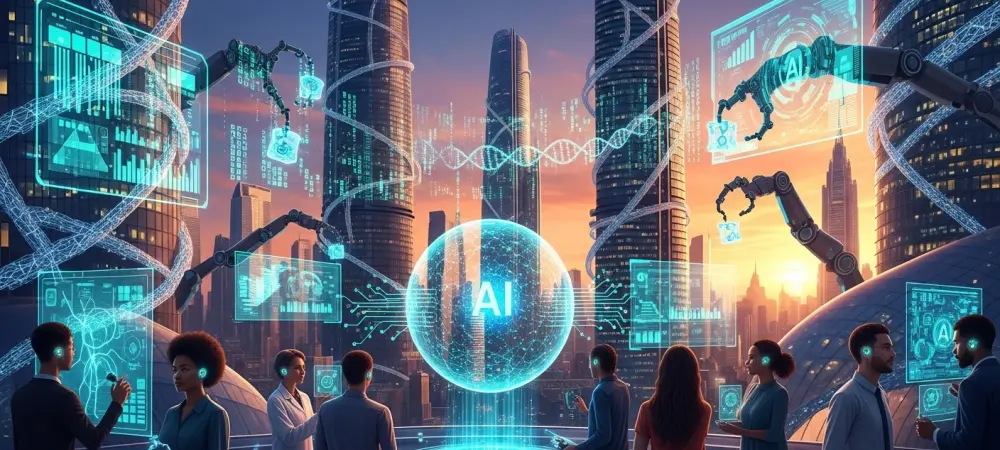
Picture a world where technology doesn’t just provide raw data but engages in meaningful dialogue, offering tailored insights and solutions to complex problems at the snap of a finger. This is no longer a distant dream but the reality of the Intelligence Age, a transformative era driven by the meteoric rise of artificial intelligence (AI). Unlike the Information Age, which redefined access to knowledge through static tools like search engines and smartphones, this new epoch introduces a dynamic partnership between humans and machines. AI has evolved from a mere repository of facts into a synthetic mind capable of learning, reasoning, and adapting to individual needs. This shift marks a pivotal moment in history, promising to reshape societal structures, enhance human capabilities, and push the boundaries of what civilization can achieve. As this technology integrates deeper into daily life, it challenges long-held notions of how knowledge is acquired and applied, setting the stage for an unprecedented intellectual revolution.
From Data Access to Cognitive Partnership
The Information Age brought a seismic change by placing vast amounts of data at humanity’s fingertips through innovations like search engines and mobile devices. Tools such as Google became gateways to endless information, yet they often left users to navigate and interpret static results on their own. Hours could be spent sifting through links to piece together answers, a process that, while groundbreaking at the time, now feels cumbersome. The Intelligence Age, sparked by advancements like conversational AI platforms introduced in late 2022, flips this model on its head. Instead of presenting unfiltered data, AI delivers precise, contextual responses that mimic a thoughtful conversation. This leap from passive access to active engagement signifies a profound reimagining of technology’s role, moving beyond mere convenience to become a collaborator in understanding and problem-solving across diverse domains.
What sets the Intelligence Age apart is AI’s emergence as a “thought partner” in ways that previous technological eras could never match. The Industrial Age amplified physical strength through machinery, while the Information Age focused on democratizing data. Now, AI offers a form of synthetic cognition, processing intricate queries with nuanced reasoning. Imagine posing a question about a philosophical concept and receiving an explanation tailored to a specific level of understanding, or requesting an analysis of emotional undertones in a public speaker’s voice and getting a detailed breakdown. This capacity to adapt and provide clarity where raw information once fell short redefines human-machine interaction. It’s a historic turning point, enabling a synergy that enhances intellectual capacity and opens doors to solving challenges that were once deemed insurmountable, paving the way for innovations across personal and professional spheres.
Accelerating Progress and Societal Shifts
The speed at which AI has advanced is nothing short of astonishing, with late 2022 marking a symbolic launch of the Intelligence Age through the debut of a widely adopted conversational AI platform. Within mere days, millions flocked to experience this new mode of interaction, a testament to the public’s readiness for technology that goes beyond static answers. Since then, the landscape has evolved rapidly, with global competition over AI leadership intensifying and breakthroughs like generative AI reshaping content creation. From crafting realistic imagery to drafting complex texts, these developments highlight a momentum that shows no sign of slowing. This rapid adoption isn’t just a technical milestone; it reflects a broader cultural shift, as societies grapple with integrating a technology that promises to redefine everything from education to economic systems in the span of a few short years.
Beyond its swift rise, AI’s influence permeates everyday life and poses significant questions about the future of societal structures. On a practical level, it streamlines tasks that once demanded extensive time and effort, such as researching multifaceted topics or generating creative solutions to business challenges. More broadly, it prompts a reevaluation of how communities function, as roles traditionally filled by human intellect face augmentation or even replacement by machine intelligence. The implications extend to policy, ethics, and equity, as nations and institutions navigate the balance between harnessing AI’s benefits and mitigating potential disruptions. This era is not merely about technological advancement; it represents a turning point where cultural norms, intellectual paradigms, and even the definition of labor may be reshaped, urging a collective reflection on how to adapt to a world increasingly intertwined with intelligent systems.
Envisioning Futures and Human Potential
Speculation about the trajectory of the Intelligence Age often leads to concepts like the Singularity, a hypothetical point where technological growth becomes so rapid that it outstrips human ability to predict or control it. While such a scenario remains uncertain and debated among experts, the current reality already feels like uncharted territory. Cognitive tools that can reason, learn, and predict would have seemed like science fiction to generations who celebrated milestones like the invention of the printing press or the advent of television. Today, these capabilities are not just possible but increasingly commonplace, integrated into devices and platforms that millions use daily. This rapid progression compels a rethinking of human limits, as technology amplifies the capacity to tackle global issues, from climate challenges to medical breakthroughs, in ways previously unimaginable.
What truly distinguishes this era is humanity’s unique ability to drive its own evolution through AI, a trait unparalleled in the natural world. Drawing inspiration from collective intelligence in nature, such as the coordinated behavior of ant colonies functioning as a single “superorganism,” this age magnifies intellectual agency on a grand scale. Unlike passive adaptation to environmental changes, humans are actively co-evolving with technology, crafting a future where artificial and human minds collaborate seamlessly. This partnership holds the potential to unlock solutions to age-old problems and imagine possibilities beyond the scope of any prior epoch. As AI continues to integrate into the fabric of society, it serves as a catalyst for redefining potential, urging a forward-looking approach to harness this synergy for the betterment of civilization as a whole.
Reflecting on a Historic Shift
Looking back, the emergence of the Intelligence Age stood as a defining chapter in human progress, fundamentally altering how knowledge was engaged with and applied. The transition from static data tools to dynamic, reasoning AI systems marked a departure from centuries of incremental technological growth, introducing a partnership that mirrored human thought in startling ways. Societies adapted to this cognitive revolution, witnessing shifts in daily interactions, workplace dynamics, and even philosophical outlooks on what it meant to be human. The rapid strides made during those early years, from conversational platforms to generative innovations, laid a foundation that reshaped cultural and intellectual landscapes, proving that technology could be more than a tool—it could be a collaborator in the truest sense. As history unfolded, the focus turned toward sustainable integration, ensuring that AI’s vast potential was channeled into equitable solutions, setting a precedent for future generations to build upon with wisdom and foresight.