

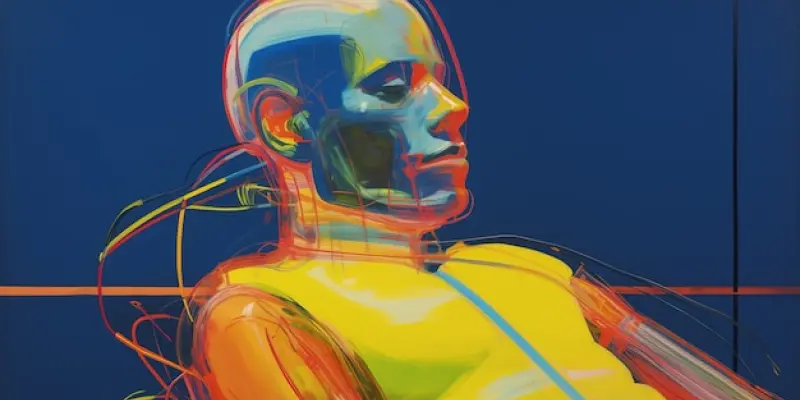
Artificial Intelligence (AI) continues to revolutionize various sectors, and the world of art has not been left behind. As AI’s integration into artistic processes deepens, it challenges existing perceptions of creativity and authorship, paving the way for innovative collaborations between humans and machines. The fusion of technology with artistic expression creates new avenues for artistic exploration, breaking traditional creative boundaries and redefining what art can be. This intersection is not entirely novel, but recent technological advancements have taken AI-generated art to unprecedented levels, offering fresh perspectives and opportunities.
The Evolution of AI in Art
The journey of AI in art began in the 1960s when pioneers like Harold Cohen developed programs capable of creating rudimentary drawings. These early experiments laid the foundation for more sophisticated artistic endeavors using AI. Over the decades, significant strides in machine learning and neural networks have propelled AI-generated art into the mainstream, allowing for more complex and intricate creations. The evolution of AI in art reflects broader technological advancements, where early programs have given way to sophisticated algorithms capable of mimicking human artistic processes.
Recent technological developments have seen AI’s role in art-making expand from simple patterns to intricate masterpieces. Modern AI systems employ deep learning, a subset of machine learning that analyzes vast datasets to learn and replicate various artistic styles. The introduction of Generative Adversarial Networks (GANs), consisting of a generator that creates images and a discriminator that evaluates them, has been a game-changer. This adversarial system enables the production of highly realistic or abstract art pieces. The level of detail and technical intricacy achieved by contemporary AI in art often surpasses human capabilities, pushing the boundaries of what machines can accomplish in creative fields.
Advanced AI Capabilities in Art Creation
Modern AI algorithms harness the power of deep learning to process extensive datasets, allowing them to comprehend and emulate diverse artistic styles. This capability has revolutionized the creation of AI-generated art, enabling machines to produce original works with a level of nuance previously believed to be exclusive to human artists. By analyzing thousands of images, algorithms can generate art that mirrors specific styles or introduces entirely new ones. The role of GANs has been particularly influential, where the generator and discriminator work in tandem to refine and perfect the artwork. The ability of GANs to produce highly realistic and abstract art pieces speaks to the advanced capabilities of contemporary AI. As these algorithms become more refined, they can blend different styles and techniques, resulting in artwork that can be indistinguishable from pieces created by human artists. This progress has not only elevated AI’s role in artistic creation but has also sparked discussions about the nature of creativity itself. The intricate patterns and designs generated by AI challenge traditional notions of artistic skill, showing that computational prowess can achieve extraordinary creative outcomes.
The Collaborative Dynamic Between Humans and Machines
Despite AI’s growing autonomy in art creation, human input remains indispensable. Artists and users play a crucial role in setting parameters, selecting styles, and curating the AI-generated outputs to achieve specific aesthetic or conceptual goals. This dynamic creates a collaborative relationship where human intuition and machine computation converge to produce unique works of art. By guiding AI in its creative process, humans ensure that the art produced aligns with their vision, effectively blending human creativity with machine precision.
This symbiotic relationship highlights the potential for co-creation between humans and machines. The collaborative process allows artists to experiment with new styles and techniques, pushing the boundaries of their creativity. At the same time, it demonstrates the importance of human oversight in maintaining the essence and intention behind the artwork. This partnership not only fosters innovation but also reshapes the traditional artist’s role, transforming it into one that encompasses both creative direction and technological prowess.
Diverse Applications and Ethical Considerations
AI-generated art has found applications across various domains, including fine arts, graphic design, entertainment, and marketing. In fine arts, artists leverage AI to explore new styles and push creative boundaries. Graphic designers utilize AI tools to create logos, layouts, and other visual elements, enhancing their creative toolkit. In the entertainment industry, AI aids in producing visuals for video games, films, and virtual reality experiences, while in marketing, brands use AI to generate personalized and dynamic content tailored to their audience. These diverse applications illustrate the transformative potential of AI in expanding creative possibilities.
However, the integration of AI in art also raises ethical and legal concerns. The debates surrounding authorship and copyright are particularly significant, as the distinction between human and machine-created art blurs. Questions arise about who owns the art generated by AI and how it should be valued. These ethical considerations are not just theoretical but have practical implications for artists, consumers, and legal frameworks. Addressing these challenges requires ongoing dialogue within the art community and beyond to establish guidelines that balance innovation with ethical responsibility.
Platforms and Future Prospects
Artificial Intelligence (AI) is transforming numerous fields, with the art world being a significant area of impact. As AI becomes more deeply embedded in artistic processes, it challenges long-standing ideas about creativity and authorship. This integration fosters groundbreaking collaborations between humans and machines, opening up new pathways for artistic exploration. The merging of technology and art breaks conventional creative barriers and redefines the essence of art itself. Although the concept of using technology in art isn’t entirely new, recent advancements have propelled AI-generated art to extraordinary heights. These developments provide fresh perspectives, novel opportunities, and innovative methods for creating art, transcending what was previously thought possible. For artists, AI offers tools that expand their creative capabilities, enabling the generation of complex patterns and designs that may have been otherwise impossible. Audiences, too, can enjoy unique artistic experiences that blend human creativity with machine precision, ultimately evolving the definition of art for both creators and viewers alike.