

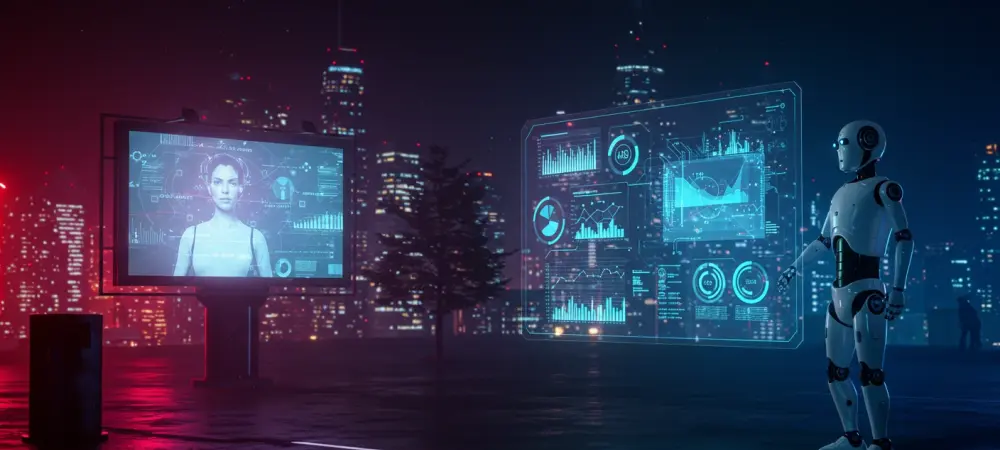
In an era where artificial intelligence has pervaded nearly every industry, the advertising sector stands on the cusp of a revolutionary transformation driven by AI technology. This change is not just a passing trend; it is a profound shift that challenges the very essence of creativity and human involvement in ads. At the forefront of this paradigm shift are tech giants like Baidu and Meta, which are pioneering innovative methods to automate processes traditionally reliant on human agency. The inaugural example comes from a Baidu livestream where AI-generated avatars successfully engaged viewers, demonstrating AI’s capability to conduct product promotions that rival human interaction. Parallelly, Meta has set ambitious goals to fully automate ad creation, targeting, and deployment within a short span, fundamentally questioning the relevance of traditional agencies’ roles.
The Rise of AI in Creative Processes
AI’s impact on advertising is visible through developments like Baidu’s use of digital avatars. These AI-driven figures astonished audiences with their ability to interactively host a livestream. This development questions the necessity of human presenters, posing an existential challenge to roles historically rooted in personal charisma and spontaneity. Moreover, it disrupts the conventional ad-making process, from brainstorming sessions to pitching ideas, marking AI as an efficient, dynamic alternative. Meta’s plan to automate entire ad campaigns articulates a future where human-driven segmentation and strategic planning might become redundant. The move towards automation brings forth the possibility that much of the work traditionally managed by creative teams could be overtaken by algorithmic precision and efficiency.
Yet, the rise of AI in this realm is not purely about elimination but also about evolution. AI introduces tools such as Midjourney and Synthesia, enabling unprecedented levels of creativity, irrespective of traditional constraints like time or resource availability. These platforms allow users to easily generate visuals and deepfake spokespersons, highlighting the shift from traditional to digital and automated creativity. Businesses, embracing these capabilities, could save significant resources previously spent on exhaustive creative processes, positioning themselves strategically in an increasingly competitive marketplace. As companies leverage AI to redefine their strategies, the focus may pivot from typical advertising methods to more streamlined, data-driven procedures that align with modern consumer behavior, providing personalized ad experiences.
Challenges and Opportunities for Ad Agencies
While AI provides undeniable efficiencies, it also raises critical questions about ad agencies’ future roles, once bastions of human creativity and ingenuity. The landscape recalls a nostalgic past, much like the celebrated 1960s advertising industry portrayed in Mad Men, where human interaction, creativity, and intuition were indispensable. This contrasts with today’s evolving reality, where AI threatens to render full-service marketing agencies less relevant. Creatives, once indispensable for crafting compelling campaigns and managing media, face an uncertain future, where their expertise might need redefining. This shift suggests an industry not vanishing, but demanding reinvention—where creativity finds new avenues, potentially fostering innovative human-AI collaborations.
Opportunities emerge for those willing to adapt. The industry’s transformation means that creative professionals could use AI as a powerful partner rather than a replacement. People skilled in AI tools may find newfound value in roles focusing on more strategic and empathetic aspects of advertising, aspects machines may not easily replicate. In this changing landscape, the capacity to harness AI’s potential while maintaining the human touch in campaigns could become a coveted skill, signaling a shift from traditional roles towards more integrated, technologically adept positions. Individuals adept at combining AI’s efficiencies with a human-centric approach will likely become cornerstones in agencies, marrying technical prowess with creative vision.
Human Creativity’s Evolving Role
AI’s increasing penetration into advertising compels a renaissance of human creativity, positioning it alongside machine learning’s unmatched capabilities. Human creativity’s evolution lies in its adaptability, its ability to synergize with AI’s strengths, and its inherent understanding of nuanced emotional engagements, areas where AI still lags. Individuals like Luo Yonghao and P.J. Accetturo signify this transition, demonstrating how human creativity can coexist, even flourish, with AI. Yonghao’s and Accetturo’s ventures emphasize creativity’s adaptability, transforming the artistic journey rather than extinguishing it. In this newly imagined terrain, humans contribute insightful perspectives that AI can enhance, not replace.
In alignment with AI, creatives’ roles might shift towards curating culturally resonant content and maintaining the emotional depth of branding. Responsible for devising impactful stories, professionals equipped with AI-based insights would drive campaigns with relatable appeal, strengthening consumer relations in ways AI alone cannot achieve. By leveraging AI analytics for strategic insights, creatives can focus more on conceptualization and deeper market understanding, ensuring messages resonate sincerely with audiences. Ultimately, maintaining the balance between human ingenuity and AI efficiency could lead to an advertising ecosystem richer in emotional intelligence, offering more meaningful consumer experiences.
Redefining the Industry’s Future
AI’s influence on advertising shines through significant advancements like Baidu’s creation of digital avatars. These AI entities amazed viewers by interactively managing a livestream, prompting questions about the need for human presenters. This poses a fundamental challenge to roles traditionally valued for charisma and unpredictability. Moreover, it reshapes the typical advertising process, from creative brainstorming to idea pitching, establishing AI as a dynamic, efficient alternative. Meta’s ambition to automate entire ad campaigns suggests a future where human-driven strategy and segmentation may become obsolete. Automation raises the possibility that algorithmic precision might replace the work typically done by creative teams.
Despite these changes, AI’s emergence in advertising signifies more than just a shift from traditional methods. It opens avenues for innovative creativity through platforms like Midjourney and Synthesia, which break down barriers like time and resource constraints. By adopting these technologies, businesses can save on extensive creative processes and compete more effectively, aiming for data-driven, personalized ad experiences to match modern consumer behavior.