

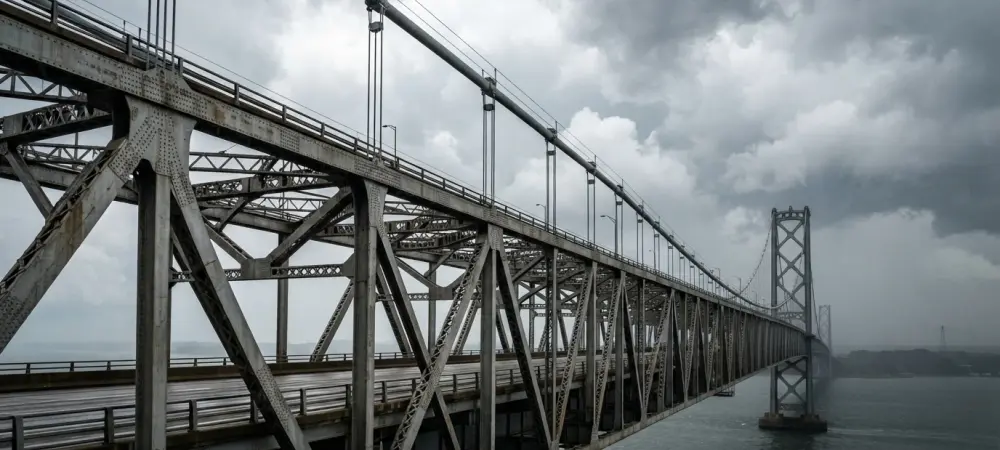
Vibration data from twelve servo accelerometers across the Xihoumen Bridge revealed that vehicle traffic must be filtered out at frequencies above one hertz to isolate pure wind effects. This fundamental insight has paved the way for a revolutionary approach in structural health monitoring, shifting the engineering focus from idealized mathematical simulations toward the power of massive, real-world datasets. For a massive suspension bridge like the Xihoumen, which boasts a main span of 1,650 meters, managing the impact of wind-induced buffeting is a critical safety priority for modern civil engineering. Researchers have recently unveiled the CA-Buffeting Net, a deep learning architecture specifically engineered to predict these complex vibrations with unprecedented accuracy and speed. By leveraging five years of high-fidelity data, this model demonstrates that artificial intelligence can effectively navigate the non-linear fluid-structure interactions that have long frustrated traditional aerodynamic theories. This breakthrough represents a significant milestone in ensuring the long-term longevity of critical infrastructure within volatile coastal environments.
Capturing High-Fidelity DatThe Xihoumen Bridge Case Study
The Xihoumen Bridge serves as an ideal laboratory for studying structural dynamics due to its geographic exposure to seasonal monsoons and intense typhoons in the Zhoushan archipelago. To capture the granular nuances of how the bridge reacts to varying atmospheric conditions, engineers deployed a sophisticated Structural Health Monitoring system consisting of six ultrasonic anemometers and twelve servo accelerometers. These sensors provide a constant stream of three-dimensional wind data and multi-axis movement readings from strategic locations along the main span, including the side-span and mid-span sections. This extensive hardware array allows for the collection of a high-fidelity dataset that reflects the true physical behavior of the structure under real-world stress. Unlike controlled laboratory environments, this field-based approach captures the atmospheric turbulence and environmental aging factors that are often impossible to replicate perfectly in a wind tunnel, providing a more authentic foundation for predictive modeling of large suspension bridges.
Data Processing: Rigorous Cleaning for High-Quality Training
A significant portion of the project’s success stems from a rigorous data-cleaning protocol that ensured the neural network was trained on high-quality, relevant information. The research team implemented safety-focused filtering, excluding all samples where mean wind speeds fell below 11 meters per second to ensure the model focused on conditions that truly impact structural integrity. Beyond traffic filtering, the team also had to differentiate between buffeting and vortex-induced vibrations, which are distinct physical phenomena that can confuse a standard learning algorithm if not properly separated. By isolating these specific variables and identifying spectral peak ratios, the researchers distilled five years of continuous monitoring into over 12,000 valid, high-quality samples. This massive repository of data provides the robust foundation necessary for deep learning, allowing the model to recognize patterns across a wide range of environmental conditions and wind intensities that occur throughout the bridge’s operational life.
Designing the Architecture: Physics-Driven Neural Logic
The architecture of the CA-Buffeting Net was not chosen arbitrarily but was carefully designed to mirror the actual physical laws governing wind engineering. Engineers recognized that the relationship between wind features and bridge response follows a predictable two-stage logic: initial wind characteristics create buffeting forces, which then interact with the structure’s natural frequencies to generate a resonant response. To replicate this process, the model utilizes a frequency convolutional network that focuses on how energy is distributed across different frequency domains rather than just looking at time-based sequences. This physics-informed approach ensures that the predictions made by the AI are grounded in the actual mechanics of structural movement. By aligning the internal logic of the neural network with established engineering principles, the researchers created a system that is far more reliable and robust than generic algorithms that lack a specific understanding of structural dynamics and the unique complexities of massive bridge spans.
Structural Dynamics: Integrating Cross-Attention and Frequency Networks
At the heart of this new architecture lies a sophisticated cross-attention mechanism, a technology originally developed for advanced natural language processing. This mechanism serves as the bridge’s digital brain, matching predicted wind force features with the structural frequency features of the massive suspension system. It mimics the physical reality where a bridge vibrates most significantly when the frequency of an external wind force aligns with its own natural resonant rhythm. By utilizing bidirectional convolution, the model analyzes both higher and lower frequency neighbors to fully grasp the energy distribution within the signal. This dual-attention strategy allows the AI to prioritize certain inputs, such as mean wind speed and specific resonance peaks, ensuring that the most critical factors are given the weight they deserve. This sophisticated fusion of data-driven learning and structural physics allows the model to capture the intricate, non-linear interactions that traditional mathematical models frequently overlook during standard bridge analysis.
Measuring Success: Superior Predictive Performance and Accuracy
The deployment of the CA-Buffeting Net has yielded impressive quantitative results, demonstrating a substantial improvement over previous computational baselines. In rigorous testing, the model reduced the mean squared error of vibration predictions by nearly 30 percent while improving the mean absolute error by more than 20 percent. One of the most significant achievements was the model’s performance at the three-quarter point of the bridge’s main span. This specific area is notoriously difficult for engineers to model accurately because of the complex coupling between wind forces and structural vibrations that occurs away from the more stable mid-span and tower sections. The fact that the CA-Buffeting Net excelled in this challenging zone suggests that its attention-based architecture is uniquely capable of processing the messy, non-linear data points that characterize real-world bridge behavior. These gains in accuracy provide a much more reliable foundation for making critical decisions regarding structural maintenance and public safety in 2026.
Operational Reliability: Maintaining Shape Fidelity in Vibration Spectra
Beyond simple error reduction, the researchers placed a high priority on maintaining shape fidelity, which refers to how closely the predicted vibration spectrum matches the actual sensor readings. High shape fidelity is essential for engineers because it ensures that the model is correctly identifying where energy is concentrated within the structure’s movement. The CA-Buffeting Net achieved a notable improvement in cosine similarity compared to previous iterations, meaning the predicted patterns are nearly indistinguishable from reality. This level of precision is vital for conducting accurate fatigue life assessments and wind-resistant design evaluations. When an engineer can rely on the vibration spectrum’s integrity, they can better predict how the bridge will respond to long-term environmental stress over decades of service. This precision transforms structural health monitoring from a reactive process into a proactive strategy, allowing for more targeted inspections and repairs that focus on the areas of the bridge experiencing the most significant energy loads.
Interpretability: Opening the Black Box of Deep Learning
One of the primary barriers to the adoption of artificial intelligence in structural engineering has been the black box problem, where the reasoning behind a model’s prediction is obscured. To overcome this hurdle, the research team performed a deep dive into the CA-Buffeting Net’s internal attention weights to determine exactly which factors the AI was prioritizing. The analysis revealed that the model naturally assigned the highest importance to mean wind speed and the vertical fluctuating wind spectrum. This outcome is highly significant because it aligns perfectly with the established aerodynamic theories developed by pioneers in the field over the last century. By demonstrating that the AI is focusing on the same variables that human experts use to calculate wind force, the researchers have provided the transparency needed for real-world application. This interpretability ensures that the model’s high accuracy is not merely the result of statistical noise but is based on sound engineering fundamentals and physics.
Model Validation: Identifying Natural Resonant Frequencies
Furthermore, the model proved its sophistication by identifying the bridge’s natural vertical bending modes without any explicit programming of the structure’s physical dimensions or mathematical finite-element models. The attention weights showed distinct peaks in the zero to 0.2 hertz range, which is exactly where the Xihoumen Bridge’s vibration energy is most concentrated according to field observations. This ability to learn the structure’s unique physical signature directly from the sensor data represents a significant advancement over traditional methods that rely on approximate mathematical simulations. When the AI can identify resonance peaks on its own, it proves that it has successfully internalized the bridge’s dynamic characteristics. This internal consistency gives engineers the confidence to use these models in critical safety environments, as they can verify that the AI is making decisions based on the actual physical properties of the bridge rather than just chasing correlations in a large and complex dataset.
Future Infrastructure: The Role of Structural Health Monitoring
The success of this deep learning approach highlights a growing consensus within the engineering community that long-term structural health monitoring data is a vital asset. While wind tunnel testing remains a necessary component for the design of new structures, AI-driven models provide a superior method for assessing existing bridges that have been in service for years. These aging structures often differ from their original blueprints due to environmental wear, construction variances, and material fatigue. By using data-driven digital twins that evolve alongside the physical structure, engineers can gain a much more accurate understanding of how a bridge handles modern environmental stressors. This shift toward localized, high-fidelity monitoring allows for a more dynamic approach to infrastructure management, ensuring that the safety protocols of the world’s most critical bridges are based on the reality of their current condition rather than theoretical models created during the design phase decades ago.
The Path Forward: Scaling Intelligent Systems for Global Safety
In summary, the CA-Buffeting Net established a new benchmark for how artificial intelligence was integrated into the preservation of large-scale infrastructure. The researchers demonstrated that by embedding physical logic directly into the neural architecture, it was possible to create a predictive tool that was both highly accurate and physically consistent. For the industry to fully capitalize on these findings, the next phase of development focused on transfer learning techniques. This allowed the knowledge gained from the Xihoumen Bridge to be applied to other structures with less extensive monitoring histories, reducing the time required for data collection. Engineering firms began incorporating these frequency-domain models into their real-time safety evaluation protocols to replace aging finite-element approximations. By focusing efforts on non-stationary wind events like major typhoons, the engineering community moved closer to a fully autonomous and intelligent structural maintenance system that safeguarded public infrastructure against volatility.