

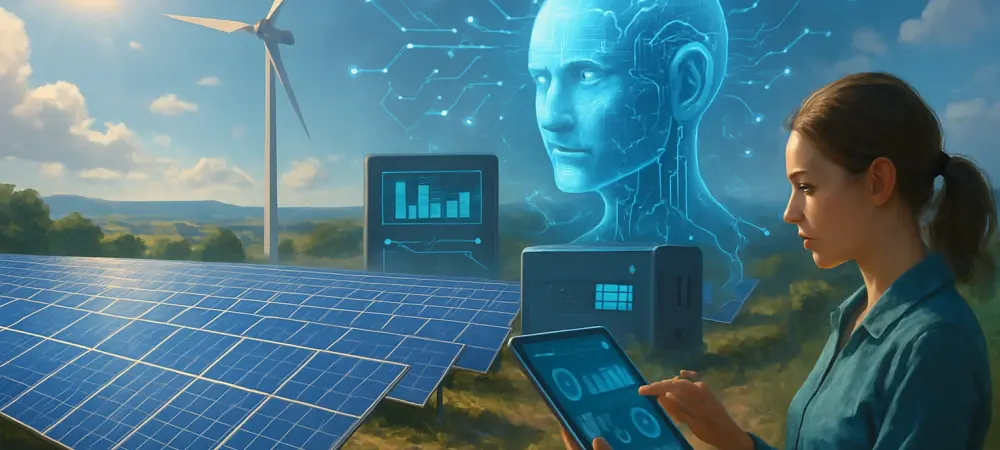
The integration of Artificial Intelligence into solar energy management is rapidly transforming commercial and industrial power systems from passive energy generators into dynamic, data-driven assets that are foundational to operational resilience. This review explores the evolution of this technology, analyzing its core features, performance metrics, and the significant impact it is having on businesses operating in complex energy landscapes. The purpose of this analysis is to provide a thorough understanding of the technology’s current capabilities, its strategic importance, and its trajectory for future development.
The Genesis of Intelligent Solar Systems
The emergence of AI-powered solar management is a direct response to the growing pains of the renewable energy transition, particularly in regions experiencing rapid economic expansion coupled with infrastructural constraints. In markets where grid stability is not guaranteed and electricity costs can be volatile, the traditional model of solar energy—viewed primarily as a means to offset consumption—falls short of its potential. This technology was born from the necessity to move beyond simple hardware installations and toward a more sophisticated approach where energy assets are actively managed.
This shift has reframed the role of commercial solar, positioning it as a strategic tool for business continuity. The core principle of these intelligent systems is the conversion of static hardware into a responsive, learning energy ecosystem. By harnessing vast amounts of operational data, AI provides the intelligence layer needed to navigate unpredictable grid conditions and fluctuating energy demands. This capability is especially critical for energy-intensive sectors where power interruptions or price spikes can severely impact productivity and profitability, establishing intelligent solar as a cornerstone of modern industrial strategy.
Core Technologies and Key Differentiators
From Static Models to Living Energy Systems
The foundational paradigm shift introduced by AI in solar management is the move away from static, assumption-based project design. Historically, solar projects were planned using spreadsheets that relied on historical annual consumption data and regional solar irradiation averages. This method, while straightforward, often resulted in systems that were optimized for a theoretical past rather than the dynamic reality of a facility’s daily operations. Such an approach could not account for fluctuating energy loads, the addition of new machinery, or the nuanced behavior of the local power grid, leading to performance gaps between projection and reality.
In stark contrast, an AI-driven approach treats a solar installation as a living, breathing component of the facility it serves. It ingests a continuous stream of high-frequency data from inverters, meters, weather services, and even building management systems. This creates a highly detailed, real-time operational profile that learns the unique energy signature of a specific site. Consequently, the solar asset is transformed from a simple electricity source into an adaptive and proactive energy management tool, capable of making intelligent decisions that align with the immediate and future needs of the business.
AI-Driven Forecasting and Resource Optimization
One of the most powerful and transformative features of this technology is its advanced forecasting capability. Traditional models often rely on broad, regional averages for predicting solar yield, but AI builds high-resolution generation and consumption profiles tailored to the specific micro-environment of an installation. These sophisticated models learn site-specific variables, such as the precise impact of afternoon shading from a nearby building, underperformance patterns on exceptionally hot days, or the historical frequency of grid-mandated curtailments. This level of granular prediction provides a far more accurate picture of future energy availability and demand.
This predictive power unlocks immense value, particularly when paired with battery storage systems. Instead of operating on rudimentary, fixed rules like charging at night and discharging during the afternoon peak, AI-powered battery optimization becomes a dynamic, strategic process. The system learns complex tariff structures to perform energy arbitrage, anticipates potential brownouts to hold energy in reserve for critical loads, and discharges strategically to mitigate costly peak demand charges. This intelligent adaptation ensures that the return on investment for energy storage is maximized while significantly enhancing the operational stability and energy security of the business.
Proactive Reliability Through Predictive Maintenance
AI is fundamentally reshaping the maintenance of solar assets, driving a crucial shift from a reactive to a predictive model. In traditional operations, maintenance is often triggered only after a component has failed, resulting in costly downtime and lost energy production. Many common failures in solar arrays, however, do not happen suddenly; they develop over time, manifesting as subtle, easily missed patterns of underperformance. A single string of panels may gradually degrade, a connector could exhibit a minor temperature anomaly, or an inverter might begin to trip intermittently.
AI health algorithms, trained on operational data from vast fleets of solar systems, excel at detecting these faint early-warning signals. By constantly analyzing performance data, comparing output across different components, tracking thermal deviations, and flagging recurring alarms that a human operator might dismiss, the system identifies potential issues long before they escalate into critical failures. This enables maintenance teams to intervene proactively, scheduling repairs at convenient times and preventing catastrophic breakdowns. The result is a more resilient system, protected energy yield, and the assurance of long-term reliability without the expense and operational disruption of emergency repairs.
Emerging Trends and Innovations
The latest developments in this field are solidifying the trend of viewing commercial solar installations not merely as energy sources, but as sophisticated data platforms. In this evolving landscape, the competitive differentiation among solar providers is increasingly found within this data layer. An AI-managed solar and storage system provides far more than a simple reduction in an electricity bill; it effectively creates an intelligent buffer that allows a business to operate as if it were connected to a stronger, more reliable power grid.
This innovation is creating a new competitive arena where a provider’s data strategy and the proven efficacy of its AI capabilities are becoming the primary value propositions. The focus is shifting from the hardware itself to the intelligence that manages it. This ability to deliver enhanced grid resilience and operational stability through data-driven insights is becoming the key factor that separates leading-edge solutions from conventional solar offerings, setting a new standard for performance and reliability in the commercial energy sector.
Real-World Applications and Sector Impact
The real-world applications of AI-powered solar management are already demonstrating significant impact across various sectors, particularly in the emerging markets of Southeast Asia. For instance, manufacturers in Vietnam, logistics operators in the Philippines, and data centers in Malaysia are deploying this technology to gain a competitive edge. These industries are often located in industrial zones where rapid expansion has outpaced the development of the supporting power grid, making them highly vulnerable to volatility.
In these contexts, the technology’s most compelling use case is its ability to create an intelligent shield against grid instability. An AI-managed solar and storage system continuously monitors the local grid’s behavior and the facility’s operational needs. It can preemptively store energy in anticipation of a potential outage or strategically discharge power to smooth over voltage fluctuations. This capability provides invaluable insulation from external power disruptions, ensuring that critical business operations can continue uninterrupted, thereby transforming a sustainability investment into a core component of operational risk management.
Overcoming Legacy System Limitations
The challenges often associated with commercial solar are more accurately framed as the inherent limitations of legacy systems, which AI-driven platforms are specifically designed to overcome. One of the most significant technical hurdles of traditional solar is inaccurate forecasting. Static models are incapable of adapting to the dynamic reality of a facility’s changing energy loads or the day-to-day variability of weather and grid conditions, leading to suboptimal performance and financial returns.
Furthermore, traditional systems lack the agility to respond to real-time events. They cannot dynamically adjust battery charging schedules to capitalize on new time-of-use tariffs or hold back energy reserves when the grid shows signs of instability. AI-driven platforms directly address these shortcomings. By leveraging machine learning and a constant flow of data, they provide the adaptive intelligence necessary to optimize asset performance under any condition. Consequently, AI is not merely an incremental improvement; it is the primary solution that mitigates the fundamental weaknesses of older solar management philosophies.
Future Outlook and Long-Term Vision
Looking ahead, the criteria for selecting commercial solar partners are undergoing a profound evolution. Business leaders are beginning to shift their focus beyond simple hardware metrics like system size and projected payback periods. The more sophisticated and critical questions now revolve around a provider’s data strategy and proven AI capabilities. Decision-makers are increasingly probing how a provider’s algorithms specifically address regional challenges like grid reliability and demanding concrete evidence of how their battery optimization AI has improved outcomes for similar clients.
This trend points toward a future where the most valuable solar systems are defined not by their peak capacity but by their ability to continuously learn and adapt. The long-term vision is one of intelligent energy assets that grow smarter over time, learning from weather patterns, facility load profiles, grid events, and the collective experience of a distributed network of systems. This continuous learning process is what will ultimately deliver the stable power and predictable costs that are essential for modern businesses to thrive in an increasingly complex and competitive global economy.
Conclusion and Final Assessment
The analysis of AI-powered solar management revealed a technology that fundamentally reshaped the value proposition of commercial renewable energy. It became clear that while high-quality hardware remained an essential foundation for any successful project, the intelligence layer provided by AI was the critical differentiator that unlocked the full potential of these assets. The integration of advanced forecasting, dynamic resource optimization, and predictive maintenance moved solar installations beyond the role of simple generators and transformed them into strategic tools for operational resilience.
This technological evolution was particularly impactful in developing economic landscapes, where AI provided a necessary buffer against infrastructural weaknesses, enabling businesses to sustain growth despite external volatility. The shift in market focus from hardware specifications to data and AI capabilities marked a significant maturation of the industry. Ultimately, AI proved to be the key enabling technology that bridged the gap between the promise of solar energy and the practical demands of modern commerce, delivering the stability and predictability that businesses required.