

The traditional paradigm of music visualization has long been confined to mechanical oscillators and rhythmic pulses that lack the emotional nuance required to truly complement a complex live performance. Historically, the relationship between sound and sight was dictated by simple amplitude thresholds, where a louder beat simply triggered a brighter flash. However, the emergence of generative artificial intelligence has catalyzed a shift toward visual synesthesia, where algorithms do not merely react to volume but interpret the semantic meaning of a composition. This evolution represents a significant leap for the creative technology sector, as it allows for a sophisticated form of storytelling that was previously only achievable through months of manual labor in post-production studios.
The core principles of this technology lie in machine learning models that have been trained on vast datasets of visual and auditory relationships. Unlike legacy visualizers that function as simple filters, these AI-driven systems analyze frequency, timbre, and melodic progression to generate imagery that feels inextricably linked to the music. This capability is particularly relevant in the contemporary market, where the democratization of production tools has led to an explosion of independent artists. These creators require high-fidelity visual environments to compete on global stages but often lack the capital to hire dedicated lighting and visual effects teams. By leveraging AI, the barrier to entry for immersive production has been significantly lowered, allowing for a new era of professional-grade performances in intimate settings.
Introduction to AI-Driven Visual Synesthesia
The transition from basic frequency-based animations to complex, theory-informed visual narratives marks a fundamental change in how audiences consume live media. In the past, the “visualization” was often a distraction or a secondary layer of the show; today, it is an integrated component of the artistic statement. Generative AI allows for the creation of visuals that evolve in real-time, responding to the subtle shifts in a performer’s energy and the specific nuances of the musical arrangement. This creates a feedback loop where the artist is inspired by the visuals they are simultaneously generating, leading to a more cohesive and emotionally resonant experience for the spectator.
Furthermore, the relevance of this technology is underscored by the shift in consumer expectations. In a landscape dominated by short-form video and high-definition streaming, static stages no longer suffice to maintain audience engagement. Venues and independent artists are now utilizing these AI tools to transform physical spaces into reactive environments. This move toward specialized technical constraints ensures that the AI does not produce generic imagery but instead adheres to a specific aesthetic framework established by the creative technologist. Consequently, the technology serves as a bridge between the digital and physical worlds, turning a simple concert into a multisensory event.
Technical Architecture and Core Capabilities of Vibes
Musical Structure and Theoretical Integration
The Vibes framework distinguishes itself from competitors by moving beyond simple audio-reactive triggers and instead focusing on deep architectural understanding. While many platforms rely on Fast Fourier Transform (FFT) analysis to track rhythmic peaks, Vibes integrates classical music theory into its core algorithms. This allows the system to recognize complex compositional elements such as key changes, harmonic tension, and melodic phrasing. This “musical literacy” is the direct result of a developer background that combines rigorous classical training with advanced engineering, ensuring the AI “hears” the music with the same structural awareness as a trained musician.
This theoretical depth means that the visuals generated by Vibes are not random; they are compositionally justified. When a piece of music moves from a dissonant passage to a resolution, the visual output mirrors this transition through changes in color theory, geometric complexity, and motion dynamics. By training models on the intersection of musicology and visual arts, the platform avoids the repetitive, “kaleidoscopic” look of traditional visualizers. Instead, it offers a sophisticated visual language that enhances the viewer’s understanding of the music, making the abstract concepts of composition visible to the naked eye.
Real-Time Rendering and Production Efficiency
One of the most impressive performance metrics of the Vibes system is the drastic reduction in production timelines. In the traditional workflow, a high-quality music video or a synchronized live visual set could take weeks or even months to design and render. This process involved manual keyframing, complex simulation baking, and extensive editing. In contrast, the AI-powered approach allows for minute-by-minute generation, effectively providing real-time results that once required a render farm. This efficiency does not come at the cost of quality; rather, it allows for a level of spontaneity that was previously impossible.
Technical reliability in a live environment is the ultimate test for any generative system. Vibes maintains high frame rates and low latency even when processing complex audio inputs, ensuring that the synchronization between sound and sight remains perfect. This robustness is critical for professional use, where any delay can break the immersion and ruin the performance. By optimizing the underlying code to handle the heavy computational load of real-time AI, the platform provides a dependable tool for artists who cannot afford technical glitches during a live show.
Evolution of the Creative Partnership Model
The current trend in creative technology is moving away from the concept of total automation, where a machine replaces the artist, and toward “collaborative augmentation.” In this model, the AI serves as a creative partner that handles the technical heavy lifting while the human artist maintains control over the vision and intent. This shift is vital because it preserves the “human touch” that is essential for genuine artistic expression. The developer’s philosophy emphasizes that AI should be a tool that expands the artist’s capabilities rather than a black box that dictates the output.
This collaborative approach has driven a significant increase in the demand for B2B generative tools that empower practitioners. Professional musicians and event organizers are seeking systems that offer specialized constraints, allowing them to define the “rules” of the visual world while the AI handles the generation. This move toward specialized technical constraints ensures that every implementation of the technology remains unique. By positioning AI as an assistant rather than a replacement, the industry is fostering a more sustainable relationship between technology and traditional artistic practice.
Real-World Applications and Sector Deployment
Live Performance and Independent Venues
The practical application of music visualization has seen a surge in diverse New York City settings, ranging from underground clubs to experimental art spaces. Venues such as Sugar Mouse and Wonderville have become testing grounds for how these immersive environments can enhance the value proposition for independent musicians. In these spaces, the ability to transform a standard stage into a digital canvas provides a competitive edge, attracting audiences who are looking for more than just a standard audio performance. For the venue owner, this technology offers a scalable way to upgrade the production value without the need for permanent, expensive hardware installations. For the independent musician, the integration of AI-powered visuals democratizes the “stadium show” experience. By utilizing the Vibes framework, a solo performer can command a visual presence that rivals that of major label acts. The flexibility of the system allows it to be adapted to various genres, from electronic music to experimental jazz, proving that the technology is not limited to a single aesthetic. This widespread deployment across the NYC scene highlights a growing trend of “venue-as-an-experience,” where the environment is as much a part of the draw as the performers themselves.
High-Level Corporate and Cultural Integration
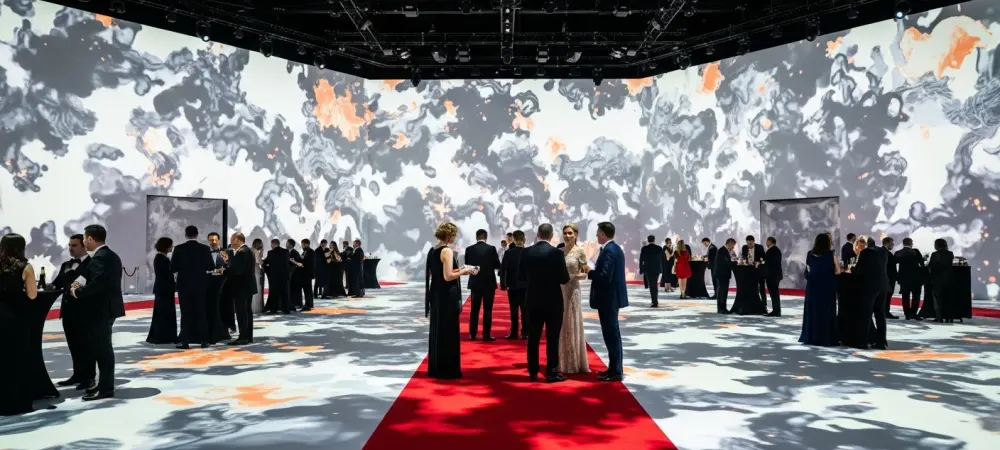
Beyond the underground music scene, AI-powered visualization is finding a home in formal corporate and cultural contexts. The use of this technology at events like the Qipao International Arts Association (QIAA) Annual Red Carpet Gala demonstrates its versatility in high-stakes environments. In these settings, the visuals must be elegant, precise, and reflective of a specific cultural identity. The ability of the Vibes framework to handle these enterprise-scale requirements speaks to its technical maturity. It is no longer just a tool for experimental artists; it is a sophisticated solution for luxury brands and cultural institutions.
This integration is closely tied to the rise of Extended Reality (XR) and spatial computing. As enterprise-scale XR becomes more common, the demand for high-quality, reactive digital content grows. The intersection of AI and spatial computing allows for the creation of visuals that exist not just on a screen, but as part of a three-dimensional space. This has profound implications for how cultural history and brand narratives are presented. By merging classical artistic sensibilities with cutting-edge engineering, the technology provides a way to celebrate tradition through a modern, digital lens.
Technical Hurdles and Industry Obstacles
Balancing Artistic Sensitivity with Technical Robustness
One of the primary challenges facing the development of AI-powered visualization is the inherent tension between artistic sensitivity and technical robustness. Ensuring that the AI behaves predictably while still allowing for the spontaneous “human touch” is a constant balancing act. This is particularly difficult in live performance environments where factors like ambient noise, lighting changes, and varying audio quality can interfere with the AI’s interpretation of the music. Moreover, managing real-time generation at high resolutions requires significant computational power. While the technology has made great strides, the hardware requirements for high-end generative media can still be a barrier. Developers must find ways to optimize their models so they can run on consumer-grade hardware without sacrificing the visual complexity that makes the technology appealing. This technical hurdle is not just about the code; it is about the practical logistics of deploying complex systems in environments that were not originally designed for high-end digital production.
Market Accessibility and Ethical Considerations
The logistical and financial barriers to adopting high-end generative tools remain a concern for many independent creators. While AI has the potential to democratize production, the initial cost of access and the learning curve for specialized B2B tools can be steep. There is a risk that the technology could create a new digital divide, where only those with the technical literacy or the budget for high-end subscriptions can benefit. Addressing these limitations requires a transparent dialogue regarding AI ethics and a commitment to making these tools more accessible through tiered pricing models and open-source contributions.
Ethical considerations also play a role in how this technology is perceived by the broader artistic community. There are ongoing concerns about the data used to train these models and whether the AI is “stealing” the styles of human artists. By focusing on a B2B strategy that prioritizes transparency and collaborative augmentation, developers can mitigate these concerns. The goal is to create an ecosystem where technology serves the artist, providing a way to enhance their original vision rather than masking it behind a layer of algorithmic noise.
The Future Trajectory of Generative Media
Integration into Professional Workflows
The trajectory of real-time AI visualization points toward its eventual status as a staple in professional music production and event management. As the technology matures, it will likely be integrated directly into the digital audio workstations and lighting consoles that professionals use every day. This seamless integration will blur the lines between sound engineering and visual design, creating a new class of “creative technologists” who are equally proficient in both disciplines. We are moving toward a future where a song’s visual identity is developed simultaneously with its sonic identity, leading to a more unified form of media.
Breakthroughs in spatial computing and Extended Reality will further accelerate this trend. The AI-powered tools being developed today are the foundation for the immersive digital worlds of tomorrow. This will allow for performances that are not confined to a stage or a screen, but that exist all around the audience, creating a truly global and decentralized performance space.
Long-Term Impact on Artistic Collaboration
The “messy truths” of innovation will continue to shape the next generation of creative technologists and technical mentors. As AI becomes more deeply embedded in the creative process, the role of the artist will shift from “maker” to “curator” or “director.” This evolution will require a new set of skills, focusing on the ability to guide and constrain complex systems to achieve a specific emotional result. The impact on artistic collaboration will be profound, as artists from different disciplines—music, code, and visual arts—will find new ways to communicate through a shared digital language.
Ultimately, the long-term success of generative media will depend on the ability of its practitioners to bridge the gap between high-level engineering and independent artistic practice. By fostering a community that values both technical excellence and artistic integrity, the industry can ensure that AI remains a force for creative good. The goal is not to replace the artist’s hand but to provide them with a more powerful brush, allowing them to paint with light and sound in ways that were previously unimaginable.
Final Assessment of the Technology
The evaluation of the Vibes framework and the broader AI-powered music visualization sector confirmed that this technology reached a critical level of maturity. The analysis demonstrated that the integration of classical music theory into generative algorithms provided a unique value proposition that set it apart from legacy systems. The platform effectively solved real-world logistical problems for independent artists by reducing production times from weeks to minutes, while maintaining a high standard of artistic relevance. It was clear that the ability to provide real-time, audio-reactive environments significantly enhanced the immersive quality of live performances in both underground and corporate settings. The implementation of these tools revealed that the future of live entertainment would be defined by the successful collaboration between human ingenuity and algorithmic efficiency. The project established a new benchmark for how creative technology could be deployed at scale without losing the essential “human touch” that defined great art. Moving forward, stakeholders in the music and tech industries were encouraged to prioritize the development of more accessible, B2B-focused generative tools that democratized high-end production. The assessment concluded that as spatial computing and XR continued to evolve, the necessity of bridging the gap between engineering and artistic practice would remain the most important factor in the ongoing revolution of the live entertainment industry.