

Dominic Jainy, an IT professional with deep expertise in artificial intelligence and machine learning, has spent his career exploring the application of these technologies in the real world. As the conversation around AI shifts from digital chatbots to tangible, physical systems, his insights into the industrial sector are more relevant than ever. We sat down with him to discuss this transformation, exploring the nuances of creating truly intelligent supply chains, the common-sense reasoning required for autonomous vehicles, and the revolutionary concept of entire factories operating as single, self-correcting organisms. We also touched upon the stunning efficiency gains early adopters are seeing and how these same principles are poised to reshape something as complex as pharmaceutical research.
When a component like a bumper fails on an industrial vehicle, AI can provide full traceability. How does this technology pinpoint the exact cause, from a factory bolt’s torque to a specific supplier, and what are the main obstacles to integrating smaller partners into this transparent system?
You’re touching on what I call the “euphoria” of a truly connected system. Imagine a bumper failure on an Oshkosh vehicle. The first thing the system does is go back through its own manufacturing data. It can check the digital record for that specific vehicle and ask, “Was the torque applied to the bolt within the specified tolerance?” If the data shows the factory process was flawless, the system then broadens its search. It can trace that specific bumper back to the exact batch it came from, the date it was manufactured, and by which supplier. This creates an unbroken chain of accountability. The main obstacle, however, is that this chain is only as strong as its weakest link. While Oshkosh can digitize its own factories, and its larger suppliers are likely on the same path, the system breaks down with smaller partners who haven’t made that investment. It’s a massive undertaking, and it’s going to take several years to bring that entire ecosystem up to the same level of digital visibility.
For autonomous cars to be safe, they must grasp real-world context, like a child chasing a ball into the street. How are AI models being trained to develop this situational awareness, and what are the biggest challenges in testing for these unpredictable, split-second human behaviors?
This is the critical leap from simple automation to true intelligence. An autonomous car’s AI can’t just be programmed with a set of rules; it has to understand the world. As Nvidia’s Jensen Huang put it, the AI needs to know that if a ball rolls into the street, a child might follow. It’s about inferential reasoning. Models like Nvidia’s Alpamayo are trained on vast datasets of real-world driving scenarios to build this contextual understanding. The new Mercedes-Benz CLA, built on this platform, just achieved a five-star EuroNCAP safety score, which is a powerful testament to its effectiveness. The biggest challenge is the sheer unpredictability of the real world. You can simulate millions of miles, but you can’t possibly pre-program for every single bizarre, split-second human decision. That’s why the AI must learn to generalize and predict based on context, not just react to pre-defined events, which is an incredibly complex and ongoing process.
The concept of treating an entire factory as a single “giant robot” is gaining traction. How does a digital twin of a factory go beyond simulation to autonomously predict failures and reroute production? Could you walk me through the steps of how this system would respond to a critical machine malfunctioning?
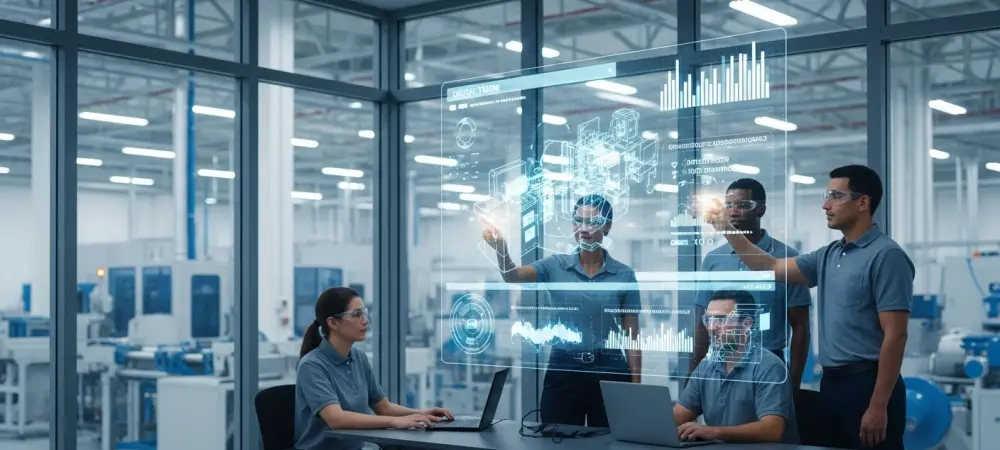
The “factory as a robot” concept is a paradigm shift, and digital twins are the brain that makes it work. A traditional simulation lets you test a hypothesis. A true industrial digital twin, like what Siemens is building, is a living, breathing model that is constantly learning. It’s not just mirroring what’s happening; it’s predicting what’s about to happen. So, let’s say a critical machine starts showing subtle signs of an impending failure—a minute temperature increase, a slight change in vibration. The AI, having analyzed data from the one-third of global manufacturing machines running Siemens controllers, recognizes this pattern. Before the machine ever fails, the system autonomously reroutes the production schedule. It shifts that machine’s workload to other available units, adjusts the flow of materials, and alerts maintenance with a specific diagnosis, all without human intervention. It can even pull in external data, like a weather forecast predicting high humidity that might affect a sensitive process, and adjust accordingly.
PepsiCo reported a 20% efficiency increase and a 10-15% capital expenditure reduction within just three months at its Gatorade plant. What specific operational changes driven by physical AI lead to such immediate and significant results? Please share some details on how this is achieved.
Those numbers from PepsiCo are stunning, and they demonstrate how quickly this technology can deliver a massive return. The results aren’t from one single change but from thousands of micro-optimizations happening every second. A physical AI system looks at the entire Gatorade plant as one integrated system. It’s optimizing production schedules to minimize changeover times, managing energy consumption based on real-time costs, and predicting maintenance needs to prevent unplanned downtime. The 20% efficiency boost comes from eliminating those small, cascading delays and bottlenecks that are invisible to the human eye. The 10-15% capex reduction is achieved because the system maximizes the output of existing equipment. Instead of buying a new machine to meet demand, the AI figures out how to get more out of the ones you already have, delaying or even eliminating the need for major capital investment. It’s about squeezing every last drop of performance out of the physical assets.
Applying industrial manufacturing principles to drug discovery is a new frontier. How can simulating the interaction between cells and drug compounds realistically accelerate the lab-to-patient cycle? What are the primary technological or ethical hurdles to overcome in automating parts of this sensitive research process?
This is one of the most exciting applications of physical AI. Traditionally, drug discovery is a slow, labor-intensive process of trial and error in a wet lab. The idea, as Siemens’ Roland Busch explained, is to apply the same simulation and optimization principles we use in a factory to biology. By creating highly accurate digital twins of cells, antibodies, and drug compounds, you can run thousands of simulated experiments in the time it takes to run one physical one. This allows researchers to test how a potential drug might interact with a cell and identify promising candidates much faster, potentially accelerating the lab-to-patient cycle by an estimated 50%. The primary technological hurdle is the mind-boggling complexity of biological systems; creating a digital twin of a cell is orders of magnitude more difficult than modeling a machine. Ethically, we must ensure that as we automate, the system remains transparent and that human oversight is maintained, because the ultimate decisions directly affect human health and well-being.
What is your forecast for the adoption of physical AI in industrial settings over the next five years?
My forecast is one of rapid but uneven adoption. Over the next five years, we are going to see more flagship “giant robot” factories come online, and the incredible ROI stories from early adopters like PepsiCo will create a powerful incentive for others to follow suit or risk being left behind. The technology itself is maturing rapidly. However, the biggest bottleneck won’t be the AI models or the digital twin software; it will be the foundational work of integration. As we see with Oshkosh’s supply chain, bringing every partner, big and small, into a fully digitized ecosystem is a multi-year journey. So, I predict we will see pockets of hyper-advanced, autonomous manufacturing excellence emerge, while the broader industry spends much of the next five years focused on the crucial, less glamorous work of getting their data and systems ready to join this new industrial era.