

Setting the Stage for Industrial Cybersecurity
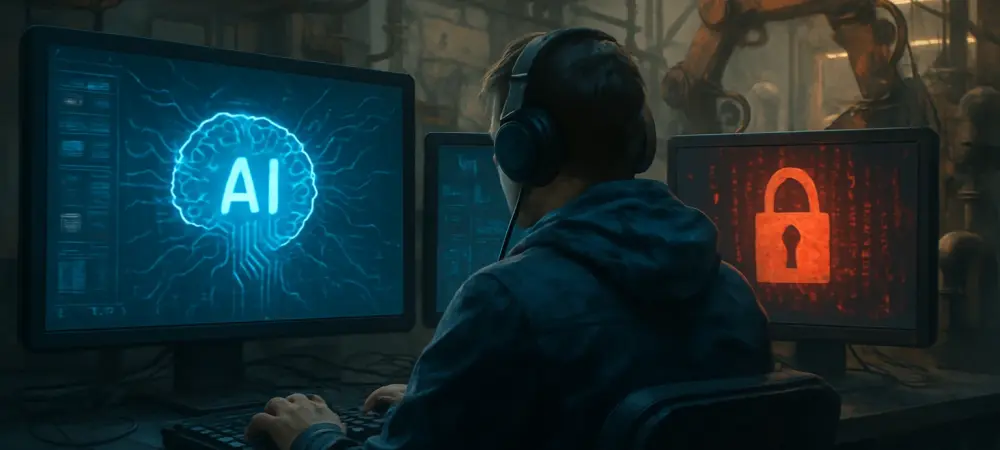
In the heart of a sprawling industrial facility, thousands of sensors monitor every valve, turbine, and pipeline, generating a relentless stream of data that can be overwhelming to analyze. Buried within this flood of alerts, a single malicious anomaly could spell disaster for critical infrastructure like power grids or oil refineries, making cybersecurity a top priority. As of 2025, operational technology (OT) environments face unprecedented cyber threats, with attackers increasingly targeting these systems that underpin modern life. Artificial intelligence (AI) has emerged as a pivotal tool to transform this chaos into clarity, promising to sift through noise and pinpoint genuine risks. This review delves into how AI is reshaping OT security, examining its capabilities, real-world impact, and the challenges that lie ahead in safeguarding industrial ecosystems.
Understanding OT Security and AI’s Integration
OT security focuses on protecting industrial control systems that manage physical processes in sectors like manufacturing and utilities. Unlike traditional IT environments, OT systems prioritize uptime and reliability, often at the expense of robust cybersecurity, leaving them vulnerable as connectivity with IT networks increases. This convergence exposes critical infrastructure to sophisticated attacks that can disrupt operations or cause physical harm.
AI steps in as a game-changer by addressing systemic issues like alert overload and limited expertise in OT-specific threats. By leveraging machine learning and data analytics, AI tools can contextualize vast amounts of information, helping security teams focus on high-priority risks rather than drowning in notifications. Positioned within the broader cybersecurity landscape, AI offers a bridge between operational needs and digital defense, aiming to bolster resilience in industrial settings.
This integration is not merely a technological upgrade but a strategic necessity. With regulatory mandates tightening and attack surfaces expanding, AI’s ability to adapt and learn from evolving threats provides a dynamic layer of protection that static defenses cannot match. The following sections explore how this technology is being applied in practical terms.
Core Features of AI in OT Security
Contextual Threat Analysis and Prioritization
One of AI’s standout capabilities in OT security is its capacity to filter through an avalanche of alerts by analyzing data within specific operational contexts. Unlike traditional systems that bombard teams with undifferentiated warnings, AI correlates internal processes with external threat intelligence to highlight only the most relevant risks. This drastically cuts down on alert fatigue, allowing analysts to zero in on threats that could impact business continuity.
Tools like Radiflow360 exemplify this feature by tailoring threat prioritization to the unique environment of a facility. By understanding normal operational patterns and cross-referencing them with global attack trends, such platforms ensure that security personnel address critical vulnerabilities first. This targeted approach has proven invaluable for mid-sized industrial firms struggling with limited resources.
The impact of contextual analysis extends beyond efficiency to strategic decision-making. Security teams can now allocate resources based on potential business impact rather than reacting to every signal, fundamentally shifting how industrial environments manage cyber risks in real time.
Anomaly Detection and Behavioral Profiling
Another cornerstone of AI in OT security lies in its ability to detect deviations from normal operations through anomaly detection and behavioral profiling. By establishing baselines of typical activity within a system, AI algorithms can flag unusual patterns—such as unexpected changes in sensor data or unauthorized access attempts—that might indicate a cyberattack. This early warning mechanism is critical for preempting threats before they escalate.
The technical foundation of these capabilities relies on machine learning models that continuously adapt to evolving operational conditions. For instance, in manufacturing plants, AI can distinguish between a harmless equipment glitch and a deliberate attempt to manipulate control systems. Case studies from mid-sized firms show that such systems have successfully identified subtle threats that would have otherwise gone unnoticed by human analysts.
Beyond detection, behavioral profiling adds depth by mapping long-term trends and user interactions within OT environments. This layered approach not only enhances threat visibility but also supports predictive maintenance, ensuring that potential issues are addressed before they compromise safety or productivity.
Current Trends Shaping AI-Driven OT Security
As of 2025, AI in OT security is witnessing a shift toward proactive rather than reactive strategies. Organizations are increasingly adopting automation to handle routine security tasks, freeing up human experts for complex decision-making. This trend is accompanied by a growing emphasis on network segmentation to limit the spread of attacks within industrial systems, aligning with best practices and standards like IEC 62443.
Investment patterns reveal a divide in adoption rates across the industry. While some companies are leveraging AI to stay ahead of emerging threats, others remain hesitant, often acting only after experiencing a breach. Looking ahead to 2027, the focus is expected to intensify on integrating AI with automated response mechanisms, enabling faster containment of incidents without manual intervention. Compliance with global regulations such as the EU’s NIS2 directive and CISA guidelines in the U.S. is also driving innovation. These mandates push for continuous monitoring and incident reporting, accelerating the deployment of AI tools that can manage the resulting data deluge. The convergence of regulatory pressure and technological advancement signals a maturing landscape for OT security.
Real-World Impact and Case Studies
Across industries like oil and gas, manufacturing, and utilities, AI has demonstrated tangible benefits in securing OT environments. In a notable instance this year, AI systems detected and mitigated an attack on SCADA systems within a major U.S. oil pipeline, preventing a potential shutdown. By analyzing patterns in real time, the technology isolated the threat before it could spread, showcasing its practical value.
Unique applications also include bridging the historical divide between IT and OT teams. In a European utility provider, AI platforms provided shared dashboards that aligned both departments on threat priorities, fostering collaboration and improving response times. Such use cases highlight how technology can address cultural as well as technical challenges in industrial cybersecurity.
Additionally, AI has supported compliance with stringent regulations by automating asset mapping and incident documentation. For a Midwestern manufacturing firm, this meant achieving adherence to CISA guidelines without overburdening staff, proving that AI can balance operational demands with legal obligations. These examples underline the versatility of AI in addressing diverse industrial needs.
Challenges Hindering AI Adoption in OT Security
Despite its promise, AI in OT security faces significant obstacles that temper enthusiasm. Technical limitations, such as incomplete asset inventories, undermine the effectiveness of even the most advanced algorithms. Without a comprehensive understanding of all connected devices, AI tools struggle to provide accurate threat assessments, often leading to gaps in coverage.
Another concern is the risk of inaccuracies or “hallucinations” in AI outputs, where incomplete data leads to false positives or missed threats. This necessitates constant human oversight, countering the notion of full automation. Furthermore, AI’s dual nature as both a defensive asset and a potential tool for attackers adds a layer of complexity, as adversaries can exploit similar technologies to craft sophisticated assaults.
Cultural and regulatory barriers also pose challenges. The longstanding disconnect between IT and OT teams often hinders cohesive implementation, while compliance pressures can overwhelm organizations with data they are ill-equipped to handle. Efforts to address these issues include cross-functional training and improved data collection practices, though progress remains uneven across the sector.
Future Trajectory of AI in OT Security
Looking toward the coming years, AI’s role in OT security is poised for significant evolution. Breakthroughs in automation could streamline incident response further, reducing downtime during attacks. Cross-functional collaboration between IT and OT teams may also deepen, with AI serving as a unifying platform for shared insights and coordinated defense strategies. The long-term impact on industrial resilience hinges on balancing efficiency with human judgment. As cyber threats grow in complexity, AI must adapt to provide not just detection but also predictive capabilities that anticipate risks before they materialize. This could redefine how industries approach cybersecurity, embedding it into operational planning rather than treating it as an afterthought.
Regulatory landscapes will likely continue to shape AI’s development, pushing for standards that ensure accountability in automated systems. The challenge will be to integrate these advancements without sacrificing the critical human element that validates and contextualizes AI-driven insights, ensuring that technology remains a tool rather than a master in securing critical infrastructure.
Reflecting on AI’s Role in Industrial Defense
Looking back on this exploration, AI has proven to be a transformative force in OT security, shifting the paradigm from overwhelming alerts to actionable intelligence. Its capacity to prioritize threats, detect anomalies, and support compliance stands out as a lifeline for industries grappling with modern cyber risks. Despite hurdles like incomplete data and cultural divides, the technology has demonstrated measurable impact in real-world scenarios. Moving forward, industries should focus on building comprehensive asset inventories to ground AI’s capabilities in accurate baselines. Investing in training that bridges IT and OT perspectives will also be crucial to maximize collaboration. Ultimately, the journey ahead involves trusting AI to enhance defenses while maintaining rigorous human oversight, ensuring that critical systems remain secure against an ever-evolving threat landscape.